
US Navy MQ-4C Triton Contract Exposes Indo-Pacific ISR Math
 Marcus Chen
US Navy MQ-4C Triton Contract Exposes Indo-Pacific ISR Math
The useful number in the latest MQ-4C Triton news is not the contract headline. It is 15,000 kilometers.
That is the range the Royal Australian Air Force lists for the MQ-4C, alongside a 50,000-foot ceiling and roughly 600 km/h speed. Army Recognition reported on May 17 that the U.S. Navy has awarded Northrop Grumman a new support contract covering logistics, engineering, testing, and field support for Triton operations across the Indo-Pacific. The contract is easy to file under sustainment. It should not be. In the Pacific, sustainment is the mission.
A high-altitude maritime surveillance drone that can stay airborne for more than 24 hours changes the geometry of naval operations only if it is available when the fleet needs it. A Triton sitting down for sensor calibration, software trouble, or depot-level support is not an intelligence asset. It is an expensive parking problem at the edge of a very large ocean.
The Pacific Is Too Large for Episodic Surveillance
The Western Pacific punishes every neat briefing slide. Guam to the South China Sea is roughly 3,000 kilometers. Northern Australia to the Philippine Sea is farther than many European air forces ever plan to operate from home. The first island chain is not a line on a map; it is a surveillance problem measured in hours, fuel, datalinks, and maintenance cycles.
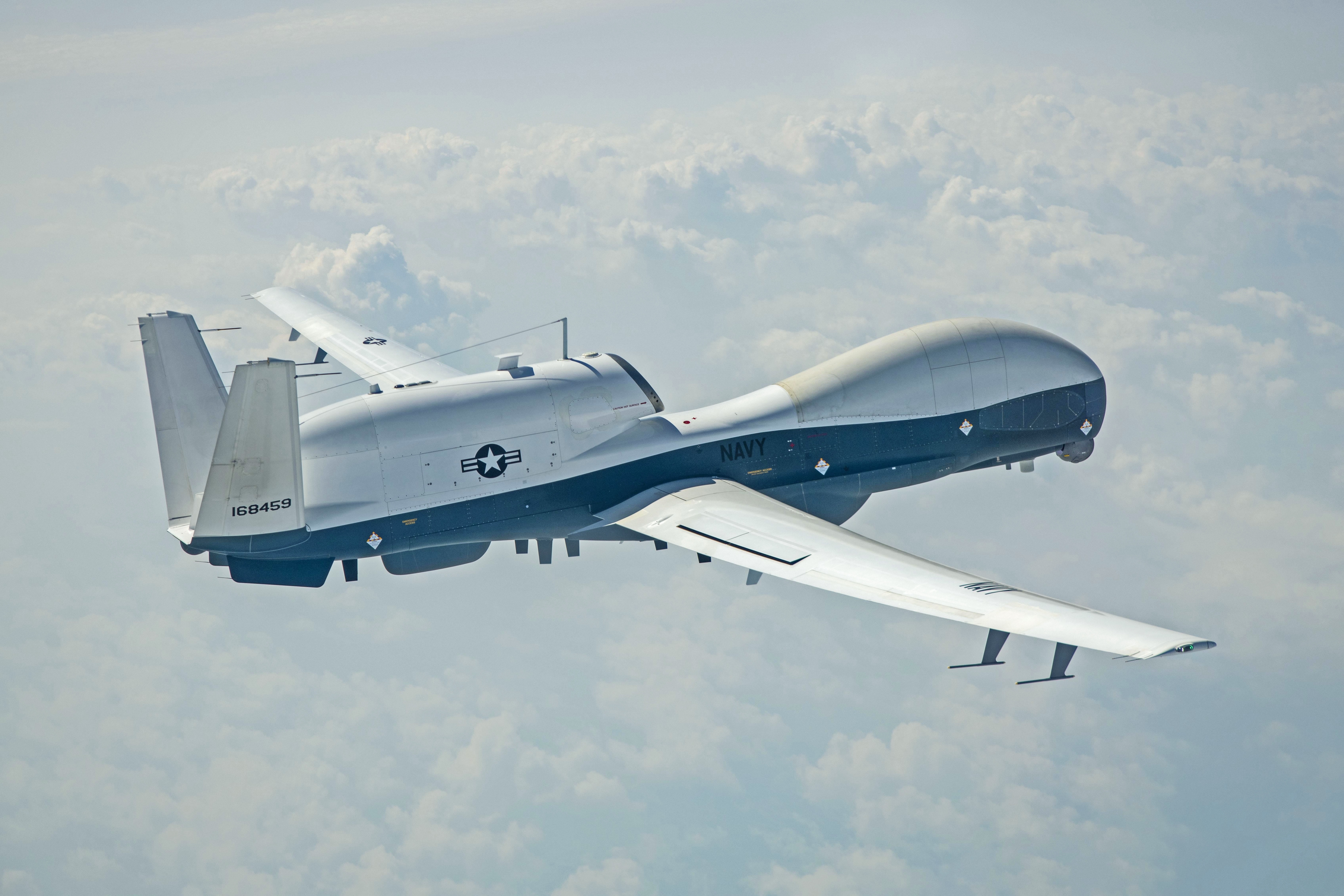
The MQ-4C exists because P-8A Poseidon crews cannot be everywhere. The basic division of labor is sound: Triton performs broad-area maritime intelligence, surveillance, and reconnaissance, while the P-8A investigates contacts, prosecutes submarines, and supports targeting. The unmanned aircraft carries radar, electro-optical and infrared sensors, automatic identification system receivers, and signals intelligence tools. Army Recognition highlighted its AN/ZPY-3 radar and its role in 360-degree ocean surveillance. Those are useful capabilities, but the operational value is persistence, not sensor brochure language.
If a Chinese surface action group, militia flotilla, or submarine support pattern appears for six hours and disappears into weather or traffic, the commander does not need an exquisite image tomorrow. He needs a track today, with enough confidence to decide whether to launch aircraft, move a destroyer, or hold fire. That is why the support contract matters. It is buying readiness for the sensing layer that makes distributed maritime operations something more than a slogan.
Guam and Northern Australia Are the Same ISR Network
The U.S. Navy has used forward locations such as Andersen Air Force Base on Guam for Triton detachments. Australia’s fleet will be based at RAAF Base Tindal in the Northern Territory and operated by No. 9 Squadron from RAAF Base Edinburgh, according to the Royal Australian Air Force. Put those points on a chart and the logic becomes clear: Guam watches the approaches into the Philippine Sea and South China Sea; northern Australia gives allied commanders depth, redundancy, and a southern operating axis.
This is not just an American system with Australian flags added later. Australia’s Triton buy makes sense because Canberra has a surveillance burden out of proportion to the size of the Royal Australian Navy. The northern approaches, the eastern Indian Ocean, the Timor and Arafura Seas, and routes toward the South Pacific all compete for attention. A manned patrol aircraft fleet can surge. It cannot provide continuous broad-area coverage without burning crews and airframes at a rate that eventually shows up in the maintenance hangar.
Triton helps close that gap, but only partially. One aircraft airborne for 24 hours does not mean 24-hour coverage if transit, turnaround, weather, sensor maintenance, and communications availability are ignored. Anyone who has served around aircraft knows the posted endurance number is not the operational coverage number. A drone with a 15,000-kilometer range still needs parts, technicians, mission-system support, data links, and a command architecture that can absorb what it sees.
The Weak Point Is Not the Airframe
The MQ-4C is derived from the RQ-4 Global Hawk, but the maritime version was reinforced for naval work, including de-icing and lightning protection to allow descent through cloud layers for closer looks at ships. That matters in the Pacific, where weather can turn surveillance plans into fiction. The aircraft is built to work high and long, not low and survivable. In a high-end fight, it will be a valuable sensor and a vulnerable node.
That vulnerability is not a reason to dismiss it. It is a reason to be honest about what Triton can and cannot do. It can widen the ocean picture before a crisis. It can help classify patterns of Chinese naval and coast guard movement. It can cue P-8A sorties, surface ships, submarines, and long-range fires. It can reduce the number of manned aircraft hours wasted searching empty water. It cannot loiter safely inside a mature Chinese air-defense envelope once the shooting starts, and it cannot replace undersea sensors, satellites, or crewed patrol aircraft.
The real question is whether the United States and Australia can keep the network resilient enough when China tries to break the kill chain. Long-range ISR is useful only if the data moves. A Triton track that cannot get through contested communications is just a local observation. A track that reaches a joint command center too late is history, not targeting.
Why a Support Contract Becomes a Deterrence Signal
Contracts like this look administrative because they fund engineers, test support, logistics, and field services. In practice, they decide whether aircraft are flyable during the week when policymakers suddenly discover that deterrence depends on mechanics. The Pacific does not reward symbolic capacity. It rewards sortie generation.
That is the part Washington often underplays. The U.S. military has spent years talking about distributed operations, resilient basing, and allied integration. Those concepts all depend on a sensing layer that can survive distance first, then enemy action second. The MQ-4C is one answer, but not a magic one. It requires a boring industrial tail: spares, software support, sensor calibration, trained operators, and enough forward maintenance depth to avoid sending every hard problem back across the ocean.
For Australia, the same lesson applies. Buying Triton is not the difficult part. Building the people, basing, communications links, and intelligence processing capacity to exploit it is harder. RAAF Base Tindal gives the aircraft a logical home. No. 9 Squadron gives it an institutional owner. But the capability only matures when Australian and U.S. operators can share tracks fast enough for a maritime commander to act on them.
The Bottom Line
The Indo-Pacific ISR problem is brutally simple: the ocean is larger than the fleet’s attention span. China can create dilemmas in multiple seas at once. The United States and Australia cannot answer that with occasional patrols and optimistic PowerPoint coverage arcs.
The new Northrop Grumman support work for MQ-4C Triton is therefore more important than it sounds. It is not a glamorous weapons buy. It will not sink a ship by itself. But without persistent maritime surveillance, the missiles, submarines, and destroyers everyone likes to count are fighting partly blind.
That is the math. In the Pacific, the side that sees first does not automatically win. The side that cannot see continuously starts losing before the first shot.
The U.S. Navy awarded a support contract to Northrop Grumman for MQ-4C Triton operations, enhancing ISR capabilities across the Indo-Pacific. The Triton, with a range of 15,000 kilometers and the ability to remain airborne for over 24 hours, is crucial for continuous maritime surveillance. This contract ensures readiness and operational support, addressing the surveillance needs of both the U.S. and Australian forces in the region.
- The MQ-4C Triton has a range of 15,000 kilometers and can stay airborne for over 24 hours.
- The U.S. Navy awarded Northrop Grumman a support contract for Triton operations.
- The contract covers logistics, engineering, testing, and field support.
- The Triton is essential for continuous maritime surveillance in the Indo-Pacific.
- Australia's Triton buy addresses its surveillance burden in the region.