
U.S. Navy teaches drones to land on ships without GPS
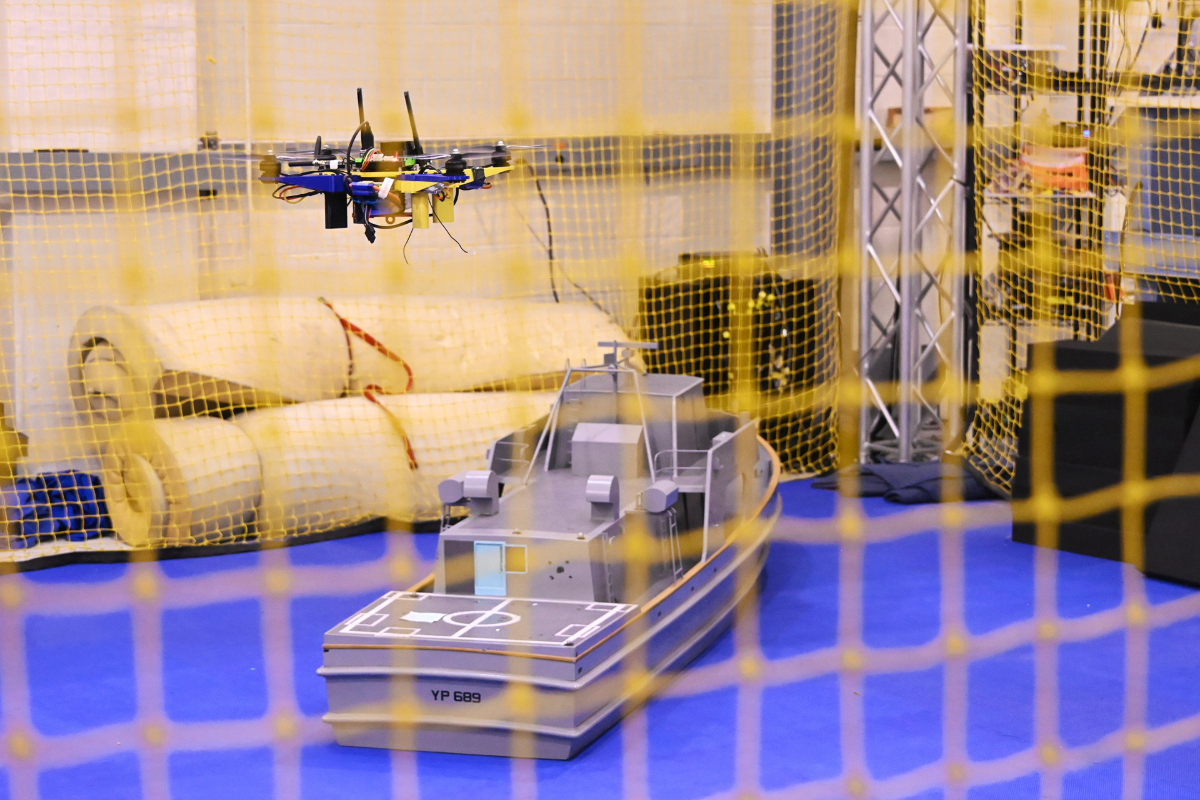
The U.S. Navy has flown a drone through mission tasks and landed it on a pitching ship at sea with GPS jammed or unavailable and no pilot at the controls, using only the aircraft’s own cameras, motion sensors and onboard software, the Naval Air Warfare Center Aircraft Division said.
NAWCAD, the U.S. Navy’s main aviation test and engineering center at Patuxent River, Maryland, said the live-flight demonstration showed a tactical drone can carry out its tasks and recover aboard a moving vessel without satellite navigation. The software is now ready for operational testing on fleet platforms.
“In contested areas where satellites and communications are jammed, autonomy gives significant advantage to our sailors,” said Rear Adm. Todd Evans, commander of NAWCAD.
Landing a drone on a ship has usually depended on extra hardware. Shipboard recoveries rely on radar systems that cost millions of dollars, along with flight deck recovery gear and ship modifications that can take months to install. When the U.S. Navy’s RQ-8A Fire Scout made the service’s first autonomous drone landings on a moving ship aboard USS Nashville in 2006, it used a radar sensor on the ship to track the aircraft’s position relative to the deck.
NAWCAD’s approach moves that job into software. Engineers at the center’s Maritime Autonomous Guidance-Navigation-Control Intelligent Coupled Systems Lab paired the drone’s existing mission cameras with guidance, navigation and control algorithms. In flight, the aircraft recognizes the ship’s shape and visual cues and steers toward it much as a human pilot would, while the software predicts how the deck is rising and falling so the drone can time a smooth touchdown.
“In a high-end maritime conflict, GPS is the first operational link an adversary attempts to sever,” said Peter Arslanian, a NAWCAD aerospace engineer.
The system runs on commercial-standard cameras, motion sensors and electronics, and NAWCAD says the software works with nearly any drone flight computer. That means it can be added through a software upgrade instead of costly changes to ships with little spare room, and it can scale from small tactical quadcopters up to large combat drones.
NAWCAD plans to apply the technology next to larger uncrewed aircraft, including tactical resupply drones. The center is working to move the capability into the U.S. Navy’s Small Tactical Unmanned Aircraft Systems program office, the Collaborative Combat Aircraft program for drone wingmen, and DARPA’s EVADE effort.
EVADE, short for Early VTOL Aircraft Demonstration, is a DARPA project to field drones that can take off from and land on ship decks without launch or recovery equipment, with five companies including AeroVironment and Sikorsky building designs for it.
The Naval Innovative Science and Engineering Program and the Office of Naval Research funded the NAWCAD work, which now moves to operational testing on fleet aircraft.
Content preview only. Full article available at source. View Full Article
The U.S. Navy successfully demonstrated a drone landing on a moving ship at Patuxent River, Maryland, without GPS, using only onboard cameras and sensors. This advancement allows for autonomous operations in contested environments, enhancing naval capabilities. The software is now ready for operational testing on fleet platforms, marking a significant step in drone technology for military applications.
- The U.S. Navy demonstrated a drone landing on a ship without GPS.
- The technology uses onboard cameras and sensors for navigation.
- The software is ready for operational testing on fleet platforms.
- This capability is crucial in contested areas where GPS is unavailable.
- The system can be integrated with various drone flight computers.