
US Navy's 2027 Shipbuilding Plan Adds 112 Ships but Loses the Indo-Pacific Math
 Marcus Chen
US Navy's 2027 Shipbuilding Plan Adds 112 Ships but Loses the Indo-Pacific Math
The Congressional Budget Office has put a number on the U.S. Navy's 2027 fleet ambition: roughly $234 billion more than the service's own estimate over 30 years. The plan would take the fleet from 286 ships today to 398 by 2056. That sounds like a response to China's growing navy. It is also a warning that the response may be priced beyond the industrial base and budget that must deliver it.
The problem is not that Washington wants more hulls. The problem is that the plan counts ships before it counts the money, maintenance capacity, crews, and missiles required to make those ships useful in the Western Pacific.
The 398-Ship Promise
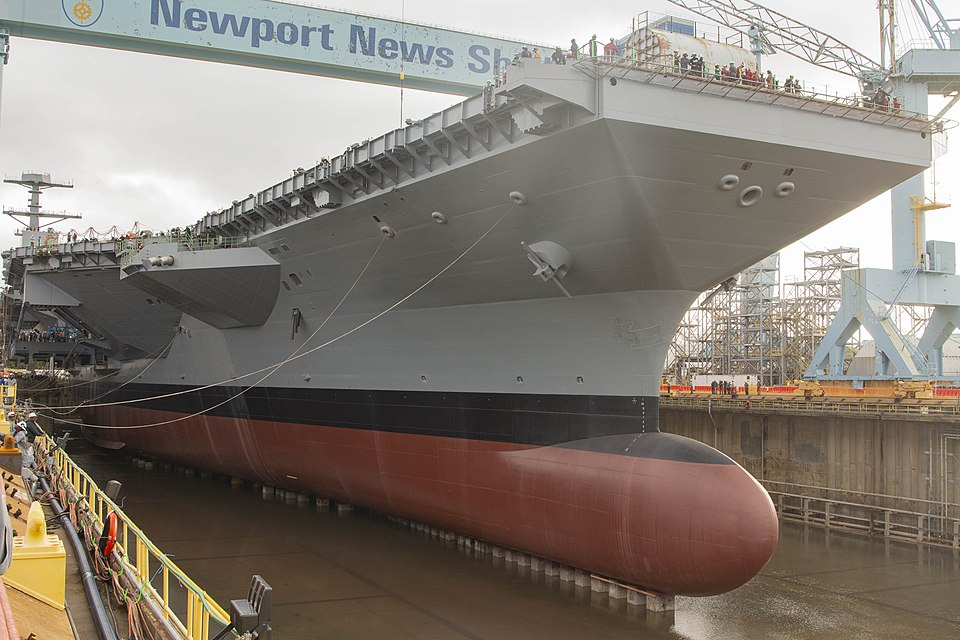
As USNI News reported on November 20, the CBO estimates that implementing the Navy's 2027 plan would raise the sea service's annual budget from about $310 billion today to $415 billion. That is a 41 percent increase. The Navy's own estimate for the 30-year shipbuilding bill is approximately $1.2 trillion; the CBO puts it near $1.5 trillion.
Those figures are not accounting trivia. A 41 percent increase has to survive changing administrations, competing Army and Air Force requirements, debt pressure, and the next war's emergency spending. A plan that works only if every future budget arrives on time is not a plan for sea control. It is a wish list with a procurement schedule attached.
The Navy's current 30-year plan calls for 371 ships, with the fleet eventually reaching 398 when existing ships and planned additions are counted. It also assumes a much larger unmanned force. The CBO notes that the plan does not fully price those unmanned vessels, including medium unmanned surface vessels (MUSVs). With a planned service life of only six years, the Navy would need to buy roughly 347 MUSVs over 30 years to sustain a force initially described as 72 hulls.
China Benefits from the Delay
Beijing does not need to defeat a 398-ship American fleet in 2056. It needs to exploit the period before that fleet exists. The Indo-Pacific problem is measured in the next five to ten years, when a Taiwan contingency would be fought across thousands of miles of ocean and under the threat of China's land-based missiles, submarines, aircraft, and maritime surveillance network.
A fleet inventory is not the same as deployable combat power. A destroyer in a maintenance yard contributes no air-defense umbrella to a carrier strike group. A submarine delayed at a shipyard contributes no undersea uncertainty around the first island chain. A new unmanned vessel without a reliable control network, spare parts pipeline, or trained operators is an expensive sensor with a short operational life.
The CBO's most uncomfortable observation is that maintenance delays could prevent the Navy from deploying as many ships as its inventory goals imply. The report also projects a temporary decline in combat power between 2030 and 2035 as older ships retire before new capacity arrives. That is the strategic gap Beijing can plan around. The United States may own more ships on paper while having fewer available ships at the moment of decision.
Firepower Is the Constraint
Ships are only the launch platforms. The Pacific fight would consume the weapons they carry at a rate that peacetime procurement models were never built to sustain. A recent CSIS assessment found that U.S. munitions production and inventories remain under pressure after intensive operations. It described Patriot production rising from roughly 300 missiles per year before the Ukraine war to about 600 today, with a goal of 2,000 by 2030. That is progress, but it also illustrates the time scale: factories cannot surge at the speed of a crisis.
This matters for the Navy's large-surface-combatant plans. A ship with vertical-launch cells is not automatically a persistent deterrent if the magazines ashore cannot reload it. In a Taiwan scenario, the United States would need long-range anti-ship missiles, air-defense interceptors, undersea weapons, and the logistics to move them through contested bases. The platform count and the magazine count must be funded together.
Anyone who has served on a destroyer knows the difference between being assigned to a force and being ready for deployment. The ship needs trained sailors, working propulsion, current software, spare parts, and weapons loaded. Multiply that problem across a fleet expanding from 286 to 398 ships and the arithmetic gets harsher, not easier.
The Industrial Base Cannot Be Assumed
The CBO estimates that the Navy's planned shipbuilding tonnage would rise 70 percent from 2031 to 2056. That is not simply a request for more shifts at existing yards. It means more welders, nuclear-qualified workers, suppliers, drydock capacity, design stability, and leadership attention. Every troubled program competes for the same finite industrial base.
There is a reasonable case for buying more distributed platforms, including unmanned ships. Smaller vessels can complicate China's targeting problem and provide additional sensors, decoys, and missile capacity. But the Navy should not use unmanned hulls to hide the cost of manned fleet readiness. A six-year service life means recurring procurement, recurring maintenance, and recurring software integration. Cheap at launch can become expensive over a campaign.
What Washington Should Count
The useful metric is not the 2056 fleet number. It is the number of combat-ready ships that can enter the Western Pacific, remain on station, fire their weapons, and be replenished after the first month of fighting. That calculation should include maintenance availability, munitions inventories, tanker support, repair capacity, and the bases that China would attack first.
The United States should still expand naval capacity. But it should sequence the expansion around readiness and industrial throughput rather than announce a politically attractive endpoint. If the Navy cannot explain how the extra 112 ships will be crewed, maintained, armed, and sustained, then the number is not a deterrent. It is a liability on a spreadsheet.
The Indo-Pacific does not wait for 2056. China's advantage is not that it has already solved every naval problem; it is that it can exploit American transition periods. The CBO's $234 billion warning is therefore more than a budget dispute. It is a test of whether Washington can turn fleet ambition into usable combat power before the next crisis arrives. Right now, the math does not work.
Sources
- USNI News, “Navy’s Shipbuilding Plan Would Exceed Budget Estimates by Hundreds of Billions, CBO Finds,” November 20, 2026.
- Congressional Budget Office analysis of the U.S. Navy FY2027 30-year shipbuilding plan.
- CSIS, “Munition Inventories: An Update Amid Renewed War Risk,” November 2026.
The U.S. Navy plans to expand its fleet to 398 ships by 2056, but faces significant budgetary and logistical challenges. The Congressional Budget Office warns that the estimated costs could exceed $1.5 trillion, necessitating a 41% increase in the annual budget. Maintenance delays and readiness issues may hinder the Navy's ability to deploy combat power effectively in the Western Pacific, allowing China to exploit these gaps.
- U.S. Navy plans to increase fleet from 286 to 398 ships by 2056.
- CBO estimates shipbuilding costs will exceed $1.5 trillion.
- A 41% budget increase is required to implement the Navy's plan.
- Maintenance delays could reduce deployable combat power.
- China may exploit delays in U.S. naval readiness.