
U.S. Navy’s San Diego heads out from Naval Base Guam
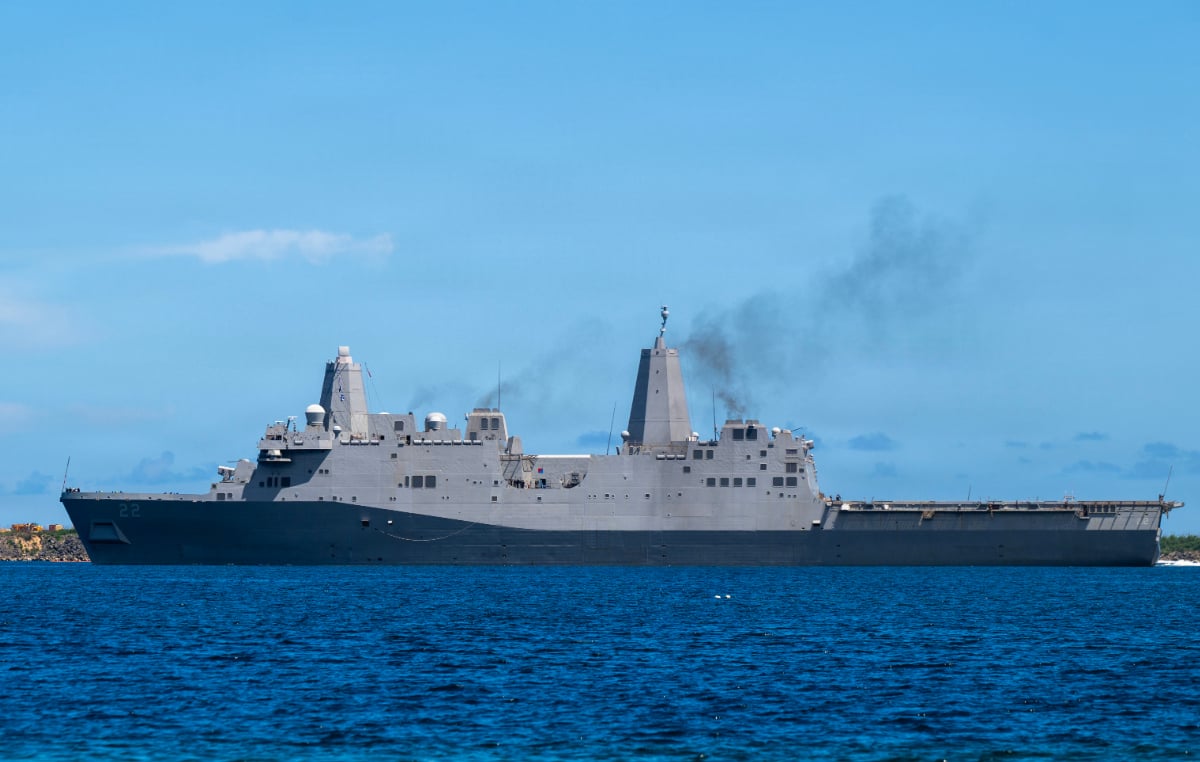
A U.S. Navy warship built to carry Marines ashore just wrapped up a stop at one of America’s most important Pacific outposts. USS San Diego (LPD 22), an amphibious transport dock, departed Naval Base Guam on September 12, 2026, after transiting Apra Harbor during what the Navy described as routine operations in the U.S. 7th Fleet area of responsibility.
Navy amphibious ship movements like this one are drawing closer reader attention these days, as the United States remains engaged in an open-ended war with Iran that has strained the fleet’s resources in the Middle East.
There’s nothing dramatic about a port call, but the ship itself does an unusual job. San Diego belongs to the San Antonio class, a type of vessel the Navy built specifically to move Marines and their gear from sea to shore. Below the flight deck sits a well deck, a flooded compartment that can launch air-cushioned landing craft or a conventional landing craft straight out the stern. Above deck, the ship can land helicopters or tiltrotor MV-22 Ospreys. Put those pieces together and you get a floating staging base that can put a battalion of roughly 700 Marines onto a beach without needing a port.
San Diego is the fourth Navy ship to carry the city’s name, following an armored cruiser from 1914, a World War II-era light cruiser, and a combat stores ship commissioned in 1969. This version was built at Northrop Grumman’s Ingalls shipyard in Pascagoula, Mississippi, and commissioned in 2012. Rather than being based stateside, it’s forward-deployed to Sasebo, Japan, meaning it’s stationed in the region full time instead of sailing over from the United States for each deployment. That arrangement lets the Navy keep amphibious ships closer to potential trouble spots in the Indo-Pacific and cuts down the weeks it would otherwise take to steam from California or Virginia.
The ship falls under Expeditionary Strike Group 7, also known as Task Force 76, which serves as the Navy’s amphibious arm within 7th Fleet. The command is headquartered at White Beach Naval Facility on Okinawa, though most of its ships, San Diego included, are actually based at Sasebo and travel south to pick up embarked Marines before heading out on patrol. Task Force 76 oversees a mix of amphibious ships, helicopter squadrons and beach landing units, and it’s the Navy’s go-to organization whenever the 7th Fleet needs to move Marines by sea, whether for an exercise, a disaster-relief mission, or something more serious.
That’s where 7th Fleet comes in. Headquartered in Yokosuka, Japan, it’s the largest of the Navy’s forward-deployed numbered fleets, covering an enormous stretch of ocean from the international date line west to the India-Pakistan border. Ships assigned to it spend most of their careers training and operating alongside allied navies in Japan, South Korea, the Philippines and elsewhere in the region, rather than rotating home between deployments the way many U.S.-based ships do.
Guam fits into that picture as a forward staging point. The island, a U.S. territory roughly 1,500 miles east of the Philippines, hosts both Naval Base Guam and Andersen Air Force Base, and it functions as a logistics and refueling hub for American ships and aircraft moving through the western Pacific. Apra Harbor, where San Diego pulled in, is a regular stop for Navy vessels passing between deployments in the region, so a single-day port visit like this one doesn’t typically signal anything beyond routine scheduling.
The Navy did not say what brought San Diego to Guam this time or where the ship is headed next. It’s also unclear whether the stop was tied to a broader deployment involving other ships from Expeditionary Strike Group 7 or Task Force 76, or whether San Diego was traveling largely on its own. Ship movements like this are common enough that the Navy doesn’t always spell out the full itinerary, and unless there’s a specific mission to announce, port visits and transits generally get logged rather than explained in detail.
For now, what’s confirmed is straightforward: an American amphibious ship built to land Marines on a beach spent time at a key Pacific base and then got back underway. Whatever comes next for San Diego hasn’t been made public.
Content preview only. Full article available at source. View Full Article
USS San Diego (LPD 22) departed Naval Base Guam on September 12, 2026, after completing routine operations in the U.S. 7th Fleet area. The amphibious transport dock is designed to transport approximately 700 Marines and is forward-deployed to Sasebo, Japan, enhancing U.S. military readiness in the Indo-Pacific region. The ship's movements are part of standard Navy operations, with Guam serving as a key logistics hub.
- USS San Diego departed Naval Base Guam on September 12, 2026.
- The ship is designed to transport Marines and their equipment.
- San Diego is forward-deployed to Sasebo, Japan.
- The ship is part of Expeditionary Strike Group 7 under the U.S. 7th Fleet.
- Guam serves as a logistics and refueling hub for U.S. military operations.