
US Revives Submarine Squadron 3 in Australia But AUKUS Still Lacks Boats
 Marcus Chen
US Revives Submarine Squadron 3 in Australia But AUKUS Still Lacks Boats
Four U.S.-commanded nuclear attack submarines are supposed to rotate through Western Australia from 2027. On June 10, the U.S. Navy put a command structure under that promise by reestablishing Submarine Squadron 3, or CSS-3, at HMAS Stirling. That is real progress for AUKUS. It is also a reminder that a squadron staff cannot manufacture hulls.
What Changed at HMAS Stirling
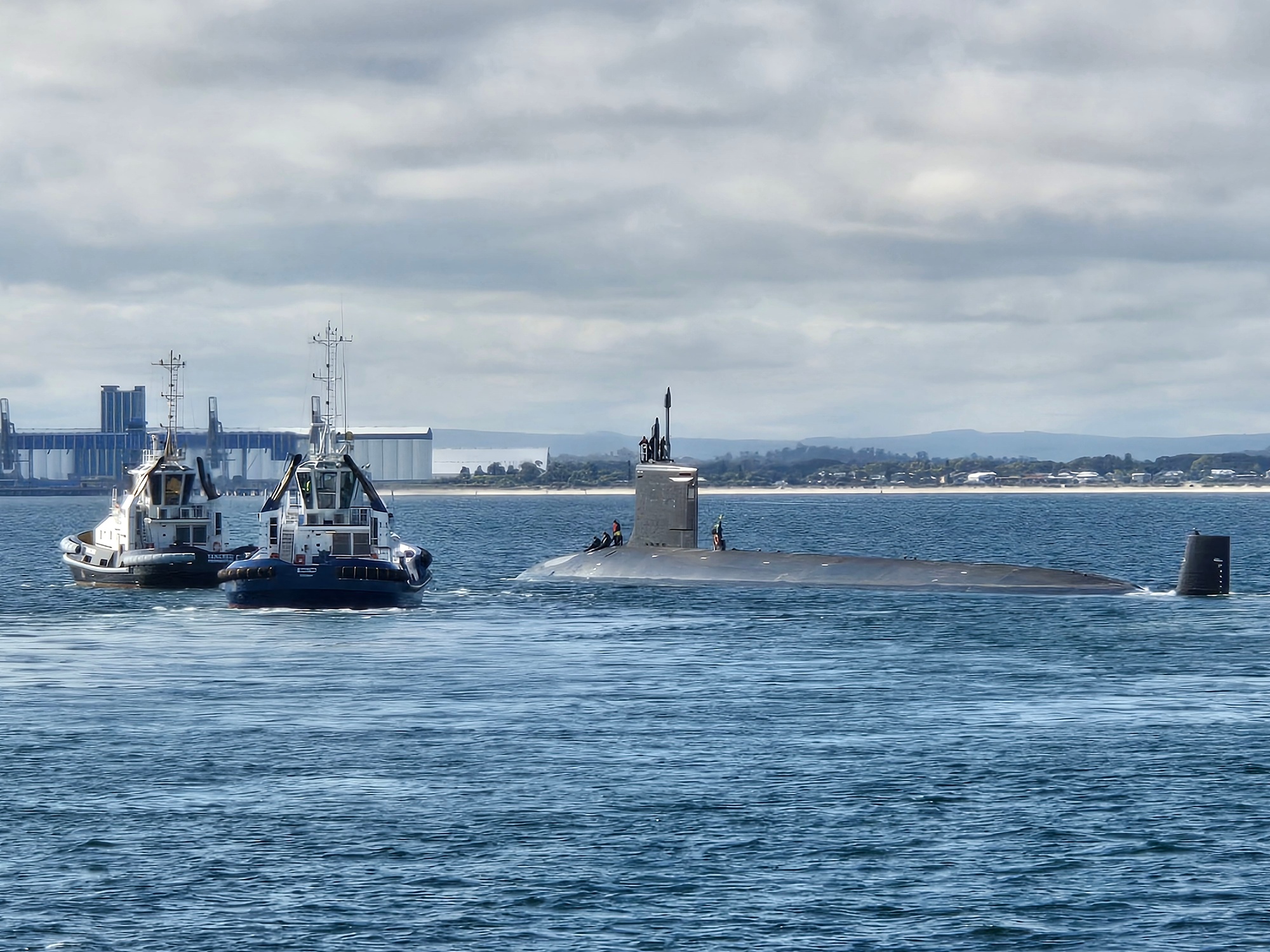
Commander, Submarine Force, U.S. Pacific Fleet said Rear Adm. Chris Cavanaugh reestablished CSS-3 to support Submarine Rotational Force-West. The squadron previously operated from Pearl Harbor and was decommissioned in February 2012. Its new home is HMAS Stirling, the Royal Australian Navy base on Garden Island near Perth.
The bureaucratic language matters here. CSS-3 personnel are not just visiting for a port call. They are meant to integrate with Australian counterparts and lay the groundwork for maintenance, logistics, and operational support for U.S. and U.K. nuclear-powered fast-attack submarines rotating through Western Australia. The U.S. Navy also stood up Naval Support Activity Stirling as of May 30 to support service members, civilians, contractors, and families tied to the rotation.
That makes AUKUS less abstract. For three years, the submarine pillar has been discussed mostly as a future acquisition timeline: Australia buys three Virginia-class boats from the United States beginning in the early 2030s, then eventually builds SSN-AUKUS with the United Kingdom. CSS-3 shifts part of the program into the present tense. The alliance is now building the shore organization that keeps submarines moving.
The Operational Math Favors Perth
Anyone who has served on a destroyer in the Western Pacific understands the tyranny of distance. The same applies underwater. A submarine operating from Pearl Harbor or Guam has to spend transit days getting to patrol areas around the eastern Indian Ocean, Indonesian archipelago, South China Sea approaches, or Philippine Sea. A boat supported from HMAS Stirling starts much closer to the Indian Ocean side of the problem.
That does not make Perth a magic answer. But it changes the patrol equation. If a Virginia-class submarine can receive intermediate maintenance at HMAS Stirling instead of returning to Hawaii, the Navy saves weeks of transit time across a deployment cycle. Those saved days become either more time on station or more time in controlled maintenance. In submarine operations, both are scarce.
The U.S. Navy's own release makes this point indirectly. Pearl Harbor Naval Shipyard and Intermediate Maintenance Facility is expected to stand up a maintenance and logistics detachment in Western Australia in mid-2026. About 20 Australian civilian maintainers and 25 Royal Australian Navy divers and Fleet Support Unit personnel have already completed training at Pearl Harbor, with more than 230 others under instruction in Hawaii. That is the part of AUKUS that is least glamorous and most important.
A submarine presence is not sustained by flags, communiques, or ministerial photos. It is sustained by radiological controls, pier services, classified parts, trained welders, quality assurance paperwork, divers, cranes, security forces, housing, medical support, and commanders who can make daily readiness decisions. CSS-3 gives that machinery a commander.
Four Rotating Submarines Is Not a Fleet
Canberra's defense minister said Friday that the U.S. submarine group will arrive this year, ahead of the planned 2027 rotational start. Under AUKUS, four U.S.-commanded submarines are expected to operate from the west coast Australian port on a rotational basis. That number sounds larger than it is.
A four-boat rotation does not mean four submarines continuously forward and ready. At any given time, some boats will be in maintenance, training, transit, or crew turnover. Attack submarines have high operational value because they are hard to find, not because they are always available. A realistic commander plans around partial availability.
This is where the AUKUS sales pitch still runs into steel. Australia has shifted toward buying three secondhand Virginia-class submarines rather than the earlier mix that included a new-build boat. The first transfer is still expected in the early 2030s. Those used hulls may be the only practical option, but they do not erase the production problem in U.S. yards.
The United States needs Virginia-class output for its own force, for deterrence around Taiwan, for undersea intelligence missions, and now for Australia. The target often cited in Washington is more than two attack submarines per year when Columbia-class ballistic missile submarine work is also consuming yard capacity. Recent delivery performance has been below that. A squadron in Perth improves employment of available boats. It does not increase the number of boats.
China Will Read This as Infrastructure, Not Symbolism
Beijing is unlikely to be impressed by another AUKUS statement. It will pay closer attention to the physical pattern: U.S. and U.K. SSNs rotating through HMAS Stirling, Australian maintainers trained in Hawaii, a U.S. naval support activity in Perth, and now a submarine squadron headquarters tied to SRF-West.
That pattern creates a harder undersea problem for the People's Liberation Army Navy. Western Australia gives allied submarines an Indian Ocean support base outside the immediate missile threat envelope that complicates Guam and Japan planning. It also connects the Taiwan scenario to the Indian Ocean. Chinese naval planners have to account for allied SSNs that can threaten surface action groups, track submarines, collect intelligence, and sit astride sea lines from a direction that is not simply east of the first island chain.
The counterpoint is that the PLAN does not need to match AUKUS announcement for announcement. It can keep building ships, expanding anti-submarine sensors, pressuring U.S. forward bases, and forcing Washington to divide a finite submarine fleet across too many missions. AUKUS helps the United States and Australia use geography better. It does not solve force structure.
The Real Test Is Maintenance Throughput
For Marcus Chen's notebook, the metric to watch is not how many ceremonies occur at HMAS Stirling. It is how many maintenance periods are completed there without sending submarines back across the Pacific, how many Australian workers qualify on nuclear submarine work, and how quickly defects are cleared.
If Perth can turn visiting SSNs around reliably, AUKUS becomes an operational undersea network before Australia owns a single nuclear-powered submarine. If it cannot, CSS-3 becomes another headquarters managing a bottleneck.
That is why the June 10 reestablishment matters. It is not decisive because it sounds bold. It matters because it puts commanders, maintainers, and logistics officers closer to the boats. The problem is that AUKUS still has more architecture than inventory. Washington and Canberra have built a better place to use submarines. Now they have to find enough submarines to use it.
Sources
The U.S. Navy reestablished Submarine Squadron 3 at HMAS Stirling on June 10, 2026, to support the rotational deployment of four U.S.-commanded nuclear attack submarines in Western Australia starting in 2027. This move aims to enhance operational readiness and logistics for U.S. and U.K. submarines in the region. Additionally, Australia plans to acquire three secondhand Virginia-class submarines beginning in the early 2030s, with ongoing training for Australian maintainers in Hawaii.
- Submarine Squadron 3 reestablished at HMAS Stirling on June 10, 2026.
- Four U.S.-commanded submarines to rotate through Western Australia from 2027.
- Naval Support Activity Stirling established to support U.S. and U.K. submarines.
- Australia is expected to acquire three secondhand Virginia-class submarines starting in the early 2030s.
- Training for Australian maintainers is ongoing in Hawaii.