
US withdrawal won’t end the region’s ISIS dilemma
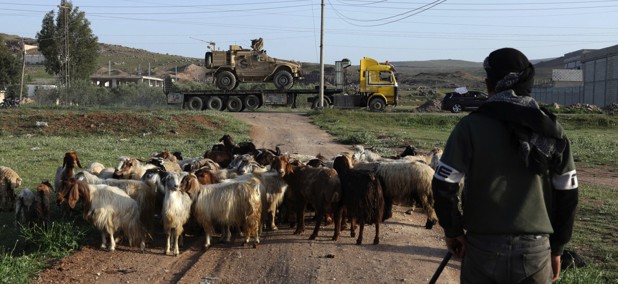
The U.S. military recently completed its withdrawals from Iraq and Syria, ending a decade of leadership in the counterterrorism fight against the Islamic State in the Levant. The gradual drawdown was meant to avoid a sudden vacuum that proxy militias, malign regional actors, terrorist organizations, and great-power rivals could fill, as happened in Iraq and Afghanistan. Yet ISIS, while greatly reduced, persists in Iraq and Syria, which must now build a sustained regional counterterrorism effort to prevent the group’s resurgence.
The absence of an American footprint in the two countries reduces cost and risks to personnel, but it also diminishes visibility into ISIS networks, undermines security relationships, and eliminates a forward position from which Washington could detect and disrupt terrorist threats before they affect U.S. interests and foreign partners.
While ISIS has mounted fewer attacks in Iraq and Syria since 2025, this is evidence not of diminished capacity but of strategic recalibration. In Syria, ISIS has been busy diversifying its targets and methods. In June alone, ISIS attacked oil tankers, commercial trucks, security checkpoints, military regional headquarters, political figures, judges, and buses ferrying personnel from the Ministry of Defense. In July, a bomb killed 10 people at a Damascus café frequented by officials working in the Justice Palace. Two more bombs exploded during President Macron of France’s first state visit, killing 10 and 18 people near the Four Seasons Hotel and Ministry of Tourism respectively.
Counterterrorism infrastructure, never perfect to begin with, can erode quickly after American forces leave. This has been seen in the dissolution of the Counter-ISIS mission and the emptying of ISIS detention camps like Al Hol and Al Roj. It has also been seen in the region’s prisons. As ISIS has lost operational capacity and territory, the group has turned to prison breaks as a strategic imperative, undertaking campaigns like the “Breaking the Walls” Campaign of 2012-13 in Iraq to replenish its ranks.
The threat is acute in Iraq, which took in 5,700 ISIS-affiliated prisoners—not only Iraqis and Syrians, but residents of 61 other countries—after the SDF’s January collapse in northeast Syria. It put them in prisons that were already overcrowded and under-resourced, and accepted responsibility for their detention, interrogation, and trial. The U.S. presence had helped encourage the humane treatment of prisoners and fair trials for those charged with terror crimes, reducing ISIS’ ability to use the prisons for recruiting, networking and organizing. Now, the troops have departed amid real concerns about backsliding.
In Syria, concerns remain about whether Syrian forces can integrate effectively and quickly to sustain ISIS’ defeat, in the face of recent incidents like ISIS infiltration into the Syrian Army and recent high-profile plots and attacks beyond ISIS’ traditional area of operations. Syrian prisons have also been targeted for breakouts, including ISIS’ 2022 attack on Al Sinaa prison and a January attempt at the Shaddadi detention facility.
Throughout the fight against terrorist organizations in Iraq and Syria, American personnel provided intelligence, surveillance, reconnaissance, airpower, special operations capacity, logistics, and local partnerships to local forces. This allowed the U.S. and its partners to monitor and disrupt groups like the Islamic State and defeat its territorial caliphate, while also giving Washington on-the-ground insight into terrorist organizations’ rapidly evolving tactics, as well as local political and security dynamics.
Absent these resources, it is likely the number and severity of ISIS plots and attacks will increase. Washington, its partners, and the Iraqi and Syrian governments must find creative ways to fill the security gaps. Syrian and Iraqi neighbors—Jordan, Türkiye, Lebanon, and other regional players—must begin forging close relationships with Damascus and Baghdad. Without these relationships, the region risks losing years of counterterrorism progress—and the U.S. may be forced to intercede once again.
This commentary is published in coordination with the 2026 Global Security Forum, of which Defense One is a media partner.
Caroline D. Rose is a Senior Director at the New York City-based Soufan Center, a nonpartisan research institution, where she conducts research on the crime-terror nexus, security, counterterrorism, and U.S. defense policy with a focus on Iraq and Syria. She is a Senior Nonresident Fellow at both the New Lines Institute and Orion Policy Institute, both where she writes about trends in terrorism and geopolitics.
Dr. Julie Chernov Hwang is an Associate Professor of Political Science and International Relations at Goucher College. She is a Senior Research Fellow at the Soufan Center & a Harry Frank Guggenheim Distinguished Scholar with over a decade researching terrorist behavior, notably social networks, radicalization, commitment, role assignment, disengagement, rehabilitation, reintegration, repatriation, and deradicalization.
ISIS continues to conduct attacks in Iraq and Syria following the U.S. military's withdrawal, which has reduced visibility into its networks. In June and July 2025, ISIS targeted various locations, including oil tankers and security checkpoints, while taking advantage of overcrowded prisons to replenish its ranks. The situation raises concerns about the effectiveness of local forces in maintaining counterterrorism efforts and the potential resurgence of ISIS.
- U.S. military completed its withdrawal from Iraq and Syria.
- ISIS has diversified its targets and methods in Syria.
- 5,700 ISIS-affiliated prisoners were taken into Iraqi custody.
- ISIS has conducted attacks in June and July 2025, including bombings in Damascus.
- Concerns exist about the ability of Syrian forces to sustain ISIS's defeat.