
USARPAC 2026 Drone Boats Cannot Yet Carry the Pacific Fight
 Marcus Chen
USARPAC 2026 Drone Boats Cannot Yet Carry the Pacific Fight
Gen. Ronald Clark wants both the 200-foot autonomous boat and the twenty 10-foot autonomous boats. That answer, given to a vendor at Pacific Forum and reported this week by Defense One, is more than procurement flexibility. It is an admission that U.S. Army Pacific still does not know what size of unmanned fleet can actually keep a joint force alive west of the international date line.
The Army is right to ask the question. In the Pacific, logistics is not the part of the war that happens after the shooting starts. It is the fight. A missile battery on Luzon, a Marine littoral regiment on an island chain, or an air defense unit moving between ports is only useful if fuel, spare parts, reloads, batteries, and data keep arriving after China begins hunting the routes. Unmanned surface vessels can help with that problem. They cannot make the geometry go away.
The New Command Has a Maritime Problem
On June 18, the Army redesignated the 7th Infantry Division as the 7th Infantry Division Multi-Domain Command-Pacific, merging the division headquarters with the 1st Multi-Domain Task Force headquarters at Joint Base Lewis-McChord. The public language was ambitious. Maj. Gen. Bernard Harrington said the command would blend Stryker endurance with long-range sensing and precision fires. The Army described a Cross Domain Contact Layer that links intelligence, electronic warfare, artificial intelligence, drones, precision weapons, space, cyber, land, air, and sea.
That is a lot of architecture for an Army formation whose hardest operational problem may still be moving things through water. Clark, the USARPAC commander, told reporters that the Army primarily uses watercraft for sustainment and that unmanned surface vessels could help at range and scale. He also said plainly that the Army is not there yet.
That last sentence matters. In Washington, unmanned systems often become a substitute for mass in briefing slides. In the first island chain, they are a way to buy time and distribute risk, not a replacement for lift. A 10-foot USV can scout, relay, decoy, and perhaps carry a small payload. It does not move a palletized reload package for a missile battery. A 200-foot autonomous vessel can move useful cargo, but it becomes a real target, needs ports or beaching arrangements, and must be maintained by someone under pressure.
Salaknib Showed Utility, Not Scale
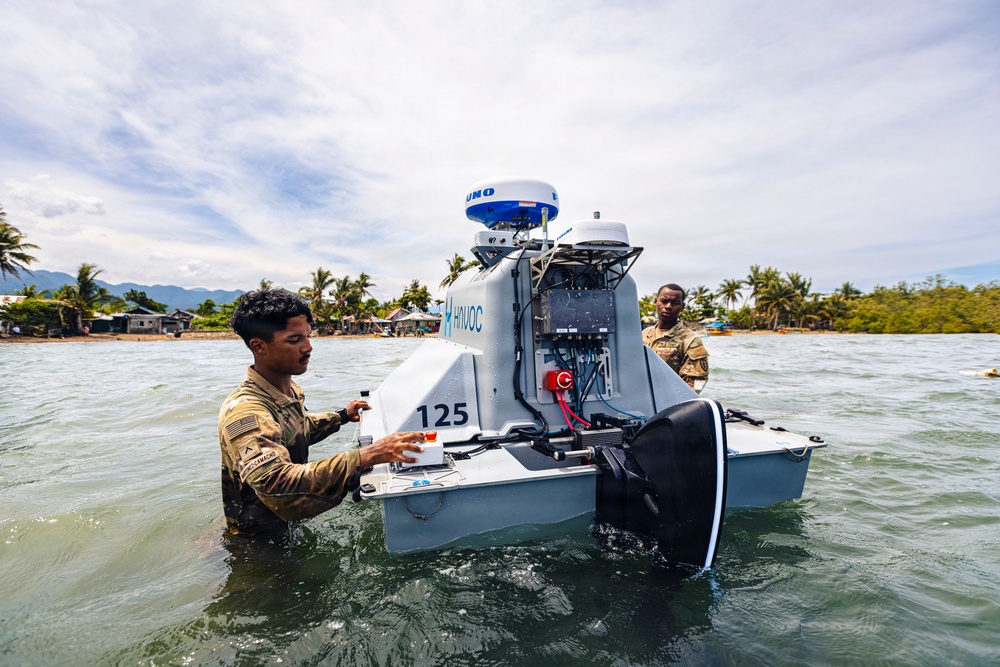
The useful part of the Army's June experimentation is that it happened in water, not in a conference room. During Salaknib 2026 in the Philippines, soldiers from the 125th Intelligence and Electronic Warfare Battalion used unmanned surface vessels in Casiguran Sound. The boats went ahead of a U.S. Army Logistics Support Vessel as it approached port, observed the environment, and pushed information back to personnel ashore. The broader move transported Philippine personnel and vehicles, including armored personnel carriers, more than 260 miles to Port Casiguran.
That is the right kind of test. It ties unmanned systems to a real logistics mission instead of treating them as a technology demonstration. An LSV approaching a small port is vulnerable. It is slow, predictable, and tied to hydrography. A small USV that can look six miles ahead, identify surface contacts, and compress a commander's decision cycle from hours to seconds is worth having.
But an escort problem is not the same as a sustainment problem. The USV helped protect the route into port. It did not create the port, harden the fuel farm, replace the ship, or guarantee the next convoy. Anyone who has served on a destroyer knows the difference between seeing the threat and having enough missiles, parts, and maintainers to keep fighting after the first exchange. The Army is now learning the same lesson at sea.
The Marketplace Is Not a Supply Chain
Army Secretary Dan Driscoll's push for an Amazon-like defense marketplace could be useful, especially for drones and counter-drone systems. Defense One reported that the service already has dedicated marketplaces for counter-UAS and aerial drones, about 45 companies represented in the unmanned aerial system marketplace, and more than $200 million in sales. Nine more partner countries signed a letter of intent at Eurosatory, joining eight nations already using or aligning with the platforms, including Australia, Singapore, South Korea, and Thailand.
Compatibility is not trivial. If a Philippine unit, an Australian logistics detachment, and a U.S. Army battery can buy interoperable drones, sensors, radios, and counter-UAS kits without inventing a new acquisition lane each time, the theater becomes less brittle. In a crisis, common interfaces are almost as valuable as common platforms.
The danger is mistaking purchasing speed for wartime depth. A vendor marketplace can help a unit order 110 or 300 systems. It does not guarantee spare batteries in month three of a blockade, data links under Chinese jamming, or enough trained operators after attrition. It also does not solve the industrial question: how many hulls, engines, electro-optical sensors, satellite terminals, and secure modems can the United States and its allies produce while China is consuming the same supply chain with cyber, missile, and economic pressure?
China Gets a Vote
The People's Liberation Army has built its anti-access system around making U.S. logistics visible and expensive. Ports, airfields, depots, and command nodes are easier to find than submarines. Long-range precision fires, maritime militia surveillance, cyber disruption, and electronic warfare all aim at the same operational effect: slow the U.S. force until it arrives piecemeal or runs dry.
Small unmanned boats complicate that targeting problem. They can multiply sensors, create false contacts, scout approaches, and make an adversary spend weapons or attention on lower-value assets. Larger unmanned vessels could move cargo through routes that commanders would hesitate to risk with crewed platforms. That is the promise Clark is chasing.
The limitation is endurance. A Pacific logistics network needs thousands of mundane movements, not a handful of clever demonstrations. If a missile unit fires from northern Luzon, the reload problem begins immediately. If an air defense battery shifts after emitting, the generator, fuel, and repair kit must move too. If China targets a main port, the Army needs secondary beaches and austere nodes that have been surveyed, exercised, and politically cleared before the crisis.
The operational test for USARPAC is not whether a drone boat can escort one landing craft. It is whether unmanned vessels can keep several dispersed units supplied when the ports are under surveillance, the spectrum is contested, and commanders are losing ships they cannot quickly replace.
The Math Still Has To Work
The RAND Corporation's new study on battle-damaged Arleigh Burke-class destroyers makes the same point from the Navy side. Its tabletop exercise found outdated command-and-control frameworks, unrealistic assumptions about allied repair support, vulnerable facilities, limited organic repair capacity, and poor parts availability. That report was about DDG-51 repair, not Army drone boats, but the operational logic is identical. The joint force has concepts for distributed operations faster than it has regeneration capacity.
USARPAC's unmanned push is therefore necessary. It is also insufficient until it is tied to tonnage, sortie rates, repair plans, and partner access agreements. The Army should keep testing small USVs in the Philippines. It should also be asking uglier questions: how many are needed per convoy, how many are lost per week, how many can be repaired forward, and how many can be manufactured or bought after the first month?
There is a serious idea under the buzzwords. The Pacific theater Army needs unmanned logistics, not just unmanned reconnaissance. But the 2026 evidence still points to a gap between contact-layer language and sustainment reality. Clark is right to want both the 200-foot boat and the twenty 10-foot boats.
He will need many more of each before the concept can carry the fight.
USARPAC is assessing the use of unmanned surface vessels for logistics in the Pacific, acknowledging that current capabilities are insufficient. During the Salaknib 2026 exercise in the Philippines, unmanned vessels were utilized to support logistics operations. The Army is facing challenges in sustaining operations against potential threats from China, highlighting the need for improved logistics and supply chain solutions.
- USARPAC is exploring the use of unmanned surface vessels for logistics in the Pacific.
- The Army is not yet capable of fully utilizing unmanned systems for sustainment.
- The 7th Infantry Division has been redesignated to enhance multi-domain operations.
- The Salaknib 2026 exercise demonstrated the utility of unmanned vessels in logistics.
- China's anti-access strategies complicate U.S. logistics in the region.