
USS Charleston Exposes the Limits of US Sea Power Near Sabina Shoal in 2026
 Marcus Chen
USS Charleston Exposes the Limits of US Sea Power Near Sabina Shoal in 2026
The most important fact about the October 20 encounter near Sabina Shoal is what did not happen. China tracked USS Charleston, a U.S. Navy Independence-class littoral combat ship, but did not stop it, collide with it, or force it to leave. That is not a Chinese victory. It is also not a clean American one. The episode shows the uncomfortable middle ground now defining the South China Sea: the United States can enter contested waters, but Beijing is getting better at making every entry expensive and politically combustible.
The Contact Near Palawan
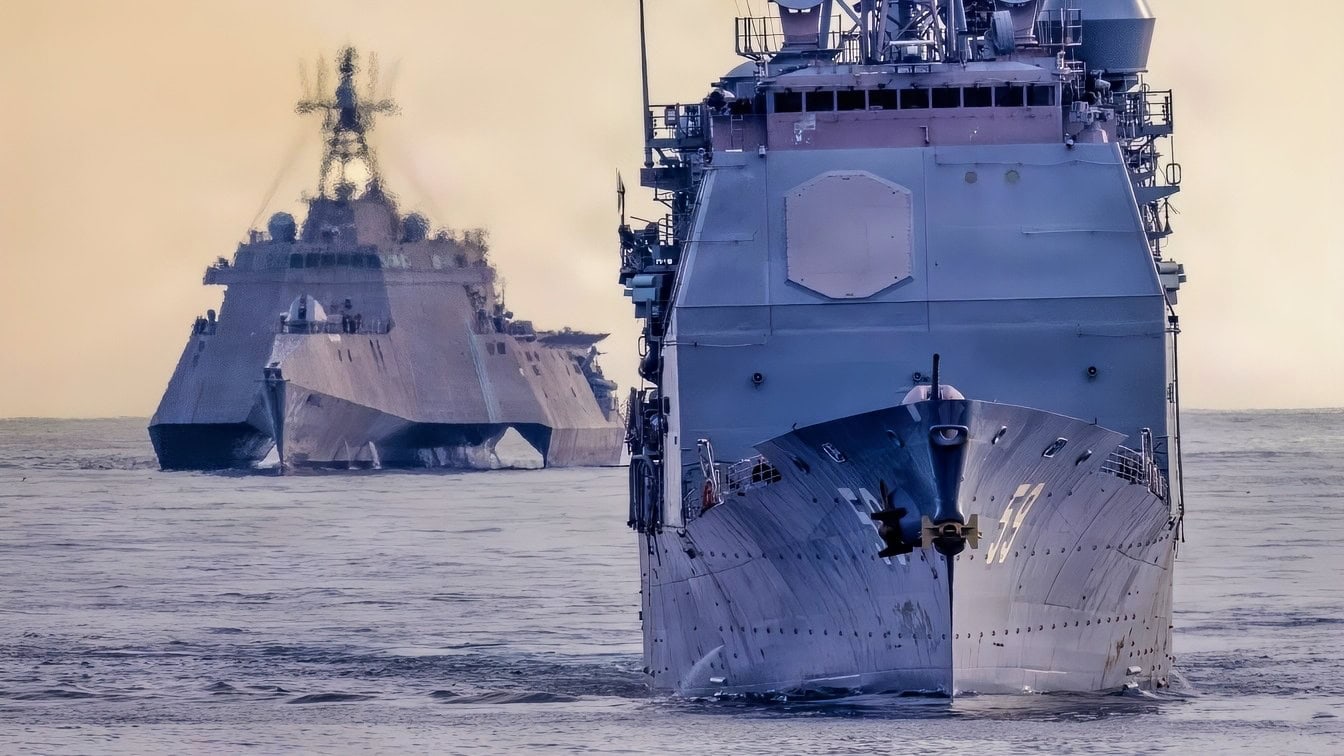
According to USNI News and reporting that cited the October 20 statements, the People's Liberation Army Navy sent forces to follow Charleston near Sabina Shoal, known in the Philippines as Escoda Shoal and in China as Xianbin Jiao. The feature sits roughly 76 to 78 nautical miles northwest of Palawan, well inside the Philippines' 200-nautical-mile exclusive economic zone. Washington described the operation as routine activity in international waters. Beijing called it an unauthorized intrusion into Chinese-claimed territory. Philippine officials rejected Beijing's legal framing.
The geography matters more than the rhetoric. Sabina is close to routes used by Philippine patrols and resupply missions toward the Spratly outposts. It is also a useful observation point for a Chinese force trying to demonstrate that foreign warships cannot operate near contested features without being watched. The United States chose a relatively fast, shallow-draft ship for the mission, not an Aegis destroyer designed to provide area air defense. That looks like a deliberate presence operation rather than preparation for a missile exchange.
The Ship Is Fast but Not a Shield
Charleston is about 127 meters long, displaces approximately 3,100 tons, and can exceed 40 knots. Its trimaran hull, waterjet propulsion, aviation facilities, and shallow draft are useful around reefs and narrow approaches. The ship can operate an MH-60 helicopter or unmanned aircraft, carry a 57 mm gun, 30 mm cannons, SeaRAM point defense, and—depending on configuration—Naval Strike Missiles.
But an Independence-class LCS is not a substitute for an Arleigh Burke-class destroyer. Charleston lacks the Burke's Aegis combat system and large vertical-launch-cell battery. It is not built to absorb a prolonged missile fight or to control the airspace over a contested maritime zone. In a gray-zone encounter, that distinction is easy to miss: a fast hull can show the flag and complicate an adversary's calculations, but it cannot by itself guarantee access once surveillance becomes targeting.
That is the operational gap. A freedom-of-navigation patrol proves the United States can arrive. Sea control requires the United States to remain, protect the ship, sustain the mission, and defeat the sensors and weapons that threaten it. One LCS near Sabina demonstrates presence. It does not establish control.
Beijing Is Building Pressure in Layers
The encounter also makes more sense alongside the Philippine maritime picture. Army Recognition, citing Philippine monitoring, reported 31 Chinese naval and China Coast Guard vessels around four contested areas during October 13–19, up from 27 the previous week. The count included 23 Coast Guard cutters and eight PLAN warships. More than half were concentrated around Scarborough Shoal, while Sabina had two PLAN vessels in the observed period.
Those numbers are not an order of battle. They are a weekly snapshot, and they exclude or undercount vessels that are difficult to classify, including maritime militia. Still, the pattern is clear. Beijing does not need to form a battle line to impose costs. Coast Guard cutters establish a law-enforcement narrative, naval ships provide escalation depth, and maritime militia vessels add numbers and ambiguity. The result is a layered screen that can shadow an American ship without immediately creating the unmistakable act of an attack.
For Manila, that screen is more dangerous than a single dramatic confrontation. A collision or water-cannon incident creates a crisis that allies can see. Persistent tracking and obstruction below the threshold of armed conflict create a daily test of whether the Philippines can use its own waters and whether Washington will respond every time.
The Security Dilemma Is Now Visible
Defense News recently summarized Chinese military analyses of the U.S. Marine Corps' distributed force concept. Those writings identify small missile units and unmanned systems as difficult to find, but argue that forward forces remain vulnerable without air superiority, logistics, and credible air defense. Chinese authors then recommend pushing China's own undersea and maritime forces farther forward.
That is the security dilemma in concrete form. Washington sends smaller forces closer to China's maritime perimeter to complicate Chinese operations. Chinese planners interpret those forces as penetration and prepare to track, surround, and eventually target them. Each side can describe its move as defensive. The contact near Sabina shows how quickly the distinction becomes irrelevant at sea.
What Washington Should Count
The wrong question is whether Charleston won the encounter. The right questions are simpler: How long could it remain on station? What aircraft and electronic support were available? Which Chinese sensors tracked it? How quickly could a second U.S. ship arrive if the encounter turned physical? And could Philippine forces continue their own patrol or resupply mission while the U.S. ship was being monitored?
Until those answers are public, the incident should be read as a warning about sustainability, not as proof of either dominance or defeat. The United States retains the legal and operational ability to enter the South China Sea. China is demonstrating an expanding ability to make that access observable, contestable, and costly.
The math is blunt. A 3,100-ton LCS can create a dilemma for China, but it cannot solve the Philippines' maritime problem alone. If Washington wants sea denial and not just episodic presence, it needs persistent surveillance, protected logistics, allied patrols, and enough missile-equipped ships to survive the first contact. Otherwise, USS Charleston's patrol will remain what it currently is: a successful visit inside a shrinking margin for error.
USS Charleston was tracked by Chinese naval forces near Sabina Shoal on October 20, 2026, but was not stopped or forced to leave. The U.S. Navy conducted a routine operation in contested waters, while China increased its naval presence in the area. This incident underscores the challenges of maintaining control in the South China Sea amid rising tensions.
- USS Charleston was tracked by Chinese naval forces near Sabina Shoal.
- The encounter occurred within the Philippines' exclusive economic zone.
- China increased its naval presence in contested areas, with 31 vessels reported.
- The U.S. Navy described the operation as routine, while China labeled it an unauthorized intrusion.
- The operational gap between presence and control in contested waters is highlighted.