
USV Swarm in the Philippines Shows the 2026 Escort Gap
 Marcus Chen
USV Swarm in the Philippines Shows the 2026 Escort Gap
Six miles off Casiguran Port, the U.S. Army tested a problem the Navy cannot solve by itself. During Salaknib 2026, soldiers from the 125th Intelligence and Electronic Warfare Battalion used unmanned surface vessels to screen a U.S. Army Logistics Support Vessel as it approached the Philippine coast. The load was not theoretical: Philippine Army vehicles and personnel had moved more than 260 miles from Port Tobaco to Port Casiguran, with armored personnel carriers rolling at the far end of the route.
That is the useful detail. The boats were not there to impress a defense expo crowd. They were there because moving men, fuel, rockets, and vehicles around the Philippine archipelago is what a Western Pacific fight would actually require.
The exercise deserves attention because it sits between two stories Washington usually treats separately. One is the high-end missile fight around Taiwan and the South China Sea. The other is the dull escort and port-security work that keeps that missile fight supplied. The U.S. military is buying exquisite long-range fires, but the first island chain is still mostly water, small ports, exposed landing points, and short warning times. A cheap autonomous screen does not close that gap. It makes the gap visible.
The Screen Was Small but the Geography Was Not
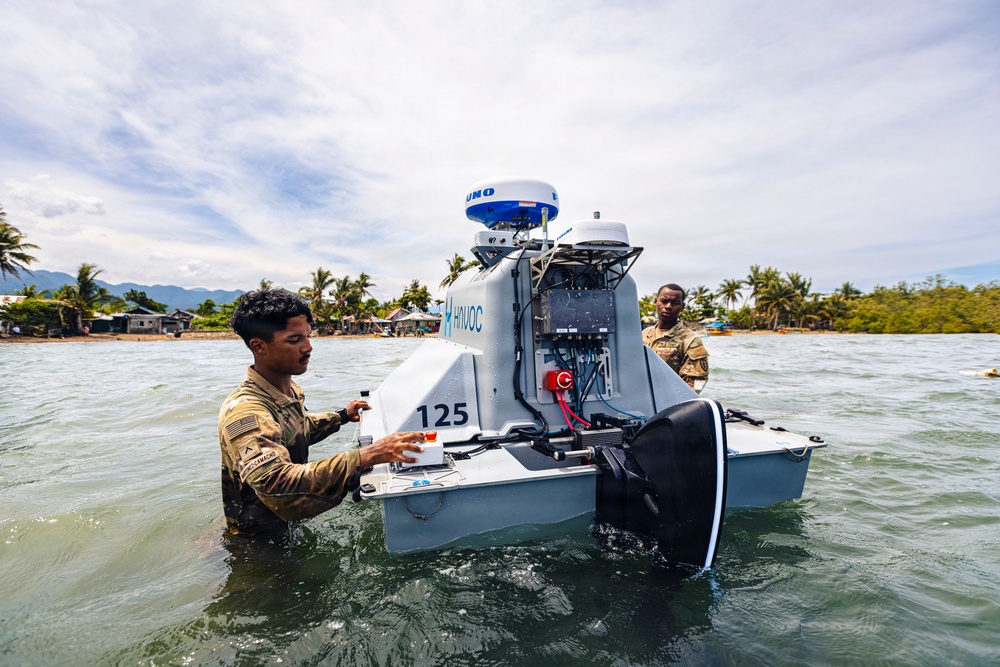
DVIDS reported that the maritime screen took place in Casiguran Sound and supported the arrival of a U.S. Army Logistics Support Vessel at Casiguran Port. The USVs spread across a wider perimeter, relaying sensor information to personnel ashore while the logistics vessel closed the port. Soldiers described the boats as intelligence, surveillance, and reconnaissance assets for landing craft security.
Casiguran is on Luzon’s eastern side, facing the Philippine Sea rather than the South China Sea. That matters. As USNI News noted after Balikatan 2026, planners have been shifting logistics routes away from the most exposed western ports and using southern and eastern movement patterns before pushing equipment toward Luzon. In a conflict, the first problem is not simply getting forces to the Philippines. It is keeping them moving after the obvious ports and airfields become watched, jammed, mined, or struck.
Anyone who has served on a destroyer knows escort is a consumption problem. You can assign a multi-billion-dollar ship to watch a logistics vessel, but every hour it spends doing close protection is an hour it is not hunting submarines, providing air defense, or launching land-attack missiles. The U.S. Seventh Fleet is already stretched across a theater that runs from the Indian Ocean to Northeast Asia. It cannot be the security guard for every pier, causeway, and landing craft in Luzon.
Autonomy Helps With Persistence Not Firepower
The operational value of the USV screen is persistence. A manned patrol boat has crew endurance limits and becomes a target itself. A small USV can sit farther out, carry electro-optical or radar sensors, and make a commander’s picture less dependent on one aircraft pass or one radio report from the beach. That is not glamorous, but in an archipelagic fight, minutes matter.
The limitation is just as clear. These systems do not replace armed escorts. They find, classify, and report. They may cue fires if the network works, but they do not by themselves defeat a missile boat, an armed drone, a swimmer delivery vehicle, or a disguised militia craft. A sensor screen buys warning. It does not buy sea control.
That distinction is important because the U.S. Army is increasingly operating in maritime terrain. During Balikatan 2026, Adm. Samuel Paparo described the exercise as a rehearsal for the defense of the Philippines, and the numbers backed him up: roughly 17,000 troops, including Japanese participation at scale, trained across the archipelago. U.S. Pacific Fleet also listed a ten-ship multinational maritime event involving U.S., Philippine, Japanese, Australian, Canadian, and Coast Guard vessels. The Army’s USVs are not a side experiment. They are part of a larger attempt to turn land forces into sensors, shooters, and sustainers inside a maritime campaign.
The Chinese Problem Is Mostly Below the Threshold
The immediate backdrop is not a Chinese amphibious invasion of Luzon. It is a steady maritime pressure campaign. AP reported this week that Manila protested a Chinese floating structure at Scarborough Shoal, while Beijing imposed an entry ban on Philippine Defense Secretary Gilberto Teodoro after his criticism of Chinese claims in the South China Sea. Those political moves sit on top of years of coast guard blocking, water-cannon use, close maneuvering, and disputed law-enforcement patrols.
This is where autonomous screens may matter first. A USV does not need to sink anything to be useful. If it can document approaches, detect unusual traffic, extend a port’s sensor radius, and feed a combined command center, it complicates gray-zone tactics. It also creates evidence. In the South China Sea, video and track data often shape the diplomatic fight before any missile is fired.
But there is a danger in overreading one exercise. A handful of USVs in Casiguran Sound is not a deployable theater architecture. The U.S. and the Philippines need maintenance crews, batteries, spare hulls, datalinks, hardened control stations, deconfliction rules, and operators who can keep working when satellite communications are degraded. The boring parts decide whether autonomy survives first contact.
The Escort Gap Is the Real Lesson
The U.S. military has spent years talking about distributed operations. The Philippines is where that phrase either becomes logistics or stays a slogan. Distributed forces need distributed protection. If a landing craft, fuel bladder, HIMARS reload, or air-defense battery has to wait for a destroyer or a manned patrol aircraft before it can move, then the force is not distributed. It is delayed.
USVs are attractive because they are cheaper than ships, less politically visible than bases, and easier to spread across small coastal nodes. They fit the geometry of the first island chain. They can make an adversary search more water with more uncertainty. They can help a commander decide whether a port approach is clean enough for a logistics run.
Still, the math remains unforgiving. A 260-mile intra-Philippine movement protected at the end by autonomous boats is a useful proof of concept. A wartime sustainment network would need dozens of such screens operating at once, across Luzon, Batanes, Palawan, Mindanao, and the approaches to key airfields. It would need enough attritable hulls to lose some and keep moving.
That is the standard. Not whether a USV swarm can work during Salaknib, but whether the U.S. and the Philippines can field enough of them to make Chinese targeting harder every day of a crisis.
The Casiguran demonstration points in the right direction. It also shows how much has not been built. Washington has missiles for the first island chain. What it still lacks is the escort layer that lets those missiles, crews, and reloads arrive on time.
Sources
The U.S. Army tested unmanned surface vessels to screen a logistics support vessel six miles off Casiguran Port during Salaknib 2026. Approximately 17,000 troops participated in the exercise, which involved the movement of Philippine Army vehicles over 260 miles. This operation underscores the logistical challenges of maintaining supply lines in a potential conflict in the Western Pacific.
- U.S. Army tested unmanned surface vessels off Casiguran Port during Salaknib 2026.
- The exercise involved 17,000 troops, including Japanese participation.
- The U.S. Army Logistics Support Vessel was screened by unmanned surface vessels.
- Philippine Army vehicles and personnel moved over 260 miles to Casiguran.
- The exercise highlights the logistics challenges in a potential conflict scenario.