
Video | Low-Key Test Launch → Active Disclosure: What Signals Are Released by China's Submarine-Launched Strategic Missile Test?
Yesterday (the 6th) at 12:01 PM, a strategic nuclear submarine of the People's Liberation Army Navy successfully launched a submarine-launched strategic missile carrying a training simulation warhead into the relevant high seas of the Pacific Ocean, accurately landing in the designated sea area. The footage of the missile piercing the sky has also been officially released. What model is this "underwater sword" that soared from the depths of the ocean? What does the combination of the strategic nuclear submarine and submarine-launched strategic missile signify?
Expert judgment: Most likely the JL-3
Although the announcement only mentioned "submarine-launched strategic missile carrying a training simulation warhead," military expert Shao Yongling assessed that based on the footage released last night of the missile surfacing and ascending, as well as the information about the warhead landing in the designated sea area, this launch was likely a "JL-3" submarine-launched strategic missile.
Shao Yongling: The JL-3 was already showcased during last year's National Day parade. Any equipment that is displayed must be in active service. Moreover, it reached the high seas of the Pacific, indicating a long range, so based on the missile's landing point, the probability of it being the JL-3 is higher.
Submarine-launched ballistic missiles are ballistic missiles launched from submarines, typically equipped with nuclear warheads. Their good launch concealment and immense destructive power make submarine-launched ballistic missiles a primary force for second-strike nuclear capabilities. Military expert Zhang Junsha also believes that based on the on-site images and official announcements, this launch was indeed the JL-3 submarine-launched strategic missile with a range exceeding 10,000 kilometers.
Zhang Junsha: Our independently developed third-generation submarine-launched intercontinental ballistic missile has become the backbone of the sea-based nuclear deterrent system. According to publicly available information, this intercontinental missile has a range of over 10,000 kilometers, capable of covering the South Pacific and the eastern Pacific region, demonstrating strong strategic deterrent capabilities.
Underwater Phantom + Intercontinental Sword: A "Dual Strategy" Combination
From "Existence" to "High Level"
The main character of this launch is not just the JL-3, but also the strategic nuclear submarine that carries it. Shao Yongling explained that during training, the JL-3's range can reach from the west coast of the Pacific to the east coast. However, in actual combat, it may not be necessary to utilize the JL-3's range to its limits; the secret lies in the words "strategic nuclear submarine" in the announcement.
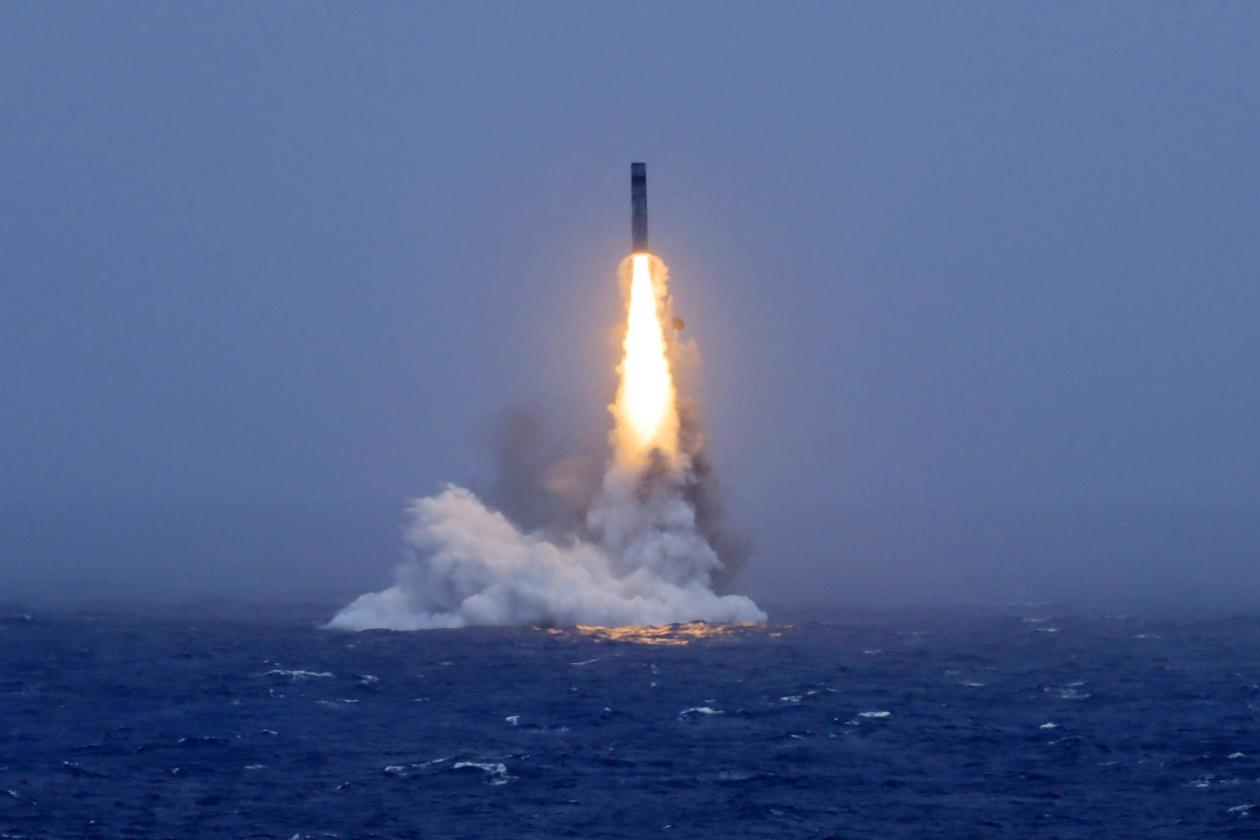
△The moment the missile surfaces.
Shao Yongling: If the JL-2 signifies the capability for a second strike, then the JL-3 and the new type of ballistic missile nuclear submarine indicate that the second strike capability has reached a higher level. One addresses the issue of existence, while the other ensures the survival of nuclear forces and the ability for a second strike; these are not on the same level.
Strategic nuclear submarines specifically refer to nuclear-powered submarines that carry submarine-launched intercontinental missiles and undertake strategic deterrence and nuclear counterattack missions. The active models reported by our military include the Type 092, Type 094, Type 094 improved version, and newer iterations.
On the eve of the 2025 Army Day, an official promotional video revealed images of a new submarine on a long-range mission, and external analysts generally assess this submarine to be a Type 094 strategic nuclear submarine. However, military expert Zhang Junsha believes that according to China's equipment disclosure practices, the equipment publicly disclosed by the official sources is not necessarily the most advanced active model, usually indicating that a newer generation of equipment has completed its deployment. Therefore, the submarine used in this test launch could be a Type 094 or its improved version, but it also cannot be ruled out that it is an advanced strategic nuclear submarine of a newer model.
From Low-Key Test Launch to Proactive Disclosure
Transparency Itself is a Form of Deterrence
Military expert Shao Yongling believes that the fact that the official announcement was made less than an hour after the successful launch contains a significant amount of information.
Shao Yongling: Past launches have generally been very low-key. Sometimes people speculate whether there are significant military activities in certain sea areas, wondering if the JL-3 is being tested or if a new type of ballistic missile nuclear submarine is conducting experiments. However, the official sources did not release related information. China has traditionally maintained a low profile regarding nuclear issues, so this time the announcement of related information may be an action to increase transparency in the nuclear field.
This launch demonstrates reliable sea-based nuclear counterattack capabilities; "proactive disclosure" itself is a form of deterrence.
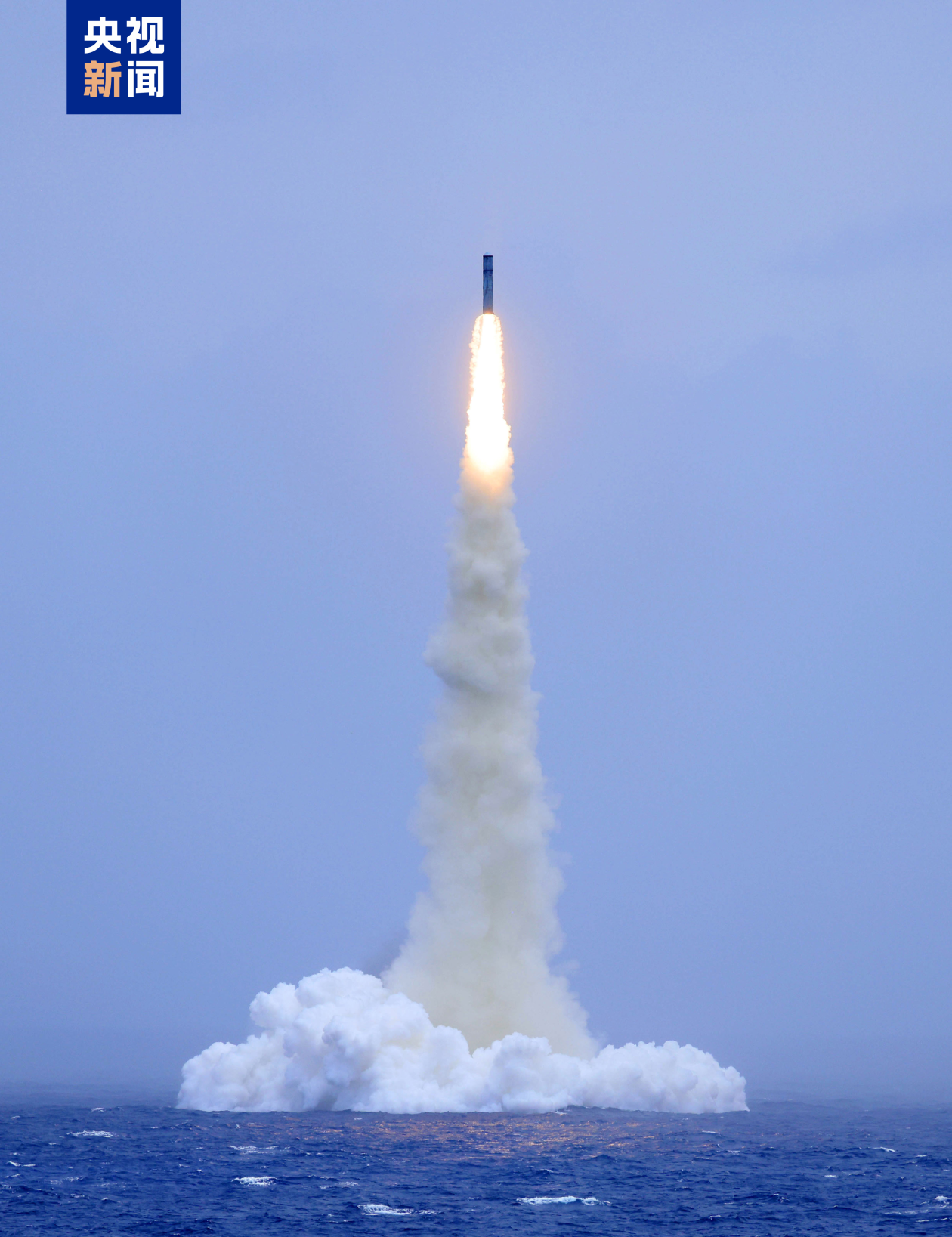
△The missile launching into the sky.
Shao Yongling: This aligns with China's national strength, allowing the outside world to perceive its capabilities. This perception serves two purposes: one is to inform the international community, and the other is to form deterrence from a strategic perspective. Although we maintain a low profile, conducting weapon tests also sends a signal to certain forces and countries. This signal is that China possesses credible and reliable nuclear capabilities, and we have the ability to safeguard national sovereignty, unity, and territorial integrity. China does not adopt a first-use policy for nuclear weapons, but it has a strong nuclear counterattack capability.
From "Dongfeng" to "Juliang"
The Complete Picture of "Trinity" Nuclear Forces
In September 2024, the Rocket Force successfully launched an intercontinental ballistic missile carrying a training simulation warhead into the relevant high seas of the Pacific Ocean. This marked China's first return to this sea area since the full-range test of the Dongfeng-5 in 1980. Now, the Navy's strategic nuclear submarine has launched this submarine-launched strategic missile from the depths of the ocean—after land-based, the sea-based has also revealed its strength.
Zhang Junsha: Sea-based nuclear forces are an important component of China's "trinity" strategic nuclear forces. Nuclear submarines are internationally recognized as the most stable and reliable nuclear counterattack force within the "trinity" nuclear forces. When land and air forces are threatened or suppressed, nuclear submarines, which operate underwater, are difficult to detect and can launch strategic missiles for nuclear counterattacks at any time, demonstrating strong nuclear counterattack capabilities. This is also why many countries are vigorously developing strategic missile nuclear submarines.
The east wind is mighty, shaking the world; the giant waves surge, sharpening the sword in the deep sea; the thunderous roar pierces the heavens and splits the earth. The "Thunder-1" air-based long-range missile, "JL-3" submarine-launched intercontinental missile, "Dongfeng-61" land-based intercontinental missile, and "Dongfeng-31" new type land-based intercontinental missile showcased during the National Day parade for the first time collectively demonstrate our military's land, sea, and air-based "trinity" strategic nuclear forces, serving as a strategic "trump card" for safeguarding national sovereignty and defending national dignity, bringing the "trinity" from strategic concepts into the public eye.
Japan Expresses "Serious Concern"
Our Foreign Ministry: Do Not Overinterpret
The Japanese government stated that around 11:30 AM local time on the 6th, it received a report from the Chinese Ministry of Defense regarding the launch of a ballistic missile. According to Japanese media reports, after receiving the report, Japan expressed "serious concern" over the so-called "increasing frequency of Chinese military activities." At yesterday's regular press conference of the Chinese Foreign Ministry, a Japanese reporter asked: What is the purpose of this test launch? Where did the missile land?
Another reporter asked: The Japanese government stated that it had strongly requested China to reconsider this test launch in advance. What is the Foreign Ministry's comment on this? Chinese Foreign Ministry spokesperson Mao Ning reiterated.
Mao Ning: This is a routine arrangement for China's annual military training, not aimed at any specific country or target, and prior notifications have been made to relevant countries, in accordance with international law and international practices. This launch activity has always maintained safety, standardization, and professional operation, and we hope that relevant countries do not overinterpret.
Supervised by丨Wu Zhehua Yang Sen
Reporters丨Cui Tianqi Wang Jiyun
Video丨Li Rui
At 12:01 PM on the 6th, a People's Liberation Army Navy strategic nuclear submarine successfully launched a JL-3 submarine-launched ballistic missile in the Pacific Ocean, carrying a training dummy warhead. This event highlights China's advancing nuclear deterrent capabilities and was publicly announced shortly after the launch, reflecting a new level of transparency in military operations. Japan has expressed serious concerns about the missile launch.
- A strategic nuclear submarine successfully launched a JL-3 missile in the Pacific Ocean.
- The missile was equipped with a training dummy warhead.
- Military experts believe this demonstrates China's advanced nuclear deterrent capabilities.
- The launch was publicly announced shortly after it occurred, indicating a shift towards greater transparency.
- Japan expressed serious concerns regarding the missile launch.