
Video refutes "misfire" claims, multiple parties urge follow-up investigation, evidence from Iranian school attack puts pressure on US military
[Global Times Special Correspondent Liu Haoran, Global Times Reporter Xian Yifan] The Tehran Times published on the front page on the 9th the portraits of over 100 elementary school students who were killed in Minab, Iran, prominently printing the headline "Trump, please look into their eyes." This page of the newspaper contained little text but quickly attracted international attention. After U.S. President Trump denied that the attacks leading to the deaths of these children were carried out by the U.S. military, there was a surge of skepticism from both Iran and within the United States. As Iranian media released video footage of the missile attack, multiple analyses suggested that the U.S. military was the most likely suspect. With calls for an investigation growing louder, the U.S. military is under immense pressure.
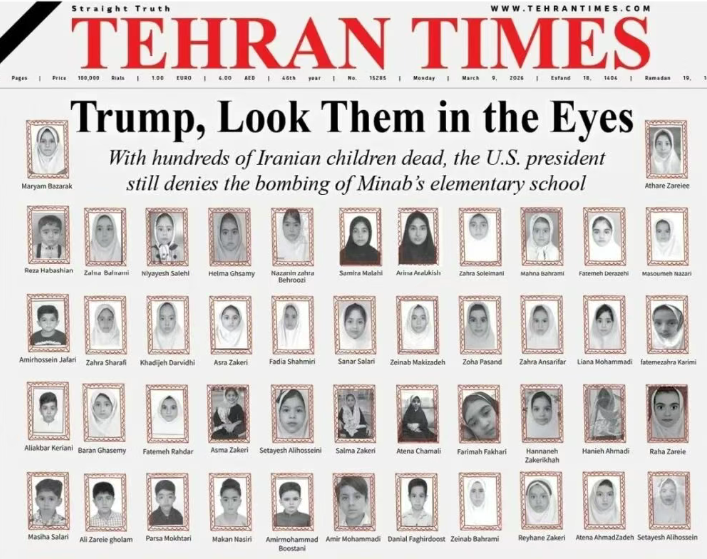
The Shajareh Tayebeh Girls' School in Minab, southern Iran, was hit by a missile on February 28, resulting in the deaths of at least 165 students. The Tehran Times stated, "Hundreds of Iranian children have died, yet the U.S. president still refuses to acknowledge the attack on the Minab school." Following this tragedy, Trump claimed that the culprit was not the U.S. but Iran, asserting that the attack was due to Iran's lack of precision in weaponry. U.S. Secretary of State Rubio also claimed that the U.S. had "no intention of targeting civilian facilities."
However, Iranian and U.S. media analyzed video and other evidence, concluding that Trump's statements were unfounded. The Iranian Mehr News Agency released a video over the weekend showing the missile attack on Minab, filmed from a construction site next to the Shajareh Tayebeh Girls' School. The footage shows a missile descending from the sky and striking a building, followed by a plume of black smoke. Off-screen, the sounds of the missile slicing through the air, explosions, and people's screams are clearly audible.
On the 9th, CNN quoted weapons experts analyzing that the missile in the footage was indeed a "Tomahawk" cruise missile, which is typically launched by the U.S. Navy from ships or submarines. U.S. Air Force Special Operations expert Wes Bryant stated that the missile's shape and explosive yield in the video closely matched that of the "Tomahawk" missile. Another naval officer who participated in the development of the "Tomahawk" series reached a similar conclusion.
Jansen-Jones, head of a military research service, told CNN that this "Tomahawk" missile undoubtedly increased the likelihood of "the U.S. military bombing a school." He speculated that the U.S. and Israel have clearly defined operational areas, and the appearance of a "Tomahawk" missile likely indicates that attacks within that area are carried out by the U.S. military.
On the 9th, Trump still claimed that Iran or other countries might also possess "Tomahawk" missiles. He said, "The 'Tomahawk' (missile) is a widely used weapon that is sold to other countries... Iran not only has some, but they also want more." When pressed by reporters, Trump first stated that "his understanding is limited, and the situation is still under investigation," but then reiterated that "the 'Tomahawk' missile is indeed used by other countries."
However, Trevor Bower, a researcher at the Dutch investigative news organization Bellingcat, emphasized that the U.S. is the only confirmed party in this conflict to possess "Tomahawk" missiles, and it remains unverified whether Israel is equipped with such missiles.
Additionally, Jansen-Jones questioned the claim of "Iran mistakenly bombing a school," noting that several buildings at the Iranian naval base near the attacked school were severely damaged, clearly indicating a strike by precision-guided weapons, rather than an accidental deviation of air defense missiles. He emphasized that these strikes had clear targets and were highly focused, aimed at completely incapacitating the relevant facilities.
Even the U.S. military has not dared to claim that it did not carry out this attack. The U.S. news outlet "Intercept" revealed that at least three current and former defense officials believe the president's statements do not hold up to scrutiny. The New York Times reported that while Trump was making his claims, U.S. Defense Secretary Hegseth merely stated, "We are investigating this matter."
On the 8th, Democratic senators in the U.S. Congress called for the Pentagon to conduct a comprehensive investigation into the attack on the Iranian school, with six senators issuing a joint statement condemning the killing of students as "appalling and unacceptable." The statement noted that if the attack was indeed carried out by the U.S. military, it would constitute one of the most severe cases of civilian casualties caused by the U.S. in the Middle East in recent decades.
On the 9th, the 61st session of the United Nations Human Rights Council's annual seminar on children's rights was held in Geneva. According to the Iranian Tasnim News Agency, Iran's permanent representative to the UN office in Geneva, Ali Bahreini, condemned at the meeting: "The attack by the U.S. and Israel on the Minab school on February 28 is an outrageous war crime, a violation of Article 8 of the Rome Statute, and the U.S. and Israel, as the aggressors, should be held accountable."
Additionally, according to a report by Mehr News Agency on the 10th, the Iranian National Charity Network, composed of 1,099 charitable organizations, issued a joint statement calling for the UN to follow up on the attack on the Minab school. The report quoted a rescue worker as saying, "About 90 more children are receiving treatment in the hospital."
A missile strike hit a school in Minab, Iran, on February 28, killing at least 165 students. Evidence suggests the missile was a Tomahawk, typically used by U.S. forces, leading to accusations of U.S. involvement. The incident has prompted significant international outcry and calls for investigation from U.S. lawmakers and human rights organizations.
- At least 165 students were killed in the missile strike on the school in Minab, Iran.
- The missile used is identified as a Tomahawk cruise missile, typically used by U.S. forces.
- U.S. officials, including President Trump, denied responsibility for the attack.
- Iranian media and experts argue that the evidence points to U.S. involvement in the strike.
- Calls for an investigation into the incident have increased from U.S. lawmakers and international bodies.