
Video: Teaching - 10 Hanging Bombs Drive Away Philippine Small Aircraft! PLA Readiness Patrols Huangyan Island
Huangyan Island is an inherent territory of China. On September 2, the Southern Theater Command of the People's Liberation Army organized naval and air forces to conduct combat readiness patrols in the territorial waters and airspace of Huangyan Island and surrounding areas.
In a video released by the Southern Theater Command, Air Force pilots flew a JL-10 trainer aircraft, armed with live PL-5 missiles on the wingtips, to warn and drive away a small Philippine aircraft that approached our airspace. This is the first time our military has showcased the JL-10 carrying live ammunition for such a mission.
From the JL-10 carrying live ammunition to drive away intruders, to the J-16 providing full support, and the coordinated operations of naval and air forces, how does this combination continuously strengthen control over the maritime and aerial domains, resolutely defend national sovereignty and security, and maintain peace and stability in the South China Sea?
Outstanding low-speed maneuverability
is a unique advantage of the JL-10
On September 2, above Huangyan Island, a JL-10 advanced trainer aircraft was executing a drive-away mission, armed with live ammunition on its wingtips. Following closely behind was a J-16 multirole fighter. The pilots in these two aircraft were actually a teacher-student pair. The footage of this "teacher-student joint patrol" released by the Southern Theater Command has attracted widespread attention. Why is there a "trainer aircraft" on the front line of combat readiness patrols in the South China Sea? What is its significance?
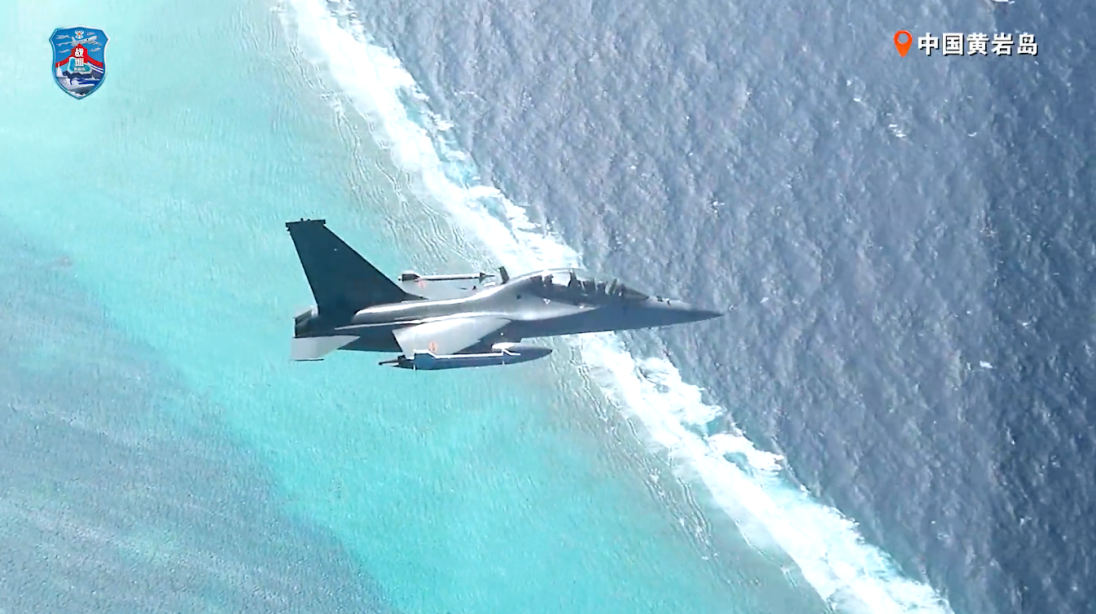
△JL-10 trainer aircraft.
Military commentator Fu Qianshao introduced that the JL-10 participating in this mission is a new generation advanced trainer aircraft independently developed by China, codenamed "Falcon." Although it is called a trainer aircraft, its foundation is anything but basic. It features a twin-engine design, advanced fly-by-wire control, and an integrated avionics system. The aircraft has seven weapon mounting points, with a maximum external load capacity of 3.5 tons, capable of carrying short-range air-to-air missiles and precision ground attack weapons. The "trump card" of the JL-10 is its low-speed maneuverability, which is one of the important reasons for its deployment over Huangyan Island for this patrol mission.
Fu Qianshao: The maneuverability of the JL-10 is excellent, with a very short takeoff and landing distance, allowing it to operate from many frontline airfields. In terms of low-altitude maneuverability, it can be said to be very outstanding, comparable to many third-generation fighters. Its close-range combat capability ranks among the world's advanced fighter aircraft. Moreover, it employs a three-axis fly-by-wire control system, which is relatively rare among trainer aircraft, further enhancing its low-speed maneuverability, thus its minimum flight speed is much lower than that of many advanced fighters.
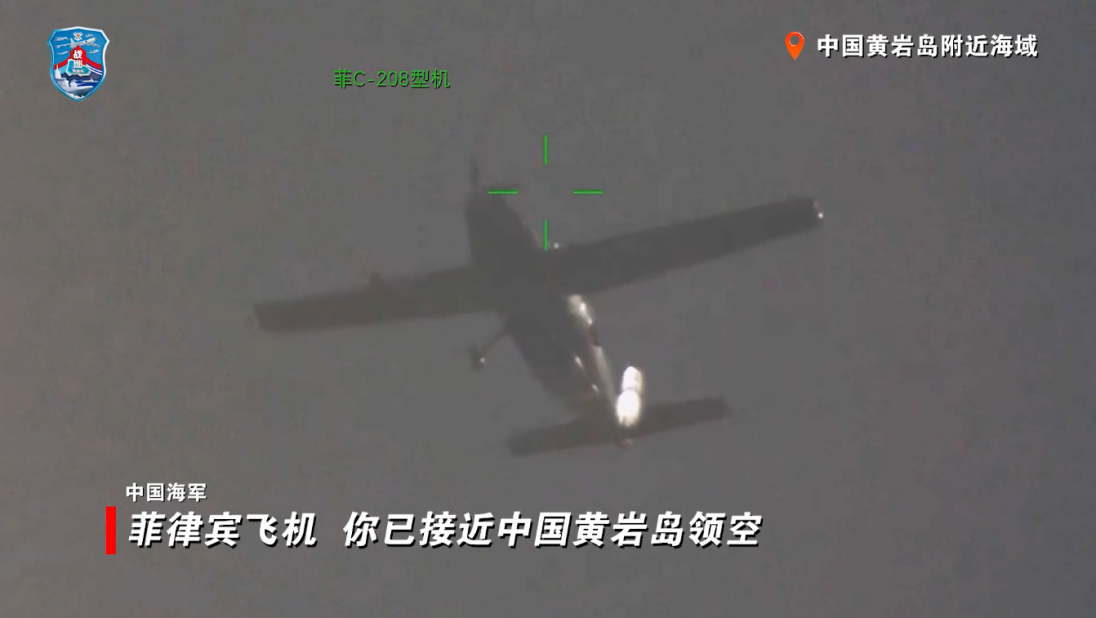
△Philippine C-208 aircraft
Public footage shows that during this operation, the Philippine side dispatched small aircraft such as the C-208 and PA-31T to illegally intrude into our South China Sea airspace. Subsequently, the Southern Theater Command forces drove away the Philippine aircraft.
Fu Qianshao: The aircraft dispatched by the Philippines are actually relatively slow-flying vehicles. The JL-10 can fully utilize its strong low-speed maneuverability to drive away these intruding aircraft, thereby maintaining the security of the area around Huangyan Island, making it a very suitable choice.
The J-16 and JL-10 form
a "high-low pairing"
During the operation, the Southern Theater Command also deployed the J-16 and H-6K, which, along with the JL-10, formed an aerial combat system through a data link communication system.
Fu Qianshao: The J-16 fighter has a relatively large nose, and its radar aperture is among the largest in active fighter aircraft worldwide. It can see far, and its multi-target processing and attack capabilities are very strong, giving it a powerful battlefield situational awareness. Additionally, it can carry heavy or long-range air-to-air and air-to-ground strike weapons, and with its advanced communication system and data link, it can transmit relevant aerial intelligence information to the JL-10 in real-time or command it to perform corresponding tasks. It can be said that a high-low pairing strategic tactical combination has been formed over Huangyan Island.
Thus, the combination of the J-16 and JL-10 resembles a "sharp knife" and a "heavy shield," creating a complete combat chain of "forward drive and rear control."
Carrying live ammunition to enhance deterrence capability
It is worth noting that this is not the first time the JL-10 trainer aircraft has appeared over Huangyan Island. On July 30 of this year, the JL-10 had already participated in combat readiness patrols around Huangyan Island with the Southern Theater Command, but at that time it was armed with training rounds. In the video released by the Southern Theater Command on September 2, the JL-10 was armed with live ammunition on its wingtips. The change from "training rounds" to "live ammunition," according to Fu Qianshao, conveys a very clear signal.
Fu Qianshao: This time carrying live ammunition indicates that in the event of a sudden incident, having live ammunition will enhance our deterrent capability. The live ammunition carried this time should be the PL-5 series air-to-air missiles, which have a relatively large field of view for their guidance systems, strong maneuverability, and longer range. As a trainer aircraft, the JL-10 equipped with PL-5 series live ammunition is sufficient to undertake close-range combat missions or tasks related to tracking and driving away foreign aircraft.
Using more targeted means
to "grasp" the opponent
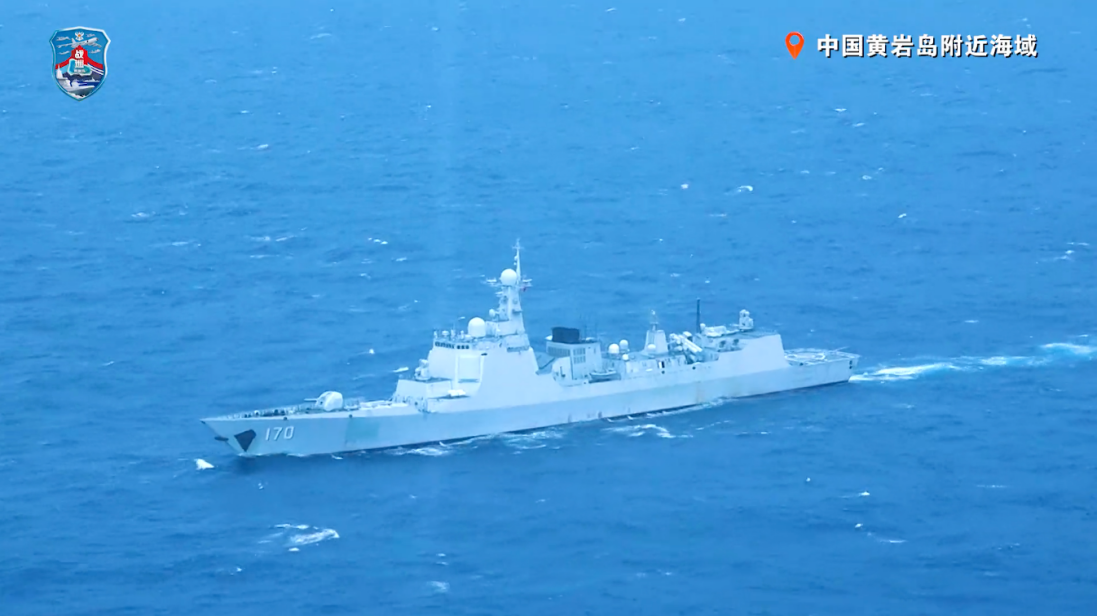
△052C missile destroyer
In fact, this combat readiness patrol is not just an aerial force's solo performance, but a systematic action of sea-air coordination. From the footage released by the Southern Theater Command, the naval formation includes the 052C missile destroyer, 054A frigate, and 071 amphibious dock landing ship. The 052C missile destroyer is equipped with an active phased array radar and vertical launch system, serving as the "air defense manager" of the formation. The 054A frigate is a "multi-functional ship at sea," equipped with HQ-16 medium-range air defense missiles. The 071 amphibious dock landing ship not only serves as a maritime mother ship for onboard helicopters to perform sea-air patrol missions but can also release landing forces and equipment from its dock if needed.
Military commentator Li Yaqiang: The combat formation we dispatched is neither the strongest nor the most advanced; rather, we are more expressing a goodwill to maintain peace and stability in the South China Sea. Secondly, the 071 amphibious dock landing ship is primarily intended for amphibious landing operations, indicating an intention to practice amphibious landing operation plans. Conducting operations in peacetime with surface ship combat formations is conducive to establishing a new normal in the South China Sea struggle.
Li Yaqiang further pointed out that the PLA has always maintained restraint and caution in the use of force, while also preparing various contingency plans to flexibly respond to sudden situations.
Li Yaqiang: We have corresponding contingency plans for various situations in the South China Sea. No matter what methods hostile forces adopt, we have ways to respond effectively.
From the precision of equipment selection to the systematization of sea-air coordination, and to the sustainability of talent cultivation—these three directions point to one fact: The People's Liberation Army is further strengthening its control over the maritime and aerial domains in the South China Sea, resolutely defending national sovereignty and security, and firmly maintaining peace and stability in the South China Sea.
Reporter丨Cai Zihan Yang Kai
Video丨Lian Jinliang
On September 2, the Southern Theater Command of the People's Liberation Army conducted a combat readiness patrol over Scarborough Shoal, utilizing a JL-10 trainer aircraft armed with live PL-5 missiles to warn off intruding Philippine aircraft. This operation marked the first deployment of the JL-10 with live ammunition in such a context, demonstrating China's commitment to asserting its territorial claims in the South China Sea. The patrol involved coordination with a J-16 fighter and naval vessels, enhancing the operational capability in the region.
- The JL-10 trainer aircraft was armed with live PL-5 missiles during the patrol.
- Philippine aircraft, including C-208 and PA-31T, were warned off by the PLA.
- This operation marked the first time the JL-10 was used with live ammunition in such a context.
- The Southern Theater Command coordinated air and naval forces for this operation.
- The operation aimed to reinforce China's territorial claims over Scarborough Shoal.