
Visiting the Beijing National Defense Electronics Exhibition: Exploring the "Ocean of Unmanned Equipment"
[Global Times Report, Journalists Liu Yang, Liang Rui, Cui Meng] Editor's Note: The 14th China International Defense Electronics Exhibition (hereinafter referred to as the "Exhibition") opened on September 15 at the National Convention Center in Beijing. Reporters from the Global Times visited the site to explore the latest technological developments in the field of defense electronics and learned about the latest technological trends from experts and staff present.
Heavy-lift unmanned helicopters are eye-catching
On the 15th, a reporter from the Global Times entered the exhibition site and was immediately struck by the feeling of being in an "ocean of unmanned equipment," from the FH-95 drone displayed at the center of the Aerospace Science and Technology Corporation's booth to various sizes of robotic dogs, and multiple models of unmanned boats and underwater autonomous vehicles...
In the exhibition hall on the basement level of the National Convention Center in Beijing, a heavy-lift tandem rotor unmanned helicopter attracted the attention of many attendees. Staff at the Hangjing Innovation Company booth introduced to the Global Times reporter that the FWH-3000 on display is currently the largest domestically developed heavy-lift unmanned helicopter, featuring a tandem rotor configuration, capable of carrying a ton of payload, with a large cargo hold and heavy-lift capabilities, and a maximum endurance of 5 hours. This type of unmanned helicopter is primarily used for transporting bulk materials and emergency support in complex environments such as plateaus, mountainous areas, and islands.
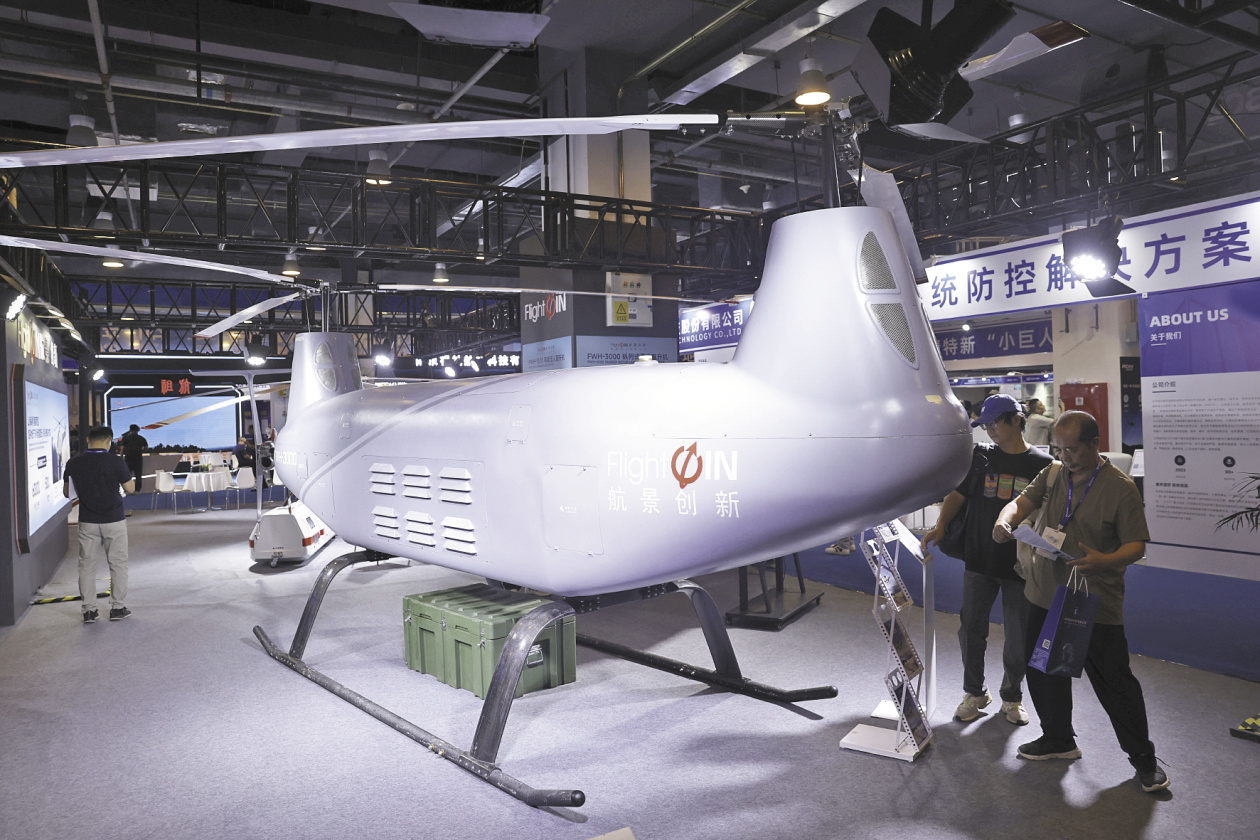
When discussing the technical characteristics of the tandem rotor unmanned helicopter, the staff member stated that compared to fixed-wing drones, tandem rotor unmanned helicopters have lower requirements for takeoff and landing sites, do not require runways, and can achieve vertical takeoff and landing, making them suitable for operations in mountainous, plateau, and temporary confined spaces; they can hover in the air, support external lifting and precise delivery, and the tandem rotor configuration allows for a large range of center of gravity variation, remaining stable even when suspended cargo sways or the center of gravity shifts, making them suitable for material lifting.
Regarding the technical challenges of heavy-lift unmanned helicopters, the staff member noted that as the load increases, the structural strength of the airframe, material performance, and power system face higher demands, with the engine being a key component. To meet the operational requirements for heavy loads and complex environments such as plateaus, the company has independently developed an aviation turboshaft engine and mastered core technologies such as a bearingless rotor system, redundant flight control systems, and advanced composite material main rotors.
In terms of practical applications for heavy-lift unmanned helicopters, the company's products have already been extensively used in emergency rescue, material transportation, and engineering lifting. Overall, heavy-lift unmanned helicopters have broad application prospects in emergency rescue and disaster warning scenarios.
The Global Times reporter also saw a spherical robot at the exhibition site, with a pure black appearance that was unforgettable. According to the staff, the application scenarios for this spherical robot mainly include: first, bird control at airports; second, following special police patrols in urban areas; and third, carrying relevant equipment to assist the police in making arrests.
The staff also mentioned that the spherical robot can achieve automatic patrolling and obstacle avoidance functions, allowing it to patrol for extended periods without supervision, making it applicable in a wide range of scenarios.
Launching a "counter-drone" combination punch
With the widespread use of drones in defense, civilian, and other fields, especially the increasing risks posed by "low, slow, small" targets flying illegally, how to systematically warn and combat illegally intruding drones has become a global focus. At this year's exhibition, many Chinese companies showcased their "counter-drone" solutions.
One company from Beijing proposed the concept of "integrated air-ground, all-domain counter-drone." According to the staff member, they have proposed an integrated counter-drone system that includes detection, countermeasures, and strike capabilities. This includes navigation signal jamming, deception disposal plans, as well as soft kill and hard kill methods. Soft kill mainly involves interfering with return or crash, while hard kill includes methods such as lasers. The staff member noted that this system is very suitable for urban scenarios.
The Global Times reporter saw a green GNSS jamming device on site. It was introduced that this device emits navigation suppression signals to interfere with the satellite navigation unit of drones, preventing them from obtaining navigation position information, thereby affecting the drone's flight control system and disrupting its precise flight capabilities, achieving the purpose of controlling the drone.
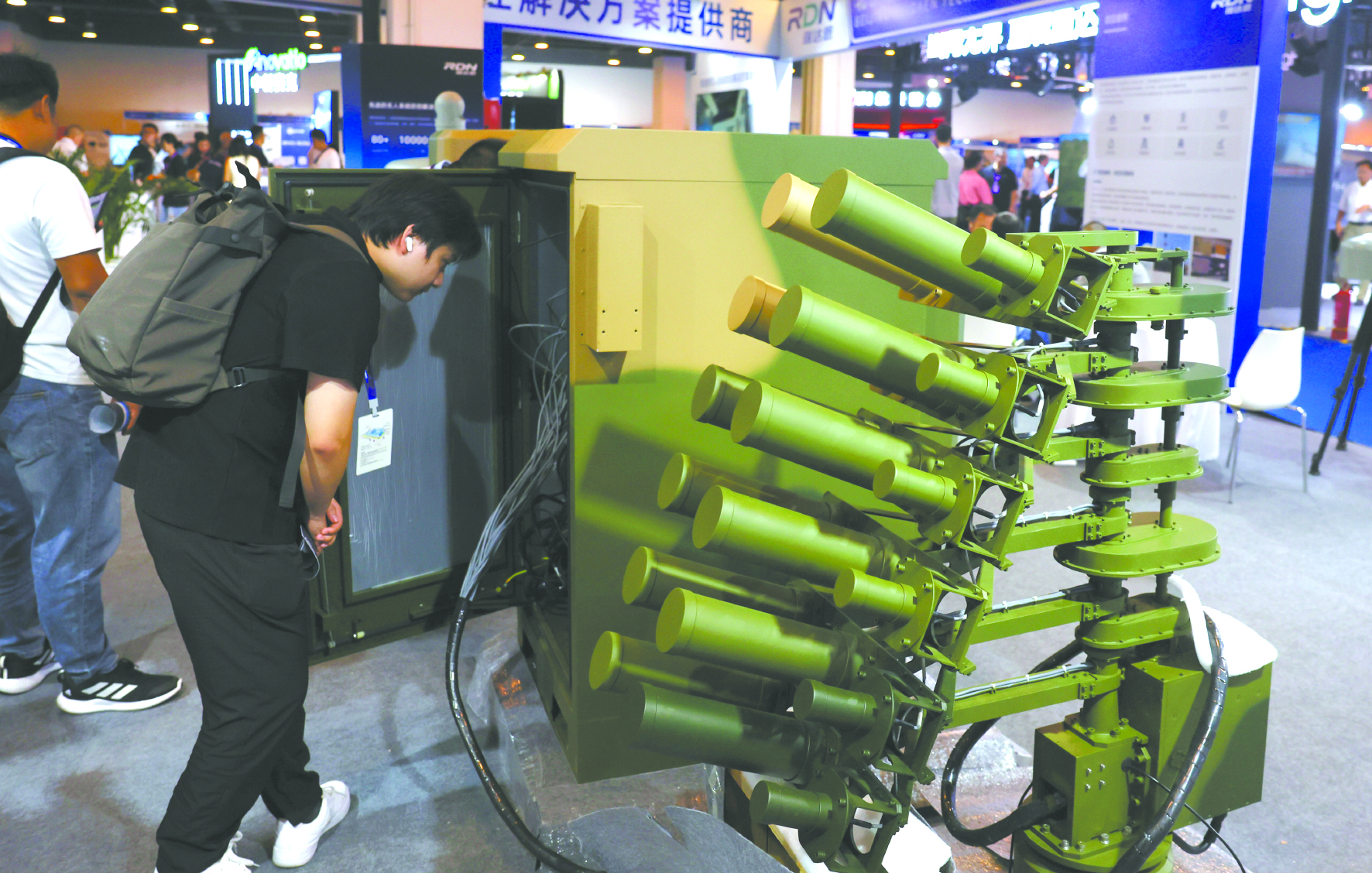
At another company's booth, a complete set of low-altitude counter-drone solutions was displayed on an electronic screen. The images marked five layers of drone defense zones at different distances, including 1 kilometer, 2 kilometers, 3 kilometers, 6 kilometers, and 20 kilometers. These five defense zones represent a complete solution from front-end detection to end strike in the event of an incoming drone.
Regarding the challenges of constructing an all-domain counter-drone system, experts indicated that the current counter-drone systems face several difficulties: first, identification is challenging. Urban environments are complex, with many obstructions and clutter; "low, slow, small" targets have small radar cross-sections, low flight altitudes, and slow speeds, making detection and stable tracking difficult, presenting a very real challenge in complex urban backgrounds. Second, striking is difficult. The flight speed of drones directly affects strike accuracy; the faster the speed, the shorter the time window for detection, tracking, decision-making, and response, making countermeasures more difficult. Third, countering illegally modified drones is challenging. Some drones, after illegal modifications, have changes in frequency bands, video transmission, flight control, payload, and flight modes, even employing frequency hopping, encryption, silence, or autonomous flight, rendering existing feature libraries, recognition models, and jamming methods ineffective. Fourth, adapting countermeasure products to different scenarios is difficult. In urban and airport environments, there are dense sources of signal radiation from mobile phones, televisions, and networks, creating a complex electromagnetic environment that requires counter-drone products to have multifunctional and multi-technology integration capabilities, able to adapt to urban, airport, and other different scenarios; at the same time, it is essential to precisely control the effective range and power to avoid impacting normal communication networks and residents' lives.
Reporters also saw a series of comprehensive counter-drone strategies at various Chinese manufacturers' booths. One manufacturer showcased an "all-channel detection, strike, and deception integrated device" that looks very much like a shipborne multi-faced radar. It was introduced that this device integrates ultra-wideband detection, multi-modal fusion perception, target identification and positioning, full-band electromagnetic countermeasures, precise directional strikes, navigation deception, and platform linkage, capable of providing closed-loop protection against threats from conventional drones, FPV drones, non-standard drones, DIY drones, and multiple target drones.
Unmanned underwater vehicles have broad application prospects
In addition to drones flying in the sky, robotic dogs and wolves running on the ground, unmanned devices on the water surface and underwater also attracted significant attention at this exhibition.
The Global Times reporter saw several unmanned underwater vehicles of various sizes at the Qingdao Pengpai Ocean booth. The smallest one is the PX-260 submersible, which has a round shape that resembles a "torpedo."
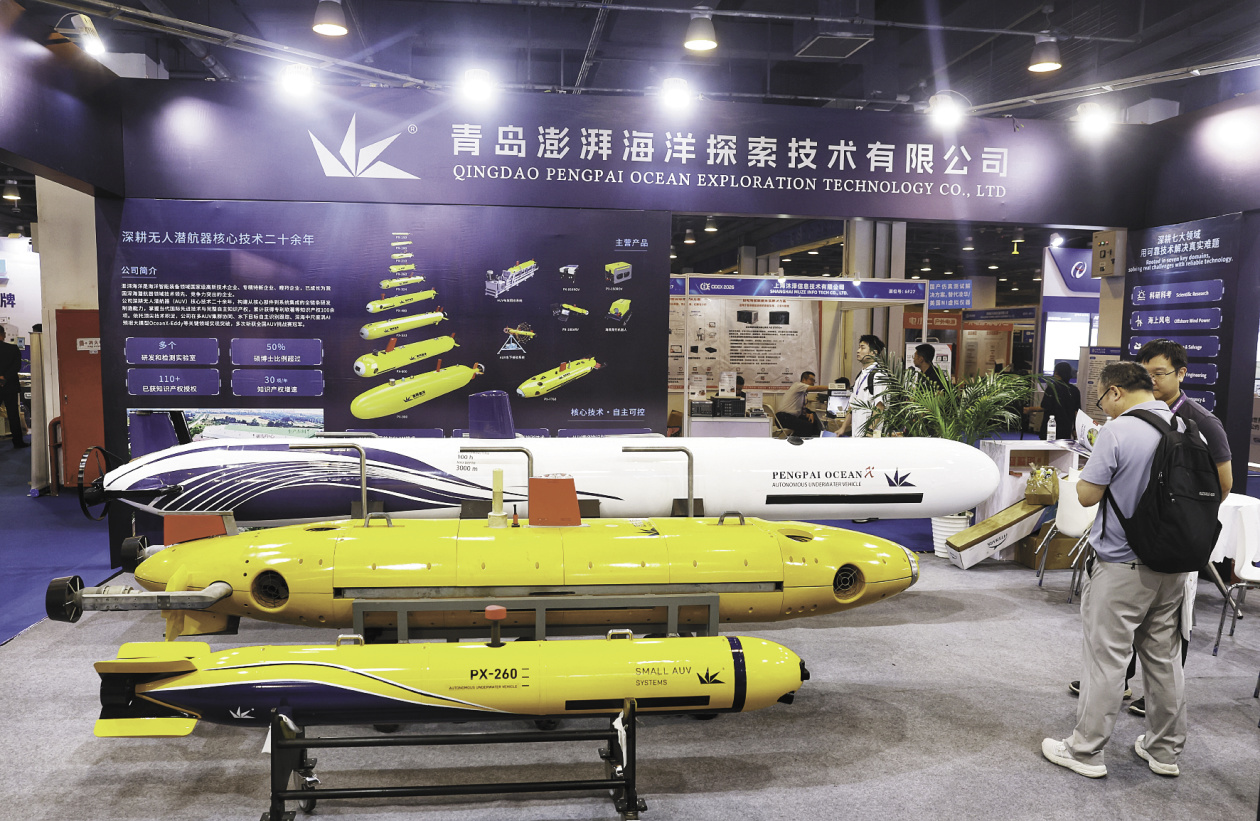
The staff introduced to the Global Times reporter that marine submersibles currently mainly come in two shapes: one is torpedo-shaped, and the other is oval-shaped, primarily used for underwater detection. The torpedo-like shape can counteract the impact of ocean currents and reduce resistance, meeting the needs for better operation underwater. These types of submersibles have broader applications, including seabed hydrological mapping and surveying, underwater salvage, and maintenance and inspection of dams in freshwater areas, as well as seabed cable inspections. "The oval-shaped one displayed this time is our latest development, mainly used for offshore wind power operation and maintenance. It abandons the traditional vertical propulsion method and adopts a six-propulsion method, allowing for vertical movement. As a highly customized product, it can be equipped with different onboard devices such as side-scan sonar, radar, and satellite communication according to user needs."
One of the most attention-grabbing autonomous submersibles on site is a large white and blue model. According to the staff, this submersible, named PX-533, has a theoretical depth of 3000 meters and a maximum working duration of 100 hours, suitable for polar and long-distance ocean voyages.
The staff explained that as water depth increases, the pressure of seawater on the hull of deep submersibles also increases. Therefore, to develop and utilize seabed resources, different models and sizes of submersibles are needed to meet various application scenarios and operational requirements. How to ensure hull strength while achieving lightweight design and longer underwater endurance is a direction for future development.
The Global Times reporter also saw a foldable, shaftless pump-driven unmanned assault boat. At first glance, the shape of this assault boat seems unremarkable, but upon closer inspection, its rear is equipped with a shaftless pump system. This device has two major benefits: it is ultra-quiet and prevents entanglement.
According to the on-site staff, this unmanned assault boat can be remotely controlled within a range of 5 kilometers, allowing rescue personnel to operate it from the shore without needing to board the boat during disaster rescue operations. Another operational mode is to achieve autonomous operation through electronic fencing and trajectory planning. Currently, this unmanned boat is mainly used in scenarios such as water police, drug enforcement, and armed police dispatch.
After visiting this year's exhibition, the Global Times reporter's biggest impression is that unmanned equipment has been applied across multiple dimensions in land, sea, and air, and has a very broad future development space. Especially in some environments that are unfriendly to humans and high-risk, the role of unmanned equipment is becoming increasingly prominent. Effectively utilizing unmanned equipment in underwater, high-altitude, and urban building environments raises higher demands for communication, anti-jamming, electronic device performance, and battery endurance, and in these areas, Chinese research and production units are providing their own solutions.
Chinese defense technology companies showcased advanced unmanned systems at the International Defense Electronics Exhibition in Beijing on September 15, 2023. Notable exhibits included the FWH-3000 heavy-lift unmanned helicopter and various anti-drone systems. The event highlighted the growing capabilities and applications of unmanned technologies in military and emergency response scenarios.
- The FWH-3000 is the largest domestically developed heavy-lift unmanned helicopter in China.
- A spherical robot is designed for various applications including airport bird control and police assistance.
- Chinese companies are developing integrated anti-drone systems to counter illegal UAV incursions.
- The PX-533 submersible can operate at depths of 3000 meters for up to 100 hours.
- The exhibition showcased a range of unmanned systems for land, air, and sea applications.