
Washington agrees to 60 AGT-1500 engines and $188 million for Omani F-16 maintenance
 Ahmed Al-Rashid
Washington Approves 60 AGT-1500 Engines and $188 Million for Omani F-16 Maintenance
On September 4, 2026, Washington announced not just one arms deal for the Gulf, but opened three small windows on the larger problem facing Arab armies: 60 AGT-1500 engines for Saudi M1 Abrams tanks worth $750 million, $188 million for sustainment services for Omani F-16 fighters, and $150 million for Bell 412EPX helicopters for Iraq, while the larger Saudi JDAM-ER deal worth $5 billion remained in the background. A quick glance at the numbers reveals $6.1 billion in sales. However, a military perspective sees a long maintenance bill for a force that cannot operate for a single day without the American supply chain.
This does not mean that the deals are marginal. On the contrary, armies do not fight with the large contracts that appear in pictures, but with ready engines, spare parts, software, calibration technicians, and supplies that do not run out at the first month of war. Therefore, the announcement of 60 engines for Saudi tanks, or a support package for Omani aircraft, is sometimes more important than announcing the purchase of a new platform. The new platform boosts morale, while maintenance is what prevents the armored brigade or air squadron from becoming a static display in the base yard.
Saudi Abrams Engines Reveal the Meaning of Ground Readiness
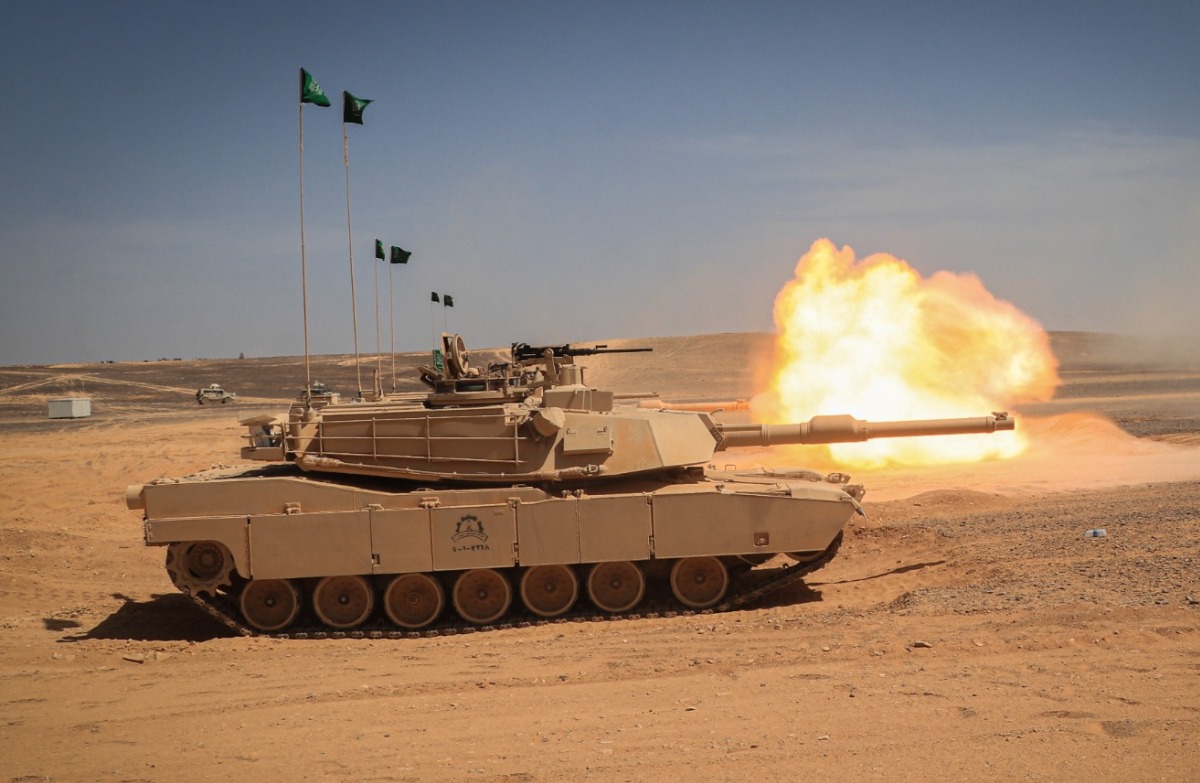
Saudi Arabia requested 60 AGT-1500 engines along with containers, spare parts, and technical, engineering, and logistical support. The engine is not an ordinary part; it is the heart of the M1 Abrams tank, which relies on a gas turbine that provides it with high acceleration and power, but comes with a heavy price in fuel and regular maintenance. Therefore, the value of $750 million does not buy new firepower as much as it buys the survival of the existing force in service.
Saudi Arabia has operated Abrams since the 1989 deal and possesses the upgraded M1A2S version. On paper, the American tank appears to be a comfortable answer to any ground threat from the north or east. However, any officer who has served in the region knows that a tank in the desert is not measured by its 120 mm gun alone. It is measured by engine operating hours, the number of maintenance teams, heavy transport capability to move it, and the stock that allows for rotating engines between units and depots. Here, the triangle of capability that I always refer to emerges: the equipment is present, but training and the logistics institution determine whether the equipment becomes a force or a burden.
Notably, the U.S. State Department notice states that the prime contractor is Honeywell at Anniston Army Depot in Alabama, and that Washington says the deal will not require sending additional American personnel to Saudi Arabia. This is a politically reassuring formula, but it does not negate the practical reality: the sustainment cycle remains American-designed and decided. The Saudi army can install the engine and operate the tank, but it cannot easily separate itself from the dependency system that starts at the factory and ends with software, spare parts, and updates.
Oman and F-16 The Calm Mediator Does Not Eliminate Squadron Needs
On the same day, Washington approved the sale of sustainment services for Omani F-16s worth $188 million. This package does not include a shiny new platform, but rather major and minor modifications, spare parts, repair and return support, communication equipment, precision navigation, laboratory calibration, classified and unclassified software, technical documentation, training, studies, and surveys. This bureaucratic language may seem dull, but in the air force, it is the difference between a capable squadron and a squadron waiting for a small part in a shipping box.
Oman is a special case in the Gulf. Muscat has played the role of mediator in Iranian files and often tries to remain less noisy than Riyadh, Abu Dhabi, and Doha. However, political neutrality does not exempt it from military accountability. The Omani F-16s do not operate in a vacuum. They are part of a training, communication, and interoperability network with American and coalition forces, as Washington clearly states. Practically, the more Oman needs to maintain a negotiation channel with Iran, the more it also needs to keep its air forces understood and readable to the American partner.
The important phrase in the Oman notice is that there is no single prime contractor associated with the deal, and that support will be provided by the U.S. government or contractors as needed. This is not just an administrative detail; it means that the sustainment is distributed across a wide network that is difficult to convert into an independent local capability. In the Gulf states, we often hear about localization, but the true sustainment of aircraft is not achieved with a slogan on an aircraft wing. It is achieved when a country can manage software, testing, spare parts, and technical training without waiting for a long decision cycle outside its borders.
Iraq and Bell 412EPX Helicopters Internal Security Function
The smaller part of the package, $150 million for Bell 412EPX helicopters for Iraq, deserves attention because it reminds us that the Middle East does not face a single threat. Saudi Arabia thinks about deterrence, munitions, and long wars. Oman thinks about balance, mediation, and the safety of its airspace. Iraq needs helicopters that can transport forces, support internal security operations, and connect areas where reliance on roads is difficult. The Bell 412 is not an Apache attack helicopter, nor does it carry the allure of heavy platforms, but it is a state tool trying to keep its units mobile between soft borders, sensitive cities, and remnants of armed groups.
When you combine the three deals, you see that Washington is not just selling the Middle East weapons, but selling the rhythm of daily military operations. An engine for a tank, software for an aircraft, a transport helicopter, precision munitions. Each small item connects an Arab army in a way that operates under American standards. This connection can be beneficial as it ensures a high technical standard and interoperability with the United States. However, at the same time, it makes the declared military independence very limited at the first political crisis or delay in Congress.
Beyond the $6.1 Billion Figure
The usual Western reading will say that these deals strengthen partners and do not change the military balance in the region, a phrase that the U.S. State Department repeats almost in every notice. In my view, the statement is formally correct but practically misleading. The deal for 60 engines does not change the balance of power if we count the number of tanks. However, it changes the readiness of units if the current engines are worn out. The F-16 sustainment package does not add a new squadron, but it may increase the percentage of aircraft ready to fly in a crisis day. In war, readiness is not an administrative detail; it is half the power.
The problem is that Gulf states and Iraq still treat sustainment as an appendage to purchase, while it is actually the essence of power. We buy the aircraft and then later ask about the maintenance chain, we buy the tank and then discover that the engine consumes both fuel and budget. As the old military saying goes, the amateur talks about weapons, while the professional talks about logistics. The Middle East has paid a heavy price because it loved the image of weapons more than the system that operates them.
Therefore, the package of September 4 does not seem to me to be news about new armament as much as it is a reminder of the limits of Arab ambition in building defensive independence. Saudi Arabia wants a ground and air force capable of waging a long war. Oman wants an armed mediator strong enough not to become weak. Iraq wants state tools, not a militia. But all three return to the same source when it comes to engines, software, and technical documentation. Here lies the paradox that official data does not resolve: the region wants greater military sovereignty, but it buys most of the conditions for that sovereignty from abroad.
Sources
- U.S. Department of State, September 4, 2026, Kingdom of Saudi Arabia AGT-1500 Engines.
- U.S. Department of State, September 4, 2026, Oman F-16 Sustainment.
- Breaking Defense, September 4, 2026, US clears $6.1 billion in Middle East arms notifications.
Washington approved the sale of 60 AGT-1500 engines for Saudi M1 Abrams tanks and 188 million dollars for F-16 maintenance services for Oman on September 4, 2026. Additionally, Iraq will receive 150 million dollars for Bell 412EPX helicopters. These agreements highlight the ongoing military support and logistical needs of U.S. partners in the Middle East.
- Washington approved the sale of 60 AGT-1500 engines for Saudi M1 Abrams tanks worth 750 million dollars.
- Oman received approval for 188 million dollars in F-16 maintenance services.
- Iraq is set to receive 150 million dollars for Bell 412EPX helicopters.
- The total value of military sales announced is 6.1 billion dollars.
- The maintenance agreements are crucial for operational readiness of the involved forces.