
Washington courts the AES in 2026 — Mali, Niger, and Burkina Faso negotiate between Russia and American intelligence
 Marie Dubois
Washington courts the AES in 2026 — Mali, Niger, and Burkina Faso negotiate between Russia and American intelligence
Bamako, June 29. A senior official from the U.S. State Department's Bureau of African Affairs, Nick Checker, met with Malian Foreign Minister Abdoulaye Diop. The official formula was cautious: "charting a new path" with Mali and also consulting Burkina Faso and Niger on common security and economic interests. On the ground, this phrase means something else. Washington is seeking an entry point into a theater it had almost abandoned after the coups from 2020 to 2023, while Moscow replaced the Wagner label with the more state-oriented Africa Corps.
This is not a sentimental return. It is a calculation of intelligence, routes, and minerals. Mali provides access to the Bamako-Gao-Kidal axis and the areas where the Support Group for Islam and Muslims (JNIM) attacks convoys. Niger remains the lock between Tillabéri, Niamey, and the Lake Chad basin. Burkina Faso holds the southern depth, which opens or closes the descent towards Ghana, Togo, Benin, and Côte d'Ivoire.
The signal from Bamako
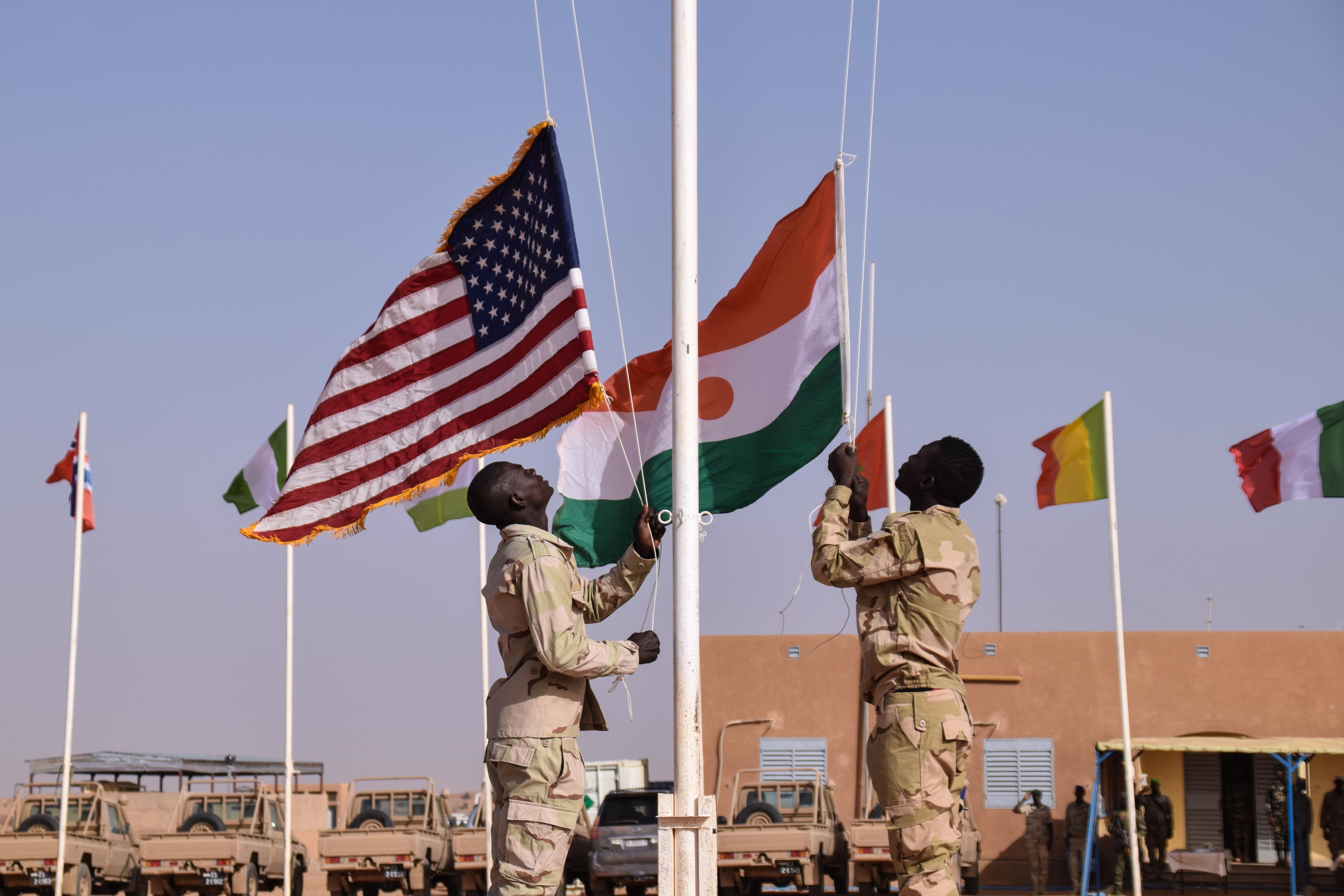
According to Business Insider Africa, the United States had already approached Bamako in March to resume intelligence operations, including aircraft and drone flights over Malian territory to monitor al-Qaeda-linked groups. The same article notes that Washington lifted sanctions targeting three Malian officials previously aimed at their ties with Wagner. This is a clear shift. For several years, the American doctrine in the Sahel conditioned the relationship on democratic transitions. The new line prioritizes counter-terrorism, the visible sovereignty of the juntas, and access to strategic materials.
In military jargon, this sounds less like reconciliation and more like a resumption of operational contact. After losing the drone base in Niger, the Americans lost a valuable observation point over a vast area. From experience, in the Sahel, those who do not see the tracks do not understand the war. The JNIM columns do not move on political maps; they travel through secondary roads, weekly markets, water points, and fuel corridors.
Jihadist pressure creates the opening
The timing is not insignificant. Sources cited by Business Insider Africa mention a recent attack on a tanker convoy in Mali, where at least 15 drivers were reportedly killed, as part of a broader blockade attributed to JNIM. This type of action does not only seek to kill. It aims to raise fuel prices, slow military rotations, and remind cities that Bamako does not always control the road that supplies them.
In Niger, RFI reported that Niamey International Airport was attacked on June 18 for the second time this year, resulting in 13 deaths, including 11 soldiers and two civilians. Tactical detail matters: the assailants reportedly attempted access through deception, using taxis and minibuses, following a more direct motorcycle attack in January. Brimaka Abdoul Azizou Garba, a Nigerien researcher interviewed by RFI, sees this as an adaptation of jihadist groups rather than a retreat. He is right. When an irregular force changes its method against the same target, it signals that it has observed security reactions.
The consequence for Washington is simple. If JNIM can strike fuel flows in Mali and test Niamey, then the argument for an American return through intelligence becomes more audible to the juntas. No captain in Ouagadougou, no colonel in Bamako, no general in Niamey wants to appear dependent on the West. But all need persistent eyes, detection, movement analysis, and strike or coordination capabilities that national forces do not yet possess in sufficient volume.
Moscow is not sidelined
However, it would be wrong to read this sequence as a pro-American shift. The Alliance of Sahel States (AES) is using the rivalry to its advantage. Mali, Niger, and Burkina Faso can talk to Moscow, listen to Washington, reject Paris, and present this triangulation as regained sovereignty. It is politically effective. It is also operationally fragile.
After the January attack on Niamey airport, Russia claimed that the Africa Corps of the Russian Ministry of Defense and the Nigerien Armed Forces repelled the assault, neutralizing about 20 assailants and seizing equipment. Business Insider Africa notes that Moscow continues to present Africa Corps as a direct support structure, following Wagner's announced withdrawal from Mali in 2025. The difference is not just cosmetic. Africa Corps makes the partnership more legible as an extension of the Russian state, less as a deniable private military company.
The problem for the juntas is therefore not to choose between Russia and the United States. The problem is whether they can accept the capabilities of each without losing political control of the national narrative.
Paris exits through the back door
The diplomatic break announced by Burkina Faso with France, reported on June 27 by Reuters and picked up by several African media, closes yet another symbolic chapter. Militarily, Paris had already left the Sahelian heart. Politically, it is now even losing the relational facade in Ouagadougou. For a former French officer, it is bitter to write, but necessary: France has not only lost bases. It has lost the ability to be heard without being immediately suspected.
This suspicion is sometimes instrumentalized. RFI recalls that General Abdourahamane Tiani still accuses France of being behind the attacks against Niger, as after the January one. The rhetoric is useful to military regimes because it transforms a security failure into a sovereignty confrontation. But it does not repair a fence around an airport, does not get a drone back in the air, and does not protect a tanker convoy between central Mali and the capital.
Minerals, drones, and roads
Economic interests are not secondary. Mali produces gold and is becoming important for lithium. Niger has uranium. Burkina Faso remains one of the major gold producers in West Africa. For Washington, the security of routes and the monitoring of mining areas intersect with competition against Moscow and Beijing. For the juntas, these resources finance power, arms purchases, salaries, and propaganda.
The difficulty is that aerial intelligence is not enough. A drone can spot a column, but it does not replace a held forward post, a cleared road, or a village willing to report suspicious movement. This is where foreign promises always clash with the same Sahelian ground. Between Gao and Ménaka, between Tillabéri and Banibangou, between Djibo and Kaya, the war is decided in spaces where administrative distance is greater than geographical distance.
The next test
The test to watch is not the next handshake photo in Bamako. It is the first operation where American, Russian, or national intelligence will prevent an attack on a vital road before it begins. If Washington achieves a limited resumption of ISR in Mali or around Niger, JNIM will likely seek to demonstrate that this capability changes nothing. The likely targets will not necessarily be spectacular: a fuel depot, a logistics convoy, a runway near an airport, or an isolated post in Liptako-Gourma.
In the Sahel, diplomacy is rarely judged in press releases. It is judged at the next intersection held after nightfall.
U.S. officials engaged with Mali's government to re-establish intelligence operations amid rising jihadist threats. The U.S. aims to strengthen ties with Mali, Niger, and Burkina Faso for security and economic interests, shifting focus from democratic transitions to counter-terrorism. Recent attacks by jihadist groups underscore the urgency of U.S. involvement in the region.
- U.S. officials met with Malian Foreign Minister to discuss security and economic interests.
- The U.S. is resuming intelligence operations in Mali after a period of reduced engagement.
- Recent jihadist attacks in Mali and Niger highlight the security challenges in the region.