
Why Are the US and Russia Modifying "Grandfather" Bombers?
[Global Times Special Correspondent Chen Yang, Global Times Reporter Ma Jun] Editor's Note: Recently, a "new trend" has emerged with the strategic bombers of the U.S. and Russia: instead of focusing on more advanced strategic bombers, they are determined to modernize and extend the service life of older bombers from the "grandfather generation." Why do these "Cold War evergreens" continue to attract the preference of the U.S. and Russia, becoming the "grandfather generation" bombers? Is their trend of deep modification worth emulating by other countries?
Does the U.S. want the B-52 to "bloom anew"?
Although the U.S. Air Force's next-generation B-21 stealth bomber is accelerating flight testing to replace the active B-2 stealth bomber and B-1B strategic bomber, the earlier-serving B-52 strategic bomber is still "blooming anew." The U.S. Air Force plans to equip it with new stealth anti-ship cruise missiles and continue to serve until the 2050s through modernization, at which point the B-52 will become the world's first bomber with an airframe age approaching a century.

New stealth anti-ship cruise missiles to be equipped on the B-52
According to a recent report from the U.S. website "Power," the U.S. Navy's Naval Air Systems Command has issued a contract notice indicating that the Navy plans to award Lockheed Martin an exclusive contract to integrate the AGM-158C Long Range Anti-Ship Missile (LRASM) onto the B-52 bomber. This is not an isolated technical upgrade but the latest component of a larger comprehensive renovation plan for the B-52: through re-engining, radar replacement, and extensive life extension, this "Stratofortress" bomber, which first flew in 1952, is set to continue flying into the 2050s, nearing a century of service.
It is reported that the U.S. Air Force had previously completed tests of the LRASM on the B-1B strategic bomber in 2018, making it the first platform with early operational capability for the LRASM. The Hong Kong-based Asia Times stated that the U.S. Air Force's equipping of strategic bombers with this advanced cruise missile is aimed at countering the increasingly sophisticated "anti-access/area denial" systems of adversaries. The Pentagon envisions the B-1B carrying a large number of LRASM cruise missiles to saturate and attack enemy naval fleets. This highlights the U.S. Air Force's emphasis on the combination of bombers and LRASM cruise missiles. However, with the imminent retirement of the B-1B, the Air Force has turned its hopes to the upgrading B-52.
The "Power" website's "Battle Zone" channel reported that the B-52 can currently carry up to 20 Joint Air-to-Surface Standoff Missiles (JASSM), and the LRASM is a naval variant developed from the JASSM-ER, with similar dimensions. The main integration work involves software updates and testing adaptations. Once completed, a B-52 could theoretically carry 20 stealthy cruise missiles capable of autonomously identifying and striking moving maritime targets simultaneously.
Retired U.S. Air Force Colonel and former B-52 pilot Mark Gonsalves commented, "The number of weapons that a few B-52s can deliver to maritime targets daily will far exceed that of naval carrier-based aircraft, and at much greater distances." He further stated that considering the number of anti-ship cruise missiles each sortie can carry and the intercontinental delivery capability, the Air Force's bomber fleet will become the U.S. military's "primary maritime strike force."
Repeated renovations of the B-52
Public information shows that the B-52 bomber's design proposal was put forward in 1948, with the first prototype flying in 1952 and the production model being delivered starting in 1955, totaling 744 units by the time production ceased in 1962. Its original mission was to drop free-fall nuclear bombs in a nuclear war. However, since a nuclear war did not occur, the B-52 found its place on conventional battlefields.
During the Cold War, the U.S. Air Force made several attempts to replace it with newer, faster platforms, but these efforts were interrupted for various reasons. After the 21st century, the older B-52 found a new reason for survival with the maturity of stand-off cruise missiles: it does not need to penetrate defenses but can launch missiles from outside the adversary's air defense firepower. The B-52 series bombers have participated in the Vietnam War, Gulf War, Afghanistan War, and Iraq War, transitioning from close air support to launching cruise missiles and precision-guided bombs from standoff ranges.
The U.S. Air Force currently operates about 76 B-52H bombers, all produced between 1961 and 1962. They feature a rounded rectangular cross-section, a slender fuselage, a high aspect ratio swept wing, and a single vertical tail layout, with eight TF33-P-3 turbofan engines mounted under the wings. In contrast, the younger B-1B and B-2 are planned to retire in the 2030s. The U.S. Air Force's assessment shows that the B-52H's airframe is large enough, with sufficient payload and space margins to allow for repeated upgrades of new electronic equipment, weapon interfaces, and communication systems; its operational cost is also low, at about $70,000 per hour, far below that of the B-1B and B-2.
However, to keep the B-52 flying into the 2050s, relying solely on the airframe's remaining lifespan is not enough. The B-52J modification that the U.S. Air Force is advancing focuses on two modernization projects: replacing the eight old Pratt & Whitney TF33 engines with Rolls-Royce F130 engines, and replacing the 1980s mechanical scanning radar APQ-166 with the APQ-188 active phased array radar based on APG-79 technology, while also fully renovating the avionics.
Significant potential risks exist
However, the U.S. Air Force's "grandfather generation" bomber program also faces significant potential risks. A report from the U.S. Government Accountability Office (GAO) in July of this year stated that the total procurement cost for the B-52J engine replacement project (CERP) is set at $20.2 billion, and among the existing 13 B-52 modernization projects, 10 are experiencing challenges related to cost, schedule, or performance. The cost of CERP has increased by about $3 billion since 2018, a rise of over 38%, with initial operational capability delayed by at least 15 months.
The more fundamental risk lies in the engineering logic itself. The GAO warned that the U.S. Air Force plans to begin engine production with "almost no developmental flight testing." Engine production and developmental flight testing are expected to commence simultaneously in fiscal year 2029, meaning that if flight tests reveal issues with airflow distortion, thrust performance, or structural compatibility, the engines already in production and the aircraft already in the modification line will face costly rework. This is not an unfounded concern; early wind tunnel tests did indeed reveal airflow distortion issues in the inlet, prompting engineers to redesign the short nacelle and inlet, but whether the related modifications will meet expectations in complex aerial environments remains unknown.
Additionally, the vulnerability of the U.S. defense manufacturing supply chain further amplifies the risks. Currently, there is already a scarcity of parts for the TF33 engine, and the GAO warned that if CERP experiences further delays, the Air Force may "not be able to effectively maintain the existing B-52 engines," leading to a shortage of operational B-52s.
Russia advances the Tu-95MSM strategic bomber "comprehensive renovation"
At the same time that the U.S. B-52 strategic bomber is undergoing modernization and life extension projects, the Russian Tu-95MS strategic bomber, which is from the same era, is also undergoing similar improvements and is planned to remain in service until the 2040s. Russia's "Red Star" television station's "Military Acceptance" program disclosed in October that this deeply modernized Tu-95MSM has also been upgraded to a standoff cruise missile launch platform. Why are the U.S. and Russia simultaneously choosing to extend the service life of these old platforms? Experts interviewed by the Global Times stated that these strategic bombers, which began service in the early Cold War, have ample underwing space in their original design, allowing them to carry a large number of advanced cruise missiles, making them more suitable than their "younger siblings" for meeting the realistic demands of contemporary strategic strike systems.
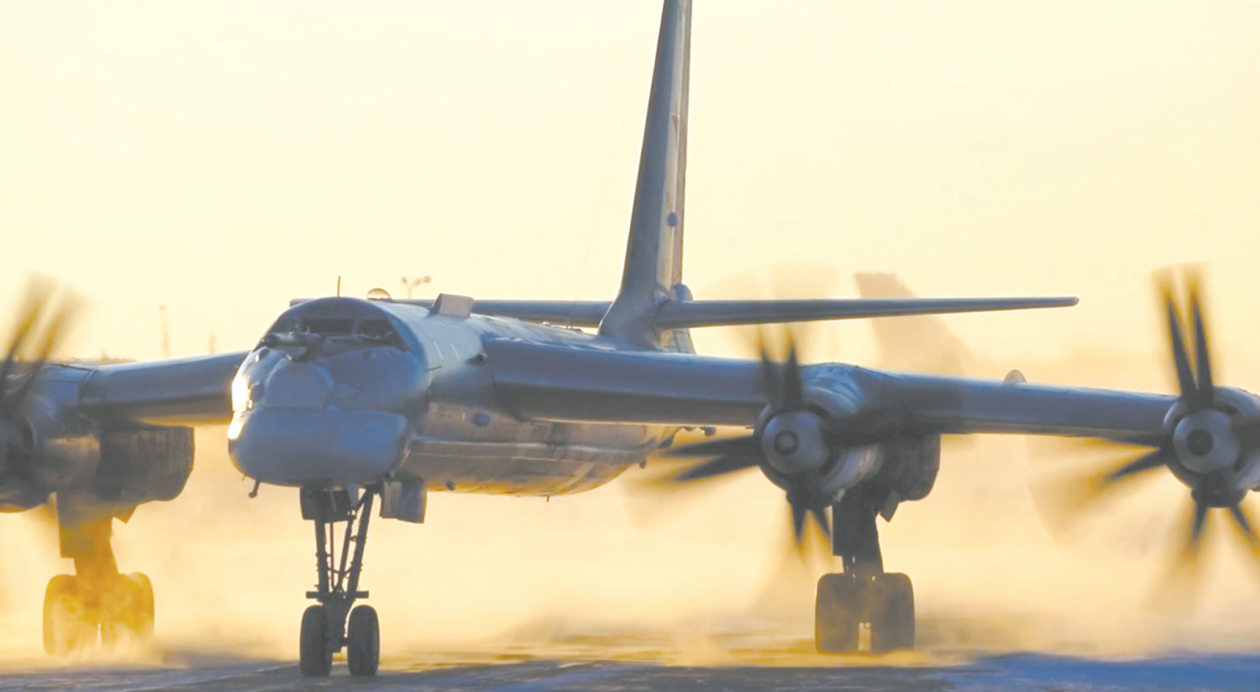
Reports indicate that the Tu-95MSM's improvements include the removal of the twin-barrel cannon at the tail and a comprehensive upgrade of the cockpit's avionics, enabling automatic flight capability without pilot intervention during certain flight segments. The Tu-95MS features an operator seat and a twin-barrel GSh-23 cannon at the tail for self-defense in close air combat. The upgraded Tu-95MSM replaces this position with a technical compartment. Russian developers explain that in modern warfare, the Tu-95MSM primarily performs standoff long-range strikes, with a "very low" probability of engaging in air combat with enemy fighters, rendering the tail gun's value obsolete; its removal can reduce structural weight and improve buoyancy during water landings.
Meanwhile, the Tu-95MSM can carry up to eight Kh-101 stealth cruise missiles or their nuclear warhead variant Kh-102 under its wings. The Kh-101 has a range of over 3,000 kilometers, with strike accuracy reaching the meter level, and a very small radar cross-section. The aircraft's avionics have also been fully upgraded, with multifunction displays covering the cockpit, and an astronomical navigation module providing backup positioning means when satellite navigation signals are jammed or denied. Additionally, the Tu-95MSM has replaced its NK-12MPM turboprop engines, enhancing reliability while further reducing fuel consumption to extend its loiter time.
Chinese experts interviewed by the Global Times stated that the U.S. and Russia's simultaneous choice to extend the service life of older strategic bombers is primarily due to their airframe materials and structural safety factors being generally high, allowing for considerable margins for decades of fatigue cycles and repeated modifications. At the same time, compared to more modern strategic bombers, these older platforms inherently have large underwing spaces, making them suitable for conversion into airborne launch platforms for long-range missiles. They also have ample internal space and redundant power generation capacity to accommodate new-generation radars, electronic warfare systems, communication equipment, and mission computers without requiring disruptive changes to aerodynamic shapes or structural layouts.
Moreover, using expensive stealth bombers to perform standoff cruise missile launch missions is not cost-effective; instead, employing older bombers with upgrade costs far lower than new platforms for this role allows for maintaining greater strike power delivery within a limited budget. This is especially relevant given the significant uncertainties surrounding the development progress and costs of the next-generation stealth bombers in both the U.S. and Russia.
However, experts indicate that the deep modifications of these old platforms by both the U.S. and Russia are based on the premise that they will not operate independently in high-threat airspace in the future, but will be used as missile launch nodes within a system. In other words, for these old bombers to serve into the 2040s and 2050s, it is predicated on the adversary's air defense systems being unable to effectively intercept beyond missile ranges. If adversaries gain the capability to target large aerial platforms at greater distances, the value of such standoff launch platforms will face fundamental reassessment.
The U.S. Air Force is modernizing its B-52H bombers by integrating AGM-158C LRASM anti-ship missiles and upgrading their systems to extend service life into the 2050s. Approximately 76 B-52H bombers are currently in service, with plans to enhance their capabilities significantly. This modernization effort aims to maintain the bombers' relevance in contemporary military operations, despite challenges related to costs and timelines.
- The U.S. Air Force plans to integrate AGM-158C LRASM into B-52 bombers.
- B-52 bombers are expected to remain in service until the 2050s.
- The modernization includes replacing old engines and upgrading radar systems.
- B-52s can carry up to 20 JASSM missiles, enhancing their strike capabilities.
- The modernization program faces potential risks related to costs and timelines.