
Why Did the 133rd Fleet Choose to Enter the Pacific from Here? Expert Analysis
The spokesperson for the Eastern Theater Command stated that on April 19, the People's Liberation Army Eastern Theater Command organized the 133 fleet to transit through the Hengdang Waterway to conduct training activities in the Western Pacific, testing the troops' capabilities for operations in distant seas. Why did the 133 fleet choose to enter the Pacific from here?
Where is the Hengdang Waterway?
The Hengdang Waterway, also known as the Hengyan Waterway, is a key international shipping route located in the middle section of the first island chain in the Northwest Pacific. Its geographical coordinates are between 28°10′N to 28°50′N and 129°15′E to 129°55′E, situated in the southern waters of the Ryukyu Islands, extending east to the eastern coast of Amami Oshima and west to the western coast of Hengdang Island. It serves as a natural maritime passage connecting the East China Sea with the high seas of the Western Pacific.
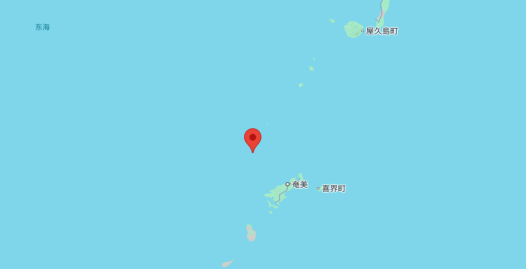
△ The red mark indicates the location of Hengdang Island
In terms of channel parameters, the overall width of the waterway is approximately 75 to 80 kilometers, with an effective navigable width of no less than 60 kilometers in the main channel. The water depth in the main channel remains stable at 1,000 to 3,000 meters, with a flat seabed and no navigational obstacles such as shoals, reefs, or shipwrecks, and the hydrological conditions are relatively stable.
From the perspective of strategic shipping and military passage value, the first island chain serves as a natural island chain barrier in the Northwest Pacific, and the Hengdang Waterway is one of the important passages connecting the East China Sea and the Western Pacific, forming a maritime passage network in the middle section of the first island chain along with the Miyako Strait and the Osumi Strait, providing diversified route options for regional maritime traffic.
Yu Hao, a key teacher in life education from Jilin Province and a geography teacher at Jilin Yuwen Middle School, believes that compared to traditional passages like the Miyako Strait and the Bashi Channel, the Hengdang Waterway has a shorter straight-line distance to the main naval ports along China's eastern coast. The fleet can effectively shorten the sailing distance and reduce sailing time by departing from the East China Sea and passing through this waterway to the Western Pacific, which is beneficial for enhancing the sustainability and economy of distant sea training and combat readiness patrols. Additionally, the waterway has sufficient navigable width and excellent depth conditions, accommodating the coordinated navigation and maneuvering needs of multiple ship types. During navigation, there is no need for complex channel avoidance, and the navigation order is controllable, making it suitable for regularized distant sea practical training.
Chinese warships transit the Hengdang Waterway
"Familiar roads"
The spokesperson for the Eastern Theater Command stated that this training activity is a routine exercise organized according to the annual plan, in compliance with relevant international laws and practices, and is not aimed at any specific country or target.
Military expert Song Xiaojun told reporters that it is noteworthy that this training activity is organized by the "Eastern Theater Command," rather than the "Eastern Theater Navy."
Song Xiaojun: The use of the term "Eastern Theater Command" is very important. Because we know that in 2024, the new structure of the Chinese military will emerge, with the original Strategic Support Force being transformed into four branches, including information support forces, cyber forces, aerospace forces, and joint logistics support forces. These four branches need to be integrated into the theater and closely cooperate with the theater's navy. Especially in distant seas, for example, the aerospace forces will provide space support for the 133 ship, the support forces will provide information support, while the cyber forces will also provide network support, and the joint logistics support forces will provide logistical support. At the same time, other branches of the theater, such as the Rocket Force and the Air Force, will also provide corresponding support before it goes out to distant seas, during the near-sea segment, the Army will also provide relevant support.
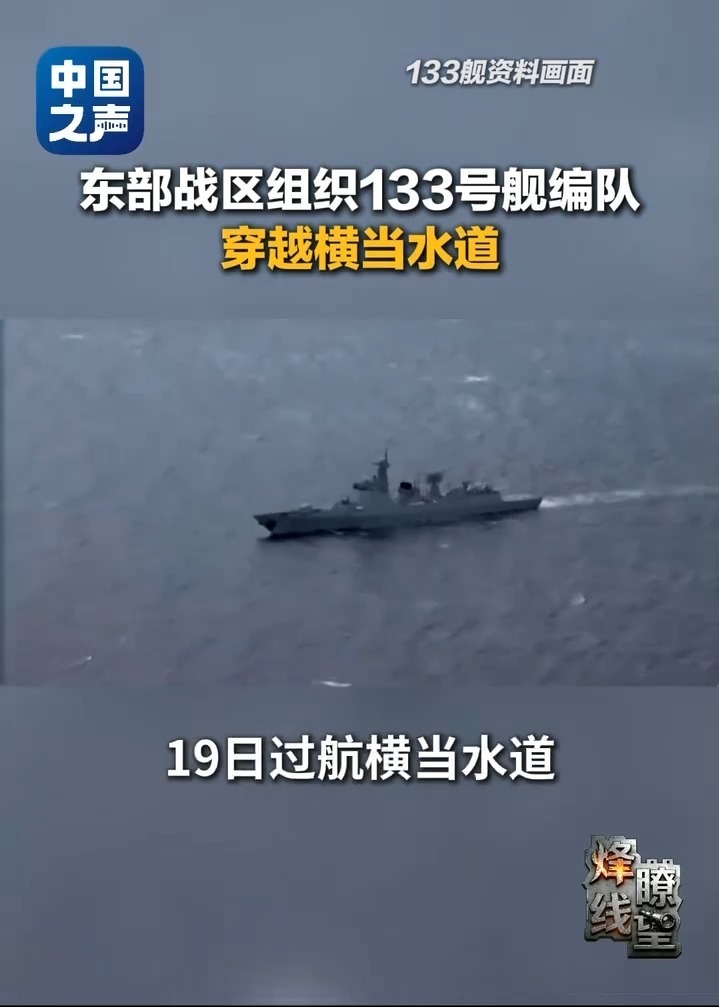
Song Xiaojun believes that the 133 fleet's transit through the public sea portion of the Hengdang Waterway is completely legitimate. In fact, our naval vessels have already become "familiar" with the Hengdang Waterway. A portion of the Hengdang Waterway falls within the public sea range, and the Chinese Navy is fully compliant with the United Nations Convention on the Law of the Sea, which is normal navigation. In recent years, the Chinese Navy's distant sea training has generally utilized this route when exiting the first island chain.
"Aircraft carrier's sword-bearing guard" Ship 133
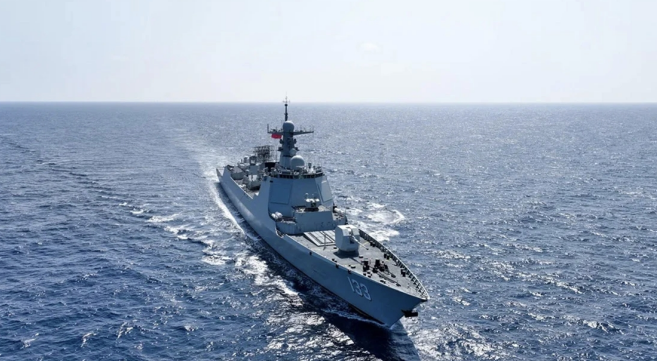
△ Ship 133 (data image)
The main vessel of the 133 fleet is Ship 133. The hull number 133, the "Baotou Ship," is a 052DL improved model guided missile destroyer. From the model name, it is evident that it is an improved version of the 052D type, with the letter "L" literally meaning extended, and the hull extension is mainly used to accommodate anti-submarine helicopters. Song Xiaojun introduced that the 052DL type guided missile destroyer, represented by the Baotou Ship, is not just an enhancement in this regard; it is actually a "sword-bearing guard for the aircraft carrier" armed with cutting-edge technology.
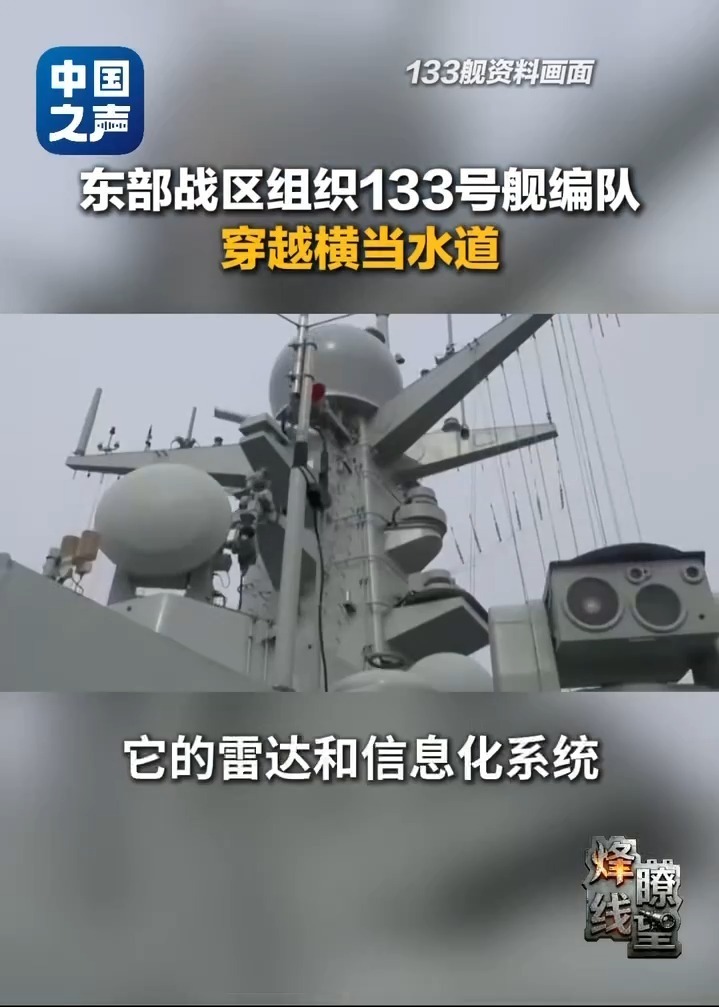
Song Xiaojun: Its radar and information systems have reached a higher level, and its X-band active phased array radar has virtually no blind spots, capable of providing area air defense for aircraft carriers or related vessels, conducting comprehensive searches for incoming threats such as drones, missiles, and aircraft. At the same time, the ship's 64 vertical launch systems can be used for both air defense and anti-missile operations. It can also be equipped with anti-submarine missiles, which are a major support for the combat capabilities of this fleet, tasked with executing distant sea escort missions.
Supervisor丨Wu Zhehua
Reporter丨Cui Tianqi
The 133 ship formation of the Eastern Theater Command conducted training exercises in the western Pacific, passing through Henggang Waterway on April 19. This exercise aims to enhance the operational capabilities of the Chinese military and is part of a routine training plan. The 052DL-class destroyer, a key asset in the formation, is equipped for various combat roles, including air defense and anti-submarine warfare.
- The 133 ship formation passed through Henggang Waterway on April 19.
- The exercise aims to test the long-range operational capabilities of the troops.
- Henggang Waterway is a key international shipping route in the Northwest Pacific.
- The 052DL-class destroyer is equipped for both air defense and anti-submarine operations.
- The exercise is routine and complies with international law.