
Why the Army can’t build its Pacific network like the one in Europe
Disruption by adversaries and the inherent unreliability of network infrastructure in the Pacific make building a reliable network infrastructure a major challenge for the US Army.
Overcoming that challenge can be the difference between being able to operate across all domains or face potential blind spots, affecting logistics, movement and combat operations, said Doug Jones, chief technology officer for defense at Leidos.
“I look at it through three lenses,” he said. “First, it’s a high-end fight with a mixture of exquisite weapons and mass. It’s not one or the other, which we’ve seen in some other domain scenarios. Second, it’s contested across all domains – space, cyber, air, sea, land. Those are areas that we are often historically dominant. It’s against an adversary force that’s been expressly created to counter how we project power.
“We project power typically through our carrier forces, through our air forces, through how we defend and launch land forces, and through cyber and information dominance. We have to be able to counter all those. From an Army perspective, we have to be able to secure all those critical nodes in the Pacific so that we can project that power across those domains.”
Maintaining the ability to deter adversaries and project power requires reliable infrastructure, strong partnerships with regional allies, and robust logistics capabilities. Although water dominates the Pacific, land operations remain critical.
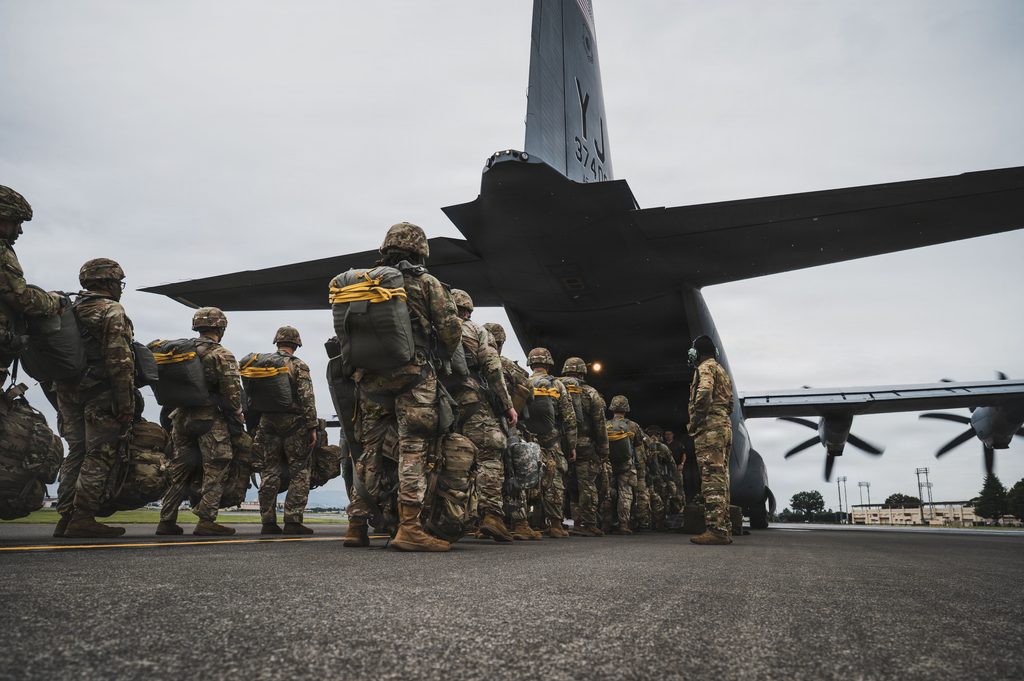 US Army paratroopers assigned to the 11th Airborne Division board a US Air Force C-130J Super Hercules, assigned to the 36th Airlift Squadron, for airdrop training in support of Orient Shield 2026, at Yokota Air Base, Japan, Sept. 15, 2026. (US Air Force photo by Senior Airman Cayla Hunt.)
Building the foundation
The Army needs a dependable network no matter where it is operating, but the characteristics of the Pacific make that a more complicated challenge than in other areas. Network infrastructure in the region is often inherently unreliable, especially in the island chains, and can easily be disrupted by weather. Those characteristics force a new way of thinking about building a reliable infrastructure, said Eric Moore, senior vice president and business area lead for Leidos digital military services solutions.
“In other theaters we can oftentimes design systems around some degree of relatively stable fiber, data center, commercial connectivity for multi-path solutions, but it’s based on some degree of fixed asset that exists in the theater that we can then leverage when bringing capabilities to the fight,” said Moore. “In this theater we have to think more about deployable and reconstitutable assets.”
Moore said that the focus needs to be on leveraging the land masses that do exist in the Pacific to be able to deploy services there when they are needed. By building a more diverse set of resources that can be mobile, the Army can take the network with it while operating in the Pacific, allowing for connectivity even in areas where there is not an existing infrastructure that can be counted on.
While there are solutions that can enable portable network capabilities, the Army also has to be prepared for the possibility that forces will be operating without connectivity or with limited connectivity for extended periods of time. Because there are fewer network paths available in the region compared to other theaters such as Europe, the Army will need to be able to work around connectivity challenges while maintaining information dominance.
“Connectivity cannot be a prerequisite for mission success. The Army must be prepared to operate, communicate and make critical decisions in environments where networks are degraded, disrupted or completely unavailable for extended periods,” said Moore. Maintaining information dominance means building resilience into every layer of the mission – ensuring Soldiers have access to the data, intelligence and capabilities they need to act decisively, even when disconnected.”
Not just water
The first thing that comes to mind about the Pacific is the vast expanses of water in the region. But as previously mentioned, land masses are key in the region, as well, as establishing footholds on islands makes it possible to support forces as they move throughout the region.
“You have to control and protect all the land assets in the theater,” said Jones. “That’s critical to the Army because they’re running the logistics. They’re doing integrated air missile defense and base defense. And then they may be doing long-range attacks, whether it’s Army assets or enabling air assets or supporting maritime assets and defending them as they’re transiting. This is not a new challenge from a logistics standpoint. During World War II, the US had to create bases as it hopped from island to island to enable the logistics needed for combat operations. But with forces now dependent on real-time information gathering and data analysis, it’s not just moving troops and materiel. It’s enabling connectivity wherever forces are, and ensuring that connectivity can stand up to jamming or disruption.
“We can’t just rely on single monolithic systems,” said Moore. “It’s not resiliency that can be bought through a single system. It comes from diversity of solution, diversity of transport, diversity of storage, diversity of underlying capabilities that enable the resiliency that supports defense against the threat.”
The Army is focusing on building a transport-agnostic underlying network, with the goal of implementing a network foundation in the Pacific comparable to the United States or Europe that can support logistics, communications and command-and-control needs in the Pacific theater. Leidos supports this effort through its work on the Army’s Global Unified Network (AGUN) modernization contract, which uses software-defined network technology to help build a standardized infrastructure for global communication efforts.
“That ultimately is the fabric that is designed to provide the secure, resilient, data-centric transport layer that is multipath, inherently resilient and allows us to extend the Army’s enterprise capability out into this reconstitutable and deployable edge that is ultimately going to be required in the Pacific theater,” said Moore.
The importance of partnerships
While the Army works with allies across the world in organizations like NATO partnerships in the Pacific are a different situation because there is no Pacific equivalent of NATO. Partnerships between allied countries are driven more by personal relationships and collaboration as opposed to a formal structure for an alliance.
Working together to collect and share information is a cornerstone of those partnerships, and doing so requires an information architecture that allows for sharing of data. It also requires managing data at different levels of classification data, enabling sharing information without giving away sources and methods or running the risk of classified data being shared over unclassified networks.
Jones offered the example of signal processing and identifying air tracks to determine if they are potential threats such as adversary planes or weapons such as missiles. While the US has extensive capabilities to identify and track potential targets, many of its techniques to do so are classified. But data can be aggregated from a number of sources and shared in a way that provides information to allies without giving away sensitive information about how the data was gathered and interpreted, Jones said.
“You have commercial radars operating on some of these islands. We may be fusing military grade radars with them, both class and unclass. How do you pull those different pictures together and share that back with the partner nations, so that they can defend aspects of their solution?”
Cooperation in the Pacific has been long-running in some cases – e.g., the US’s long relationship with South Korea – and newer with other countries. Building and maintaining relationships in the region enables not only better information sharing, but also helps from a logistical standpoint, allowing access to island chains and protecting supply lines.
“It is a critical piece of how we’re going to be successful in the theater and we talked about how important all those island land masses are to be successful. We have to create those relationships with all these different areas,” Jones said. “That’s something that the nation’s been doing at a political level, but also at an infrastructure level as we work across the region.”
Defense needs
While the communications infrastructure in the Pacific is important for logistics and offensive operations, it is also critical to defense in the region. Whether it’s air-and-missile-defense, defending against maritime threats or protecting supply lines, reliable communications are needed.
Conflicts in Ukraine and the Middle East have revealed some important lessons, but they don’t always apply to the Pacific given its characteristics.
“It’s a land battle,” said Jones. “These Class 1 UAS’s that are carrying a grenade aren’t going to operate well when you’re talking about islands that are minimum 50 to 75 miles apart, oftentimes hundreds to thousands of miles apart.”
One of the important lessons that does apply, however, is mobility. As has been repeatedly shown in both Ukraine and the Middle East, stationary targets such as TPY-2 radars can be damaged or destroyed by drone swarms and mass-missile attacks that overwhelm defenses.
Mobility means portable network capabilities, as well, which reinforces the need for a data infrastructure that can support forces on the move.
The U.S. Army is addressing significant challenges in establishing reliable network infrastructure in the Pacific due to adversary disruptions and environmental factors. Maintaining information dominance and effective logistics is critical for operations across all domains. Partnerships with regional allies are essential for enhancing information sharing and operational effectiveness.
- The U.S. Army faces challenges in building reliable network infrastructure in the Pacific due to adversary disruptions and environmental factors.
- Maintaining information dominance requires resilience in communication and logistics capabilities.
- Partnerships with regional allies are crucial for effective information sharing and operational success.