
Why the Army needs a clean sheet modern combat vehicle
The Army’s decision to walk away from another Bradley upgrade wasn’t about firepower. It was about a platform that had reached the limits of its own architecture after four decades of service, and a requirement that anything built to replace it needed enough margin, in power, weight, and computing, to serve for 30 years or more without the same problem recurring.
American Rheinmetall’s answer is the Lynx XM30, and the case for it rests on two questions: does the vehicle actually solve the problem the Army identified, and is the team behind it equipped to deliver on that solution? Jim Schirmer, senior vice president of programs at American Rheinmetall, spoke with Breaking Defense about both.
Breaking Defense: What are the key points that make the Lynx XM30 the best choice for the Army?
Schirmer: There are three areas that are important here in making this decision. Can you build it, can you grow it and can the crew fight in it?
 Jim Schirmer, senior vice president of programs, American Rheinmetall.
We can build it. We’re building it right now. We’ve already begun delivering vehicles to the Army this year, and we’re building them in the production facilities where we’re planning to do the full-rate production should we win the contract.
Can you grow it? We’ve designed it for growth. The Army’s got a variety of tests that they’re going to be conducting to validate that, in fact, we delivered all the additional margin that we planned on.
Can the crew fight in it? We’ve put an enormous amount of effort into what the Army’s calling fightability, making sure that that two-man crew has the right tools, the right graphical user interfaces, and the data is presented in a manner that’s understandable so they can be fully effective and fight with that system as intended.
We took a lot of input from soldiers and we hired a bunch of retired master gunners to make sure that we had a user’s voice every day of the week as the engineers were designing the system.
That three-part test, build it, grow it, fight in it, is the architecture behind everything else American Rheinmetall did on this program. The first half of that test starts with a problem the Army had already run out of ways to solve.
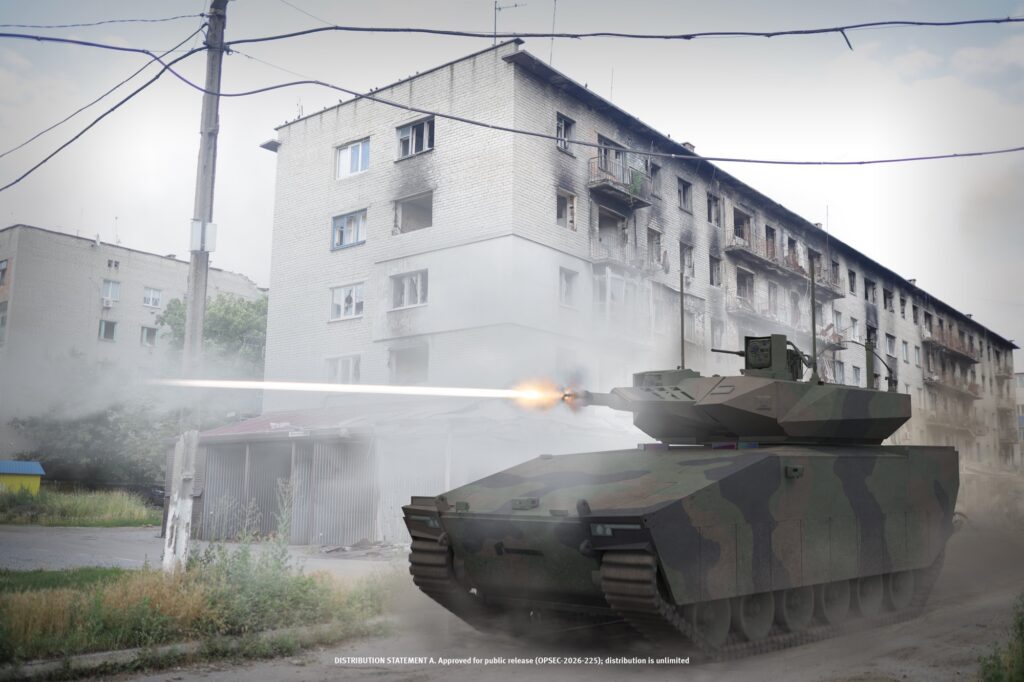 A photo illustration of American Rheinmetall’s Lynx XM30 in an urban combat zone. (Photo illustration courtesy of American Rheinmetall.)
Why does the Army need a clean sheet combat vehicle rather than upgrading the Bradley again? What are the operational limitations that the Bradley has reached that’s driving all of this?
The Bradley’s been a great infantry fighting vehicle for a bit over 40 years at this point, and we’ve upgraded a number of times. But it’s out of margin for future growth, and it’s not really about firepower. This is more about electrical power and weight-carrying capacity, and at some point you just can’t continue to upgrade it.
If you’ve seen the power pack that goes into the Bradley, it takes up almost every square inch of space in that engine compartment. They can’t make it much bigger. The Army made the right call by deciding to start over with a clean sheet where they can build in some growth margin for the future.
Ultimately you have to generate the power armored vehicles need. It’s harder for the engine to cool itself because it has to live in an armored box to survive the environment. Cooling takes up a fair amount of space and all those things work to constrain your ability to grow and draw more power out of that power pack to provide electricity for whatever the Army might need.
How has the Lynx XM30 been designed to provide the capabilities that are needed not only today, but in the future?
That’s the centerpiece of the whole modernization program for XM30, because the Army’s going to have this in its inventory for 30 years, maybe longer. The Bradley has been here for more than 40 years, almost 50. Same for the Abrams. We have to design for a fight that might happen in the 2040s, and it’s impossible to predict what the Army’s going to need 20 years from now. But what we can do is provide extra margin in a couple of key areas to allow the Army to adapt to changes on the battlefield.
That starts with building some margin for weight. How do you do that? The chassis, the structure, the suspension have to be designed to carry more weight than the vehicle’s actually going to weigh when it’s produced. The powertrain, the engine and transmission are capable of meeting the minimum mobility requirements at a higher weight than the vehicle will weigh when we deliver it to the government.
If the Army wants to add a two-ton system that we can’t visualize today, you can add that weight to the vehicle, still meet the required mobility and not have to redesign your structure, upgrade your suspension system and then electrical power. There’s a significant amount of additional electrical power that’s generated by the system that is not consumed by all the subsystems that we have on the vehicle today.
Equally important is not just generating that electricity, but the ability to distribute it. The power distribution units and the architecture for electricity are available to provide that power throughout the vehicle. If we have to add, say, a counter-missile laser of some kind in the future that draws a lot of power, it goes on the turret.
Then lastly, we have spare computational power and we have empty card slots in several of our major compute boxes. We’re leaving that space in there for future upgrades that we can’t foresee today.
A video showing some of the capabilities of American Rheinmetall’s Lynx XM30. (Video courtesy of American Rheinmetall.)
What was the sort of incremental improvement we saw on ground vehicles years ago during Middle East operations?
If you look back at the early days of the Iraq war, for example, where Abrams and Bradley went into that fight, they both had spare margin for power and for weight, in particular. And it’s a good thing they did because we had to be reactive. We added the RPG cages, we added the CREW (Counter Radio-Controlled Improvised Explosive Device Electronic Warfare) system, which is electrical power to try to jam remote controlled IEDs.
A whole host of kits were developed over the course of that war against a threat that hadn’t been thought about in the 70s when they were designing the vehicle. Those efforts also consumed a lot of that spare power and weight margin. The thought is all right, we need to start over with a clean sheet and that’s going to give us running room for hopefully 30-plus years of adapting and evolving to the emerging environment.
How are you incorporating open architecture throughout the entire process?
One of the things the Army did differently here is they dictated a vehicle architecture standard, an open system standard. They called it GCIA (Ground Combat Systems’ Common Infrastructure Architecture). That allowed them to control the interfaces because they dictated how they wanted any of these interfaces to be laid out and how data had to be structured. By doing that, they maintain some control.
In the future, a qualified third party could come in and integrate a new subsystem onto the vehicle without necessarily coming through us, and that gives the Army a lot more optionality and will make it quicker for them to make modernization choices down the road.
If they implement an imaginary counter-missile laser 20 years from now, the company that produces that laser could find these interface standards because they’re open, they’re published and they could design to that, or they could come up with a wrapper that allows them to talk to that interface and make it work without the Army having to pay American Rheinmetall to do the integration work.
Margin and open architecture solve the Army’s capability problem on paper. Turning that into a vehicle a two-person crew can actually build, maintain, and fight in required a different kind of expertise, and it’s where American Rheinmetall’s team did its most distinctive work.
The American Rheinmetall Lynx XM30 traces its design heritage back to Rheinmetall’s Lynx. What remains from that platform and what is distinctly American Rheinmetall?
We inherited a design philosophy that had to do with modularity and how we space things around the vehicle. The Army had a very unique set of requirements, and we had a team of American engineers here in the US that designed the vehicle, inspired by the architecture that we inherited.
There is not much left of that original design other than the architectural philosophy. We have a very different set of requirements for how many soldiers it’s got to carry, the two-man crew, the weapon system is different, the protection requirements are different. It’s an American vehicle designed in the US specifically for the US Army.
What did your master gunner veterans identify to change during the design process? How did you incorporate their feedback?
A lot of that was actually how we lay information out on the screens. As they’re moving through a mission, how it was easiest for them to see the information displayed so it was quicker to understand how they wanted the controls to be laid out.
It’s things that you use a lot. You want them to be very easy to reach, things that you only use occasionally, they can be a little further away.
We ended up substantially reworking the software that laid out how those controls were put together and how the information was displayed on the screen. Luckily that was software, and software is never easy, but changing it on the front end of the program was a lot cheaper than doing that later.
The hatches are larger and we had them practice getting in and out of the vehicle with all their gear on, so we made some modifications to how the ramp was laid out to make that easier and safer.
We also learned quite a bit from the maintainers who were looking at how they would get to a piece of equipment if they had to do this maintenance task. How would they reload the missile? We had dummy missiles that were weighted, so they could try to put them in and out and had to make some adjustments there.
How are you supporting the two-person crew requirement that the Army implemented?
To begin with, we placed the two-man crew side by side, you could say inspired by aircraft design. Imagine a lot of pilot/copilot arrangements where they’re sitting side by side and this is going to make coordination easier between the two because they can talk to each other more easily than they can point.
There’s a common screen between the two of them. We’ve provided the same functionality at both crew stations, so you can fire the main weapon from the left or the right. You can drive the vehicle from the left or the right. They have complete redundancy in their controls, and so we’re going to let the Army decide how they want to distribute tasks between the two positions.
The Army’s priorities shaped every detail of the Lynx XM30—margin built into the chassis, soldier‑driven crew stations, and Army‑controlled interfaces. Discover how the right capability, built by the right team and ready right now, is redefining what’s possible.
Explore more about the Lynx XM30 and the team delivering it at wwww.teamlynx-xm30.com
American Rheinmetall is developing the Lynx XM30 combat vehicle to replace the outdated Bradley infantry fighting vehicle, which has reached its operational limits. The Lynx XM30 is designed for future growth and adaptability, incorporating feedback from military personnel to enhance its usability. Production has already begun, with vehicles being delivered to the U.S. Army.
- The Army has decided to replace the Bradley infantry fighting vehicle due to its limitations after 40 years of service.
- American Rheinmetall is currently producing the Lynx XM30 and has begun delivering vehicles to the Army.
- The Lynx XM30 is designed with growth margins for future upgrades and operational needs.
- The vehicle incorporates feedback from soldiers and retired master gunners to enhance usability and fightability.
- The design includes an open architecture standard to facilitate future subsystem integration.