

Summary and Key Points: Today, the Air Force treats stealth as a baseline for everything from the B-21 Raider to its next-generation fighters, but in the 1970s, the idea was radical. The F-117A Nighthawk made it real. Built to slip through Soviet air defenses that were rendering traditional bombers obsolete, it traded speed, agility, and payload for a shape radar could barely detect. Pilots called it the Wobblin’ Goblin for its unstable handling, and they flew it almost exclusively at night, often under strict radio silence.
F-117A Nighthawk: How America’s First Stealth Bomber Came to Be
When the U.S. Air Force today considers stealth as a baseline requirement for future aircraft – from the B-21 Raider to next-generation fighters – it’s easy to forget how radical the concept once was.
That assumption that stealth should form the basis of any new aircraft can be traced back to the F-117A Nighthawk, a now-legendary aircraft conceived in secrecy during the Cold War and built to solve a problem the United States feared it was rapidly losing grip of: penetrating the increasingly lethal Soviet air defenses without enduring unacceptably high losses.
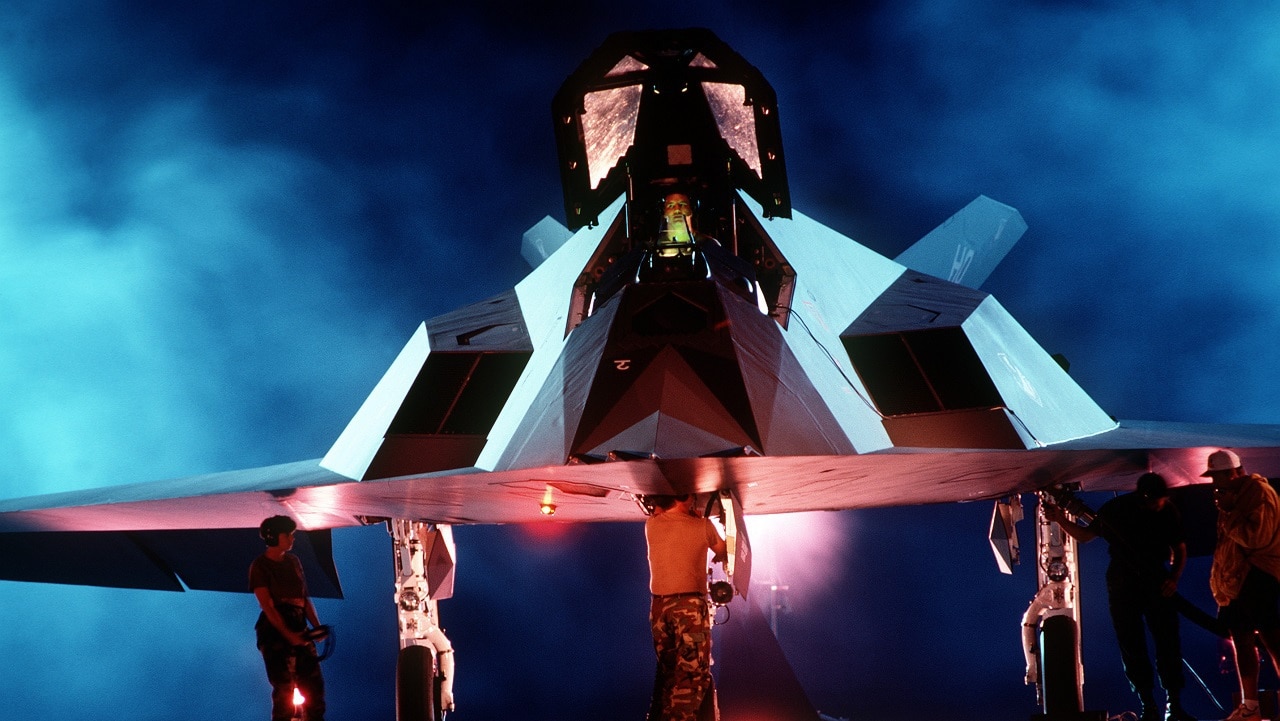
A back lit front view of a F-117A Stealth Fighter aircraft. From Airman Magazine’s February 1995 issue article “Streamlining Acquisition 101”.
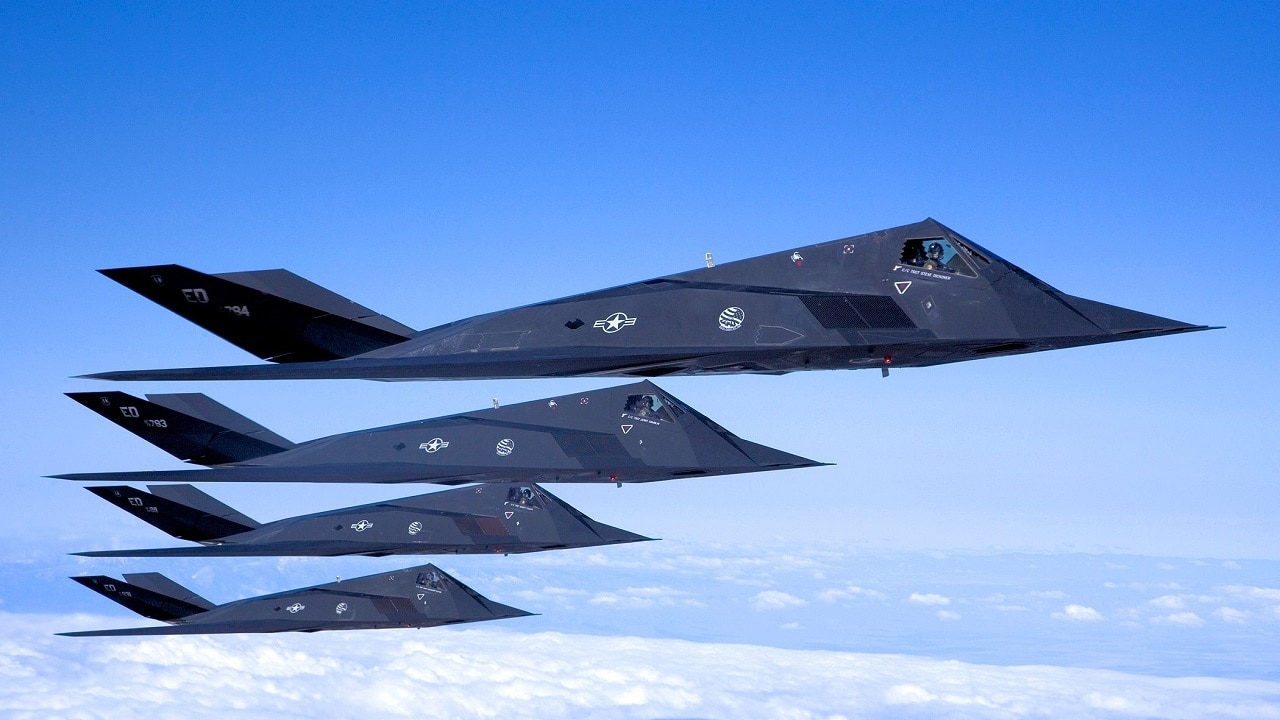
Four F-117 Nighthawks fly in formation during a sortie over the Antelope Valley recently. After 25 years of history, the aircraft is set to retire soon. As the Air Force’s first stealth fighter, the F-117 is capable of performing reconnaissance missions and bombing critical targets, all without the enemy’s knowledge. (Photo by Bobbi Zapka)
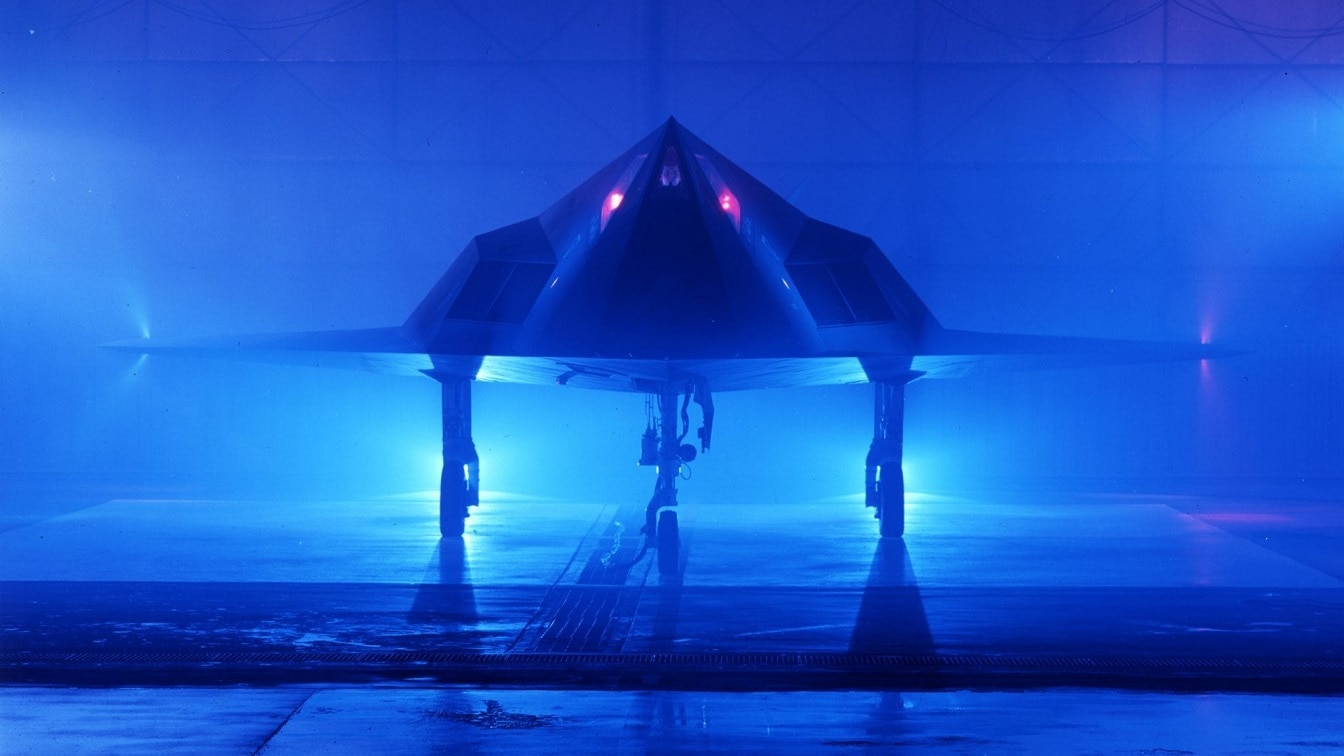
F-117. Image Credit: Lockheed Martin.
The F-117’s origins were rooted in a sense of urgency, defined by many compromises, and ultimately proved pivotal to American aircraft design going forward.
The aircraft defied almost every aerodynamic convention at the time in pursuit of survivability, and it did so incredibly well — despite many of its well-known quirks.
The program’s history offers a revealing window into how the United States approached strategic risk at the time, when a superpower adversary had reached the height of its power and posed the greatest risk the U.S. had ever faced.
The Beginning
By the early 1970s, U.S. planners were increasingly alarmed by the evolution of Soviet integrated air defense systems that incorporated early-warning radars, surface-to-air missiles, and interceptor aircraft into layered networks designed to neutralize penetrating bombers long before they could reach their targets.
Losses suffered by U.S. aircraft over North Vietnam to Soviet-supplied air defenses proved to planners that speed, altitude, and electronic jamming alone were no longer sufficient to guarantee access to heavily defended airspace.
The U.S. needed something more, and analysts within the Department of Defense began exploring whether reducing an aircraft’s radar cross section could fundamentally alter battlefield dynamics and prevent detection in the first place. And it turned out they could.
The theoretical basis for the development of the new platform drew, in part, on radar research published openly in the Soviet Union in the 1960s, which described how radar waves reflected off flat surfaces at predictable angles.
U.S. engineers recognized that shaping an aircraft to scatter radar energy away from receivers could dramatically reduce detectability.
Still, the mathematics involved exceeded what most computers of the era could model accurately and efficiently.
Engineers at Lockheed’s Skunk Works division used simplified equations and brute-force computation to approximate the effects, accepting that the resulting aircraft shape would be aerodynamically inefficient but potentially revolutionary in terms of survivability.
And that’s exactly what happened: when the aircraft eventually flew, it was known by pilots as the “Wobblin’ Goblin” because of its notorious unstable handling.
The work culminated in the Have Blue demonstrator program, which flew in 1977 and validated the core premise behind the project that shaping alone – without the reliance on any kind of exotic or expensive material – could significantly reduce radar returns.
Although both Have Blue prototypes were eventually lost in crashes, flight test data confirmed that careful attention to aircraft shape could enable it to approach defended airspace with a radar signature comparable to that of a small bird.
That success persuaded the Air Force to proceed with the development of a full-scale operational aircraft, even though its wildly unconventional design would sacrifice maneuverability, speed, and payload.
It could at least enter defended airspace without being shot down.
The resulting aircraft was later designated the F-117A, and it bore little resemblance to anything in service at the time.
The only reason the aircraft isn’t shockingly modern to modern eyes is that the subsequent B-2 Spirit looks similar, as do several copycat designs from around the world.
Secrecy At Its Core
Secrecy was central to the program’s survival and success — not just in the aircraft’s ability to secretly penetrate defended airspace, but also in the unannounced development and testing that largely took place at Groom Lake (Area 51) in Nevada.
Operational aircraft were later based at the remote Tonopah Test Range to limit observation. Pilots flew almost exclusively at night, often under strict radio silence, and the Air Force publicly denied the aircraft’s existence even as dozens entered service.
The concealment wasn’t just about protecting the technology, but also preventing adversaries from adapting their air defenses before the aircraft could be fielded (and used) in meaningful numbers.
The F-117 achieved initial operating capability in 1983, years before it was officially acknowledged by the U.S. government — something that simply wouldn’t fly (pun not intended) today.
When the aircraft was finally revealed in 1988, its appearance shocked observers and showed just how little the rest of the world knew about the direction of American aerospace development.
In proving that stealth could go beyond theory, the F-117 permanently rewrote how the United States designs, fields, and thinks about modern combat aircraft.
About the Author:
Jack Buckby is a British author, counter-extremism researcher, and journalist based in New York who writes frequently for National Security Journal. Reporting on the U.K., Europe, and the U.S., he analyzes and understands left- and right-wing radicalization and reports on Western governments’ approaches to today’s pressing issues. His books and research papers explore these themes and propose pragmatic solutions to our increasingly polarized society. His latest book is The Truth Teller: RFK Jr. and the Case for a Post-Partisan Presidency.