
Y-20B Tanker Confirmation Hides the PLAAF's Real Refueling Bottleneck
 Marcus Chen
Y-20B Tanker Confirmation Hides the PLAAF's Real Refueling Bottleneck
On August 5, state broadcaster CCTV confirmed what Western aviation watchers had tracked for four years: the Y-20B heavy transport can be converted into an aerial refueling tanker with palletized fuel tanks and removable refueling pods. Beijing does not usually volunteer capability details in a documentary. When it does, it is a message, and this one is about range.
The confirmation matched open-source intelligence almost exactly. As SCMP reported on August 13, citing aviation analyst Andreas Rupprecht, the third Y-20B prototype was photographed with refueling pods as early as January 2022. By April 2023, the first production-standard Y-20B in military grey appeared at Kaifeng airbase carrying the characteristic refueling alignment markings. What was new on August 5 was not the hardware. It was the official acknowledgment.
What Beijing Actually Confirmed
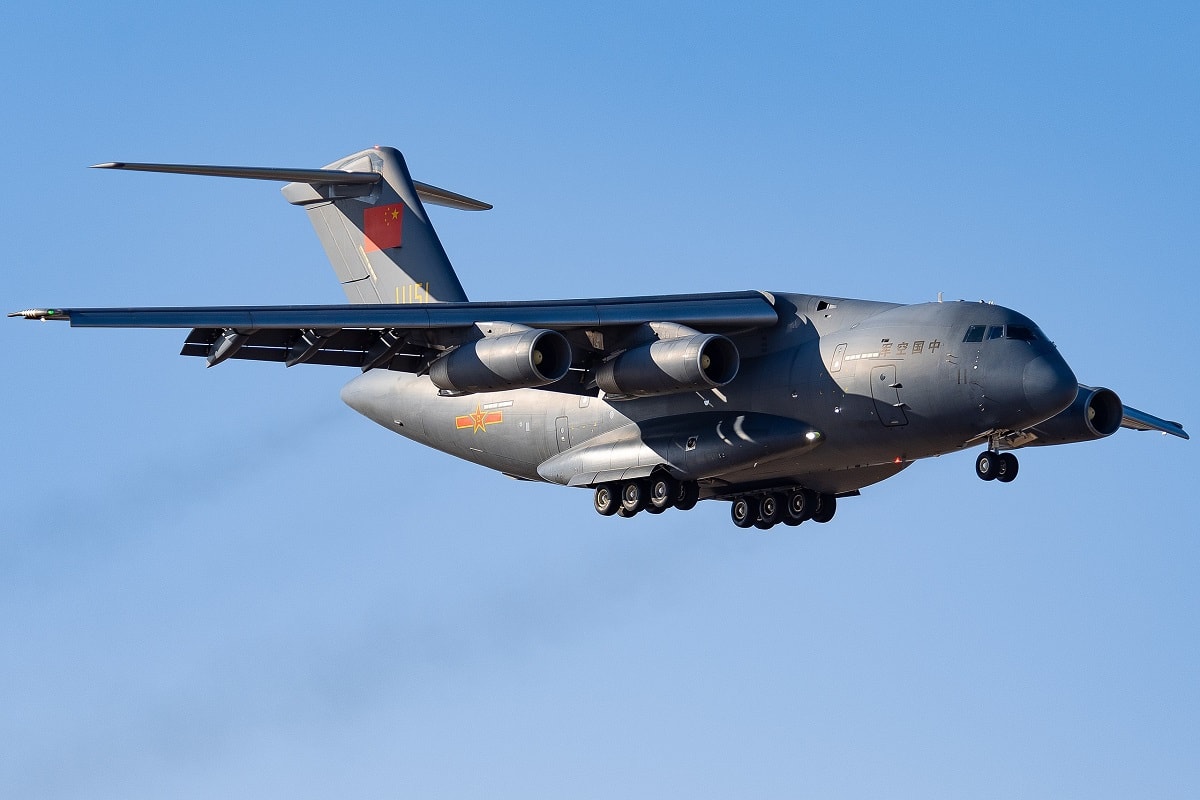
The CCTV documentary went further than the tanker mission. Pang Rongqi, a PLAAF pilot, said on camera that "the boundaries between transport aircraft and bombers, early warning aircraft, or even electronic warfare aircraft are becoming increasingly blurred." Song Zhongping, a Chinese military commentator, translated that into a cleaner operational claim: with refueling pods the Y-20B is a tanker, with jamming pods an electronic warfare platform, with bombing modules a strike aircraft, with radar modules an airborne early warning aircraft.
"With refueling pods, it becomes a tanker; with electronic jamming pods, it becomes an electronic warfare platform." — Song Zhongping, to Global Times, August 6
Janes covered the disclosure on August 10 as a formal MRTT (multi-role tanker transport) capability, and Zona Militar called the Y-20B a modular multi-role platform for the PLAAF. The framing matters. Since the Y-20 entered service on July 6, 2016, it has grown into a family — Y-20A, Y-20B, and the dedicated YU-20 tanker — with operations across more than 40 countries on four continents, according to manufacturer AVIC. The August documentary simply declared that the family's newest member refuses to pick one job.
It Is Already Flying the Taiwan Mission
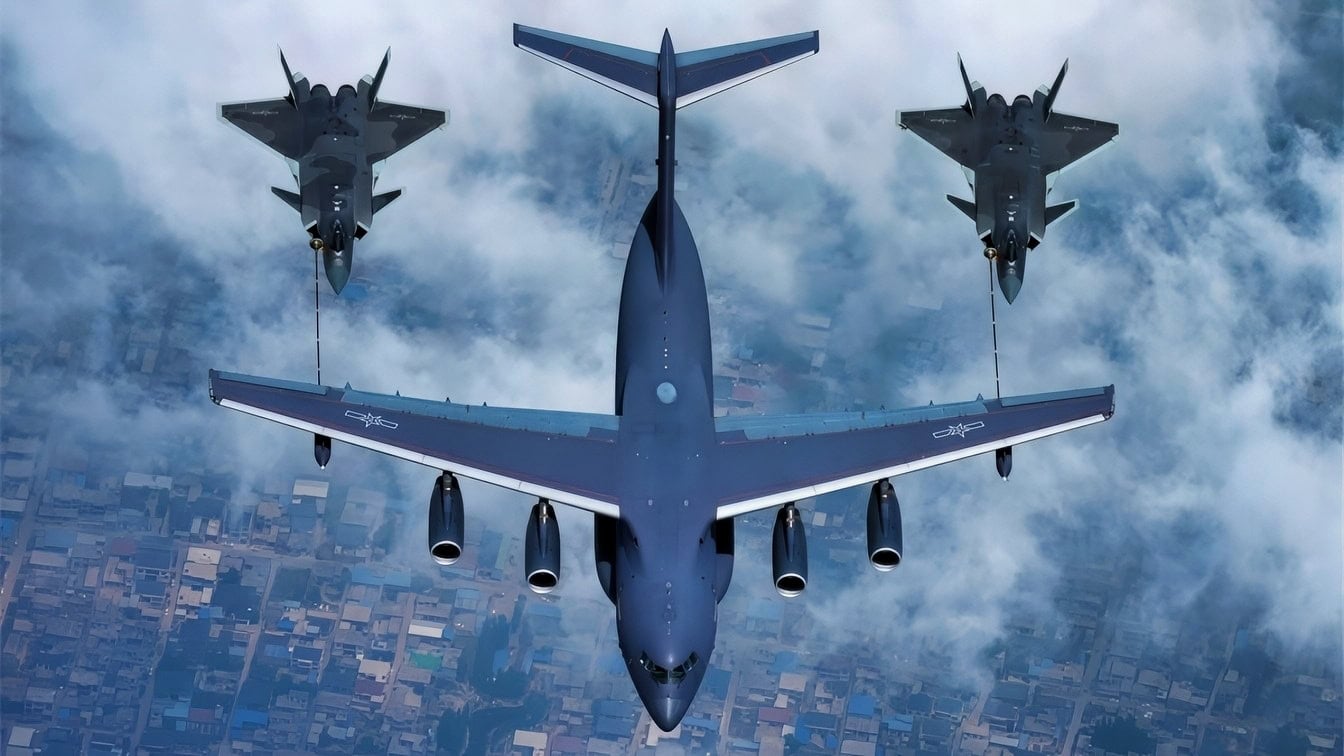
None of this is theoretical. On May 25-27, 2026, Taiwan Air Force F-16s intercepted a YY-20 aerial refueler operating east of the island while it topped off J-16 fighters — the first publicly documented tanker mission in the Taiwan Strait theater. On June 28, an official PLA promo video released rare footage of H-6N bombers taking fuel, confirming the tanker network is expanding from fighters to the bomber force. The tanker is not a future capability. It is the current rotation.
The Math Still Does Not Work
Here is where the confirmation gets less useful. A palletized conversion trades cargo capacity for fuel, and a converted airlifter still lacks what the US Air Force built its entire system around: a flying boom. The Y-20B refuels through underwing hose-and-drogue pods — fine for J-16s and J-20s, which is what the documentary shows — but a boom is what pumps fuel fast enough to support large aircraft on long missions. The KC-135 and KC-46 fleets exist because the US decided decades ago that tanking is a dedicated mission, not a side job for transports.
Run the range math. A J-16 has a combat radius of roughly 1,500 kilometers without refueling. Guam sits about 3,000 kilometers from the Chinese coast. To bridge that gap, a tanker has to loiter inside contested airspace — a slow, high-flying Y-20 with no defensive systems, escorted by the very fighters it is fueling. Anyone who has watched a carrier strike group plan a rendezvous knows the tanker is the most vulnerable asset in the chain. The US Air Force, with more than 400 tankers, still describes Pacific refueling as its tightest constraint.
And the institutional gap is bigger than the hardware gap. A "quick-change" airframe is a physical claim; a tanker force is a schedule, a training pipeline, and a maintenance cycle. Converting a transport squadron into a tanker squadron overnight is not a pod swap — it is years of crew certification and mission planning that no documentary can compress.
What to Watch
Three things. First, YU-20 production numbers: the dedicated tanker, not the converted transport, is the real fleet indicator. Second, whether conversion kits start showing up in routine squadron photography rather than staged documentary footage. Third, whether PLAAF training data — sortie counts, offload totals — ever becomes public. If Beijing wants the second island chain calculus to change, that is the evidence it will have to show.
The Bottom Line
Beijing wrote this documentary for Washington, Tokyo, and Taipei. But a transport with hoses is still a transport with hoses. The airframe shortage was real, and the Y-20B confirmation is a genuine step toward fixing it — yet the bottleneck was never just airframes. It is sortie generation, crew hours, and surviving long enough to offload. Treat the confirmation as intent. Ask for the squadrons.
CCTV confirmed the Y-20B's capability as an aerial refueling tanker on August 5, 2023, highlighting its operational use in the Taiwan Strait. The PLAAF has utilized the Y-20B to refuel J-16 fighters, marking a significant development in its aerial refueling capabilities. This confirmation indicates an ongoing enhancement of the PLAAF's operational flexibility and reach.
- CCTV confirmed the Y-20B can be converted into an aerial refueling tanker.
- The Y-20B has been operational in the Taiwan Strait, refueling J-16 fighters.
- The Y-20B's refueling capability was officially acknowledged on August 5, 2023.