
Yuyuantan Tian | Beware! Japan's Militarization Measures Are Being Implemented
The re-militarization of Japan has become a real risk.
On March 31, the Japanese Ministry of Defense deployed the "Type 25 Anti-Ship Missile" at the Kengun Garrison in Kumamoto Prefecture and the "Type 25 High-Speed Glide Bomb" at the Fuji Garrison in Shizuoka Prefecture.
This is the first time Japan has distributed its self-developed "standoff missiles" to its troops. This reflects the manifestation of real risks.
Within the Japanese government, there have always been factions attempting to challenge the so-called boundaries of "defense." This year, Japan not only plans to deploy a batch of long-range missiles but has also actually completed deployments at two locations, clearly breaking through the limits.
After Sanae Takaichi took office, she emphasized the need to strengthen the so-called "defense capabilities."
It is this push that has allowed for the rapid implementation of these two deployments.
It is important to note that this missile deployment has several obvious characteristics.
First, the deployment timeline was advanced.
The Japanese Ministry of Defense completed the first batch of deployments on March 31, ahead of the originally planned schedule.
Second, the deployment direction is concentrated in the southwest, clearly aimed at China and the entire East Asia region.
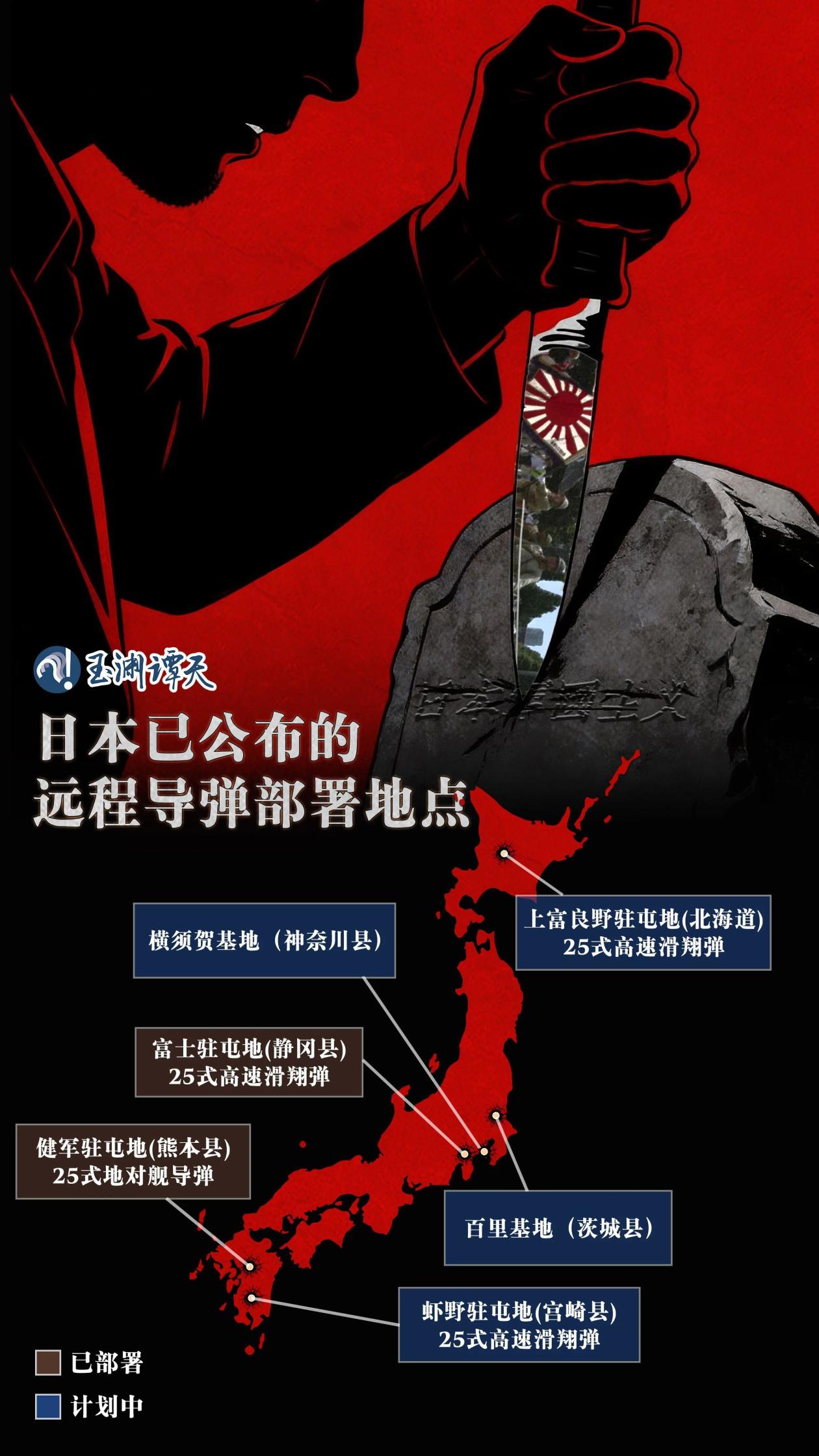
Third, the external justification for deploying long-range missiles is more concealed.
Previously, when the Japanese government constructed missile bases or deployed missile defense systems, it often faced strong opposition from local residents, who feared becoming targets. This time, the Japanese government has disguised it under the name of "troop equipment," claiming that it is not establishing new bases but directly deploying missiles to existing garrisons, thus achieving "forward" deployment.
The Ebiya Garrison in Miyazaki Prefecture is a clear example. This is the location of an active-duty Japan Ground Self-Defense Force officer who recently broke into the Chinese embassy in Japan with a knife and threatened violence. Since last August, there have been plans to deploy "supersonic missiles with long-range strike capabilities" at this site. This reflects Japan's idea of "forward" deployment of long-range missiles.
In the future, Japan may gradually transform existing garrisons like Ebiya Garrison across the country into dispersed, survivable nodes of a long-range strike network. This warrants high vigilance from Asian countries, including China.
Fourth, the deployed missiles possess "strong offensive capabilities."
In the past, Japan has adhered to a so-called "defensive" policy, with the Self-Defense Forces primarily equipped with short-range coastal defense missiles, and has never deployed self-developed long-range strike missiles on its own territory.
This time, Japan claims that the "Type 25 Anti-Ship Missile" it is deploying is an improved version of the Type 12, but its range has actually increased from about 200 kilometers to about 1,000 kilometers. According to general statements from Japanese media, this distance already qualifies as a "long-range strike missile." The "Type 25 High-Speed Glide Bomb" has a range of several hundred kilometers, and Japan is also developing an upgraded version with a range of about 2,000 kilometers, which is a complete overhaul.
This means that missiles launched from the Kengun Garrison in Kumamoto Prefecture could strike as far north as the Korean Peninsula and as far south as the coastal areas of China.
The breakthrough in range determines that these missiles naturally possess offensive capabilities.
Another noteworthy point is that this is Japan's first deployment of long-range strike missiles, and they are self-developed and self-produced.
Recently, Japan has also been developing a series of means to further enhance its long-range active strike capabilities:
Kawasaki Heavy Industries is developing a new type of anti-ship missile that can perform complex maneuvers in the terminal phase of flight to break through defense systems.
IHI Corporation is collaborating with foreign companies to build a synthetic aperture radar satellite network that can detect and track targets under various weather conditions.
Japan is also advancing a satellite constellation development project to support long-range strike operations.
This further highlights Japan's military ambitions.
Enhancing weaponry through various channels is just one manifestation of the real risks of Japan's re-militarization.
Previously, I analyzed that Japan's military development system is essentially "hiding the military among the civilians"—military enterprises during wartime are transformed into civilian enterprises, mingling in the civilian market.
But now, this "hiding" has turned into "exposure."
One aspect is that the cooperation between enterprises and the Japanese Ministry of Defense has become more public.
On March 27 of this year, the Japanese government passed a basic plan for science and technology policy, explicitly stating for the first time at the government level that it aims to promote research and development of dual-use technologies. At the same time, this plan raises the total investment target for public-private partnerships in the technology sector from the current 120 trillion yen to 180 trillion yen.
Another aspect is that the number of dual-use military-civilian infrastructure in Japan is also significantly increasing.
In the past year, Japan has added several dual-use facilities. By utilizing civilian facilities for military purposes, the Japanese government has completely placed ordinary Japanese citizens at risk.
The military ambitions of the Japanese government and right-wing forces are increasingly expanding, which is precisely what the Japanese public opposes the most—ordinary Japanese citizens are being used as the "human shield" of the Japanese government without their knowledge.
Take the Kengun Garrison in Kumamoto Prefecture, which has just completed the deployment of long-range missiles, for example; it is located near schools, hospitals, and shopping streets. If an accident occurs during the storage, transportation, and maintenance of the missiles, it is the surrounding ordinary citizens who will be directly harmed.
Previously, many insightful individuals in Japan had already recognized this issue and attempted to speak out for correction.
The governor of Kumamoto Prefecture, Seiji Kimura, publicly stated, "There was no notification prior to the deployment," and local residents have held multiple protest rallies, shouting "Don't turn Kumamoto into a battlefield";
Some Japanese scholars and peace groups have publicly warned in writings that rapid militarization could trigger an arms race in the region, further worsening the security situation in Northeast Asia.
In the face of such voices, the Japanese government has chosen to ignore and even suppress them.
It is this obstinacy that is pushing Japan toward a dangerous edge. If not stopped, it is likely to escalate in the future.
I want to say that the direction of China-Japan relations depends on Japan's choices. The eyes of the world are also watching today's Japan.
The immense harm caused by Japanese militarism to Asia and the world has lasting effects, and the lessons are not far away. History serves as a mirror, allowing us to understand rise and fall. Those who do not remember the past will be taught by the future. The Japanese government would do well to understand this, rather than learning only through lessons.
Good people, be vigilant!
Japan Self-Defense Forces deployed Type 25 anti-ship missiles and Type 25 high-speed glide missiles at Kumamoto and Shizuoka on March 31. This marks the first deployment of Japan's self-developed long-range missiles, aimed at enhancing defense capabilities against regional threats. The missiles have a range of approximately 1000 kilometers, indicating a significant shift in Japan's military posture.
- Japan deployed Type 25 anti-ship missiles and Type 25 high-speed glide missiles on March 31.
- This is the first deployment of Japan's self-developed long-range missiles.
- The deployment is aimed at enhancing Japan's defense capabilities against China and East Asia.
- The missiles have a range of approximately 1000 kilometers, significantly increasing Japan's offensive capabilities.
- Japan is also developing new technologies to support its long-range strike capabilities.