
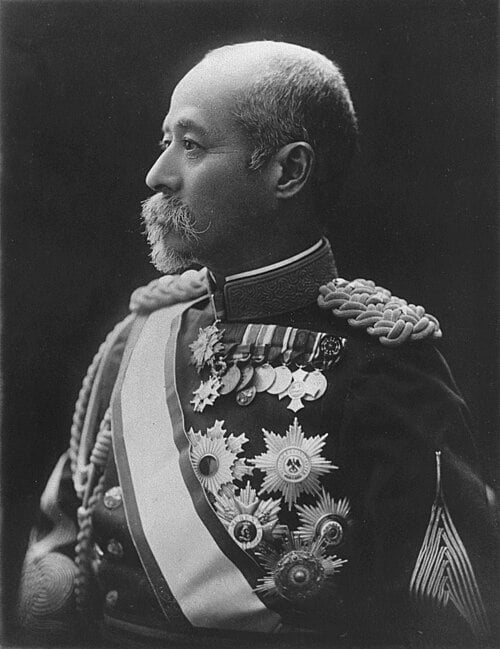
Kodama Gentarō
Kodama Gentaro was a Meiji-era figure whose importance lies in staff work, institutional modernization, and imperial administration rather than only in dramatic battlefield legend. He served as a general, statesman, and colonial governor, and during the Russo-Japanese War he played a central role in coordinating Japanese operations in Manchuria. His career illustrates that military effectiveness depends not only on heroic field command but also on planning, bureaucracy, logistics, and the integration of war with empire. He was a strategist-administrator who made expansion sustainable.
- Nationality
- JPN
- Born:
- March 16, 1852
- Died:
- July 23, 1906
- Conflicts
- Russo-Japanese War
- Tags
- Needs Review
Kodama rose as part of the generation that reorganized Japan's army for modern war and overseas expansion.
Kodama Gentaro's career unfolded during the crucial decades when Japan sought to build a modern army capable of defeating major powers and sustaining empire. His importance lies not only in rank but in the institutional work of reform, training, and strategic organization that made later battlefield success possible.
States rarely become effective war actors through charisma alone. They need administrators who can translate national ambition into doctrine, staff competence, and organizational discipline. Kodama belonged to that class of builders.
Kodama Gentaro's career draws attention to the officers whose names may be less famous internationally than frontline commanders but whose contribution to military effectiveness was profound.
His governorship in Taiwan shows how Japanese military elites combined colonial administration with broader strategic expansion.
Kodama's service in Taiwan demonstrates the close connection between military leadership and colonial governance in imperial Japan. Colonial administration was not a side assignment detached from strategy; it was part of the larger project of securing territory, extracting value, and proving that Japan could rule as a major power.
In practical terms, this meant that officers like Kodama had to think beyond combat. Administration, policing, infrastructure, and bureaucratic consolidation all formed part of imperial statecraft. Those functions shaped how power was exercised after conquest.
Kodama's career reveals how strategic influence can rest on administrative competence as much as battlefield visibility.
Kodama's war role highlights the importance of planning and coordination in Japan's campaign against Russia.
During the Russo-Japanese War, Kodama served in a senior staff capacity that made him central to the coordination of Japanese operations in Manchuria. This is strategically significant because major wars are not won by famous assaults alone; they depend on the quality of staff work that aligns armies, logistics, intelligence, and timing.
Kodama's reputation therefore points to a broader lesson in military history. Effective command systems often hinge on figures who are not the public face of victory but who make operational coherence possible behind the scenes.
Kodama's career illustrates that modern warfare rewards institutional competence and that staff leadership can shape the outcome of campaigns at least as much as battlefield spectacle.
Kodama's crossover between cabinet office and military command illustrates how tightly fused politics and strategy were in Meiji Japan.
Kodama was not confined to a purely military lane. His government service shows how military expertise, cabinet politics, and national planning intersected in Meiji Japan. This made him part of the broader elite machinery through which modernization and expansion were directed.
That crossover matters because war readiness is often political long before it is operational. Leaders who can move between ministries and military institutions help align resources, policy, and doctrine in ways that purely field-based commanders cannot.
Kodama therefore deserves attention as a strategic organizer. His page works best when it highlights not just what he did in wartime but how he linked institutions that made imperial Japan's military project durable.
Open sources strongly support Kodama's institutional importance, even if popular memory tends to favor more visible combat figures.
Open sources consistently show Kodama Gentaro's importance in army modernization, colonial governance, and staff leadership during a defining imperial war. His influence was primarily organizational and administrative, which often receives less attention in popular memory than more dramatic combat narratives.
His value lay in systems: he was one of the men who made Japanese war power administratively and institutionally effective, even when others received more immediate public acclaim.
Understanding Kodama's role underscores that serious military history depends on planners, governors, and coordinators as much as on battlefield icons.
No analysis & reports about Kodama Gentarō
No discussions about Kodama Gentarō yet
Start the first discussion