
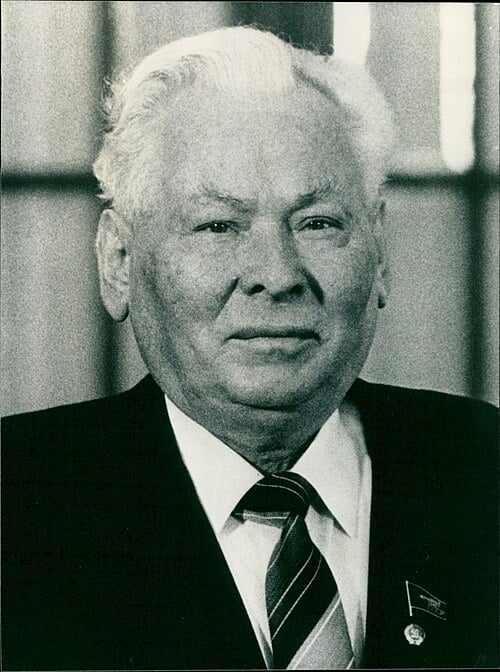
Konstantin Chernenko
Konstantin Chernenko's brief rule captured the final, stagnant phase of late Soviet leadership before Mikhail Gorbachev. He was not a battlefield commander, but he sat at the center of a nuclear superpower whose military reach, alliance commitments, and security bureaucracy remained enormous even as political vitality declined. Leadership weakness can still shape a conflict system when the state itself is heavily armed and globally engaged. Chernenko's tenure represents a case of strategic inertia: a moment when the Soviet Union still possessed formidable military power, yet its leadership was increasingly unable to renew institutions, rethink the Cold War, or respond creatively to structural decline. That combination of strength and exhaustion is historically important.
- Nationality
- RUS
- Born:
- September 11, 1911
- Died:
- March 10, 1985
- Conflicts
- Soviet-Afghan War
- Tags
- Needs Review
Chernenko rose through party bureaucracy rather than through military command or public reform politics.
Konstantin Chernenko's rise reflected the internal logic of the late Soviet party state. He was a bureaucratic insider who gained influence through long service within the Communist Party apparatus rather than through public charisma, war hero status, or policy innovation. The Soviet leadership of this period increasingly rewarded continuity, loyalty, and internal manageability over strategic imagination.
In conflict analysis, this type of leader matters because heavily militarized states can still be politically brittle when their governing class becomes insular. A vast security structure may remain intact, but the leadership overseeing it can lose adaptability.
Chernenko's background helps explain why the Soviet Union entered its final decade with great coercive power but diminishing political elasticity.
His short tenure preserved the Soviet security posture but offered little sign of meaningful rethinking in East-West confrontation.
Chernenko governed during a period when the Cold War remained intense, nuclear competition remained central, and Soviet obligations across Europe and the wider communist bloc were still substantial. Yet his leadership suggested continuity rather than renewal. The system maintained its posture, but there was little sense that it could meaningfully rethink its long-term direction.
That matters because strategic danger does not always come from aggressive innovation. Sometimes it comes from a powerful state drifting under leaders unable to change course even when circumstances demand it.
Chernenko embodied a security superpower running on inherited momentum. The machine remained formidable, but the political center directing it had become visibly tired.
His rule exposed how narrow Soviet succession had become in the years between Brezhnev and Gorbachev.
Chernenko's accession followed the broader pattern of gerontocratic succession that defined the late Brezhnev and post-Brezhnev period. Leadership choices were shaped by factional comfort and institutional habit more than by clear strategic renewal. This made the Soviet state look stable at the top level even while deeper structural problems accumulated.
For conflict historians, succession mechanics are not a side issue. The way a regime chooses leaders affects how quickly it can respond to military overstretch, alliance strain, and economic decline.
Chernenko's case illustrates how elite continuity can become a strategic liability: a state may retain weapons, allies, and doctrine, yet still drift because its leadership process selects preservation over adaptation.
Chernenko's significance lies less in major new decisions than in what his leadership revealed about Soviet exhaustion before reform.
Chernenko's short tenure revealed how little strategic energy remained in the Soviet high command before Gorbachev. The regime still projected power, but its political leadership struggled to present a believable path forward. That mismatch between capability and vitality is a recurring feature of declining great powers.
Chernenko marks the last moment before reform became unavoidable.
The strongest reading is that his leadership was an indicator event in human form. It showed that the Soviet Union's problem was no longer simply rivalry with the West, but its own diminishing ability to govern a global confrontation effectively.
Open sources clearly support Chernenko's symbolic importance as a leader of Soviet stagnation, even if his practical achievements were limited by time and condition.
The broad outline is clear: Chernenko was a late Soviet leader whose short rule represented continuity, exhaustion, and the closing phase of pre-Gorbachev politics. The main interpretive challenge is that his importance is more diagnostic than transformative. He matters less because he changed the Cold War and more because he revealed the condition of the system still fighting it.
Thus, his significance is diagnostic: understanding his rule helps explain how powerful states become strategically inflexible.
Chernenko is best characterized as a leader of stagnation within a still-dangerous superpower. This framing captures both his limitations and his historical significance.
No analysis & reports about Konstantin Chernenko
No discussions about Konstantin Chernenko yet
Start the first discussion