
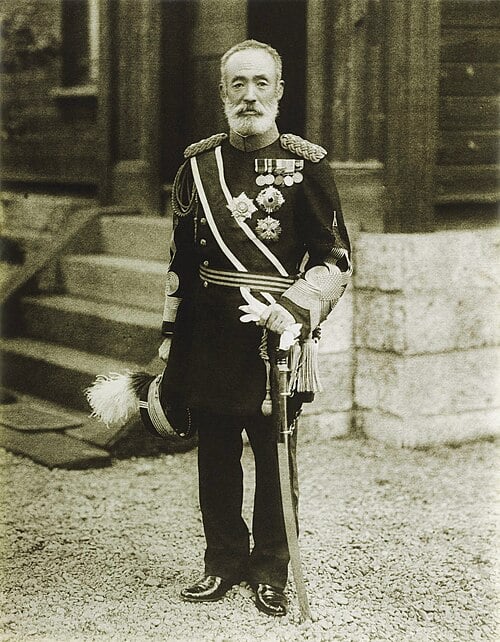
Nogi Maresuke
Nogi Maresuke was a senior general of the Meiji era, associated with the siege of Port Arthur in the Russo-Japanese War, with service also in Taiwan, and held a place in the moral culture of a rising imperial army. He links Japan's internal military modernization to its outward imperial expansion. His career demonstrates how battlefield reputation, imperial administration, and national myth can reinforce one another. Nogi helps explain how modernizing states use military heroes to validate sacrifice, empire, and loyalty even when campaigns are costly and command performance remains open to debate.
- Nationality
- JPN
- Born:
- December 25, 1849
- Died:
- September 13, 1912
- Conflicts
- Russo-Japanese War
- Tags
- Needs Review
Nogi's career grew alongside the creation of a modern army that fused imported methods with imperial ambition.
Nogi Maresuke belonged to the generation of officers who helped turn Meiji Japan into a modern military state. His career developed during the period when Japan was reorganizing force structure, doctrine, and command culture in order to compete with the established powers. Nogi's later prominence was inseparable from the state-building project around him.
Command biographies often reveal institutional transformation as much as personal achievement. Nogi's rise reflected a system determined to make military professionalism and imperial expansion mutually reinforcing.
He is a representative figure in the creation of Japan's modern officer corps and in the militarized nationalism that accompanied it.
Nogi's fame rests on Port Arthur, where success brought prestige but also controversy because of severe Japanese losses.
Nogi is most closely associated with the siege of Port Arthur during the Russo-Japanese War. The operation ended in a major Japanese victory and became one of the defining episodes of the war, but it also imposed heavy casualties.
Military reputations are often built in campaigns where tactical success coexists with operational or human cost that later generations judge more critically. Nogi became a hero of national perseverance, yet his command legacy cannot be separated from the brutal price of the assault.
Nogi's historical value lies in showing how modern states convert costly battles into narratives of honor, inevitability, and national maturity.
His service in Taiwan underscores that Japanese military leaders were also instruments of colonial rule and state expansion.
Nogi's career included governing responsibilities in Taiwan, which shows that military command and colonial administration were closely linked in imperial Japan. Officers were not only expected to fight external wars; they were also expected to consolidate control over territories brought under Japanese rule.
This mattered because empires often relied on the same elite cadre for combat, occupation, and bureaucratic supervision. The result was a political-military class trained to think of territorial control as an integrated mission rather than a sequence of separate tasks.
Nogi's importance is not confined to one famous siege. He also helps explain how military prestige fed into the practical governance of empire.
Nogi's later symbolic status rested as much on moral theater and imperial loyalty as on battlefield command.
Nogi's later reputation in Japan was shaped by ideals of loyalty and sacrifice that extended beyond formal military assessment. His death by ritual suicide after the Meiji emperor's death turned him into a powerful symbol of samurai-inflected fidelity within a modern imperial state.
That symbolism is important for conflict studies because military memory affects future political culture. When states elevate commanders as moral exemplars, they encourage later generations to read war through duty and sacrifice rather than through institutional criticism alone.
Nogi thus occupies a place where biography becomes national narrative. His page is useful because it shows how personal conduct can be enlisted into broader arguments about obedience, martial virtue, and the legitimacy of imperial power.
Nogi's military importance is well-established, while his exact command reputation remains best understood as a mixture of success, cost, and later mythmaking.
The basic outline of Nogi's significance is not in doubt: he was a major Meiji general, central to Port Arthur, linked to colonial administration, and transformed into a national symbol. What is harder to settle neatly is how far his battlefield reputation should be read as outstanding command skill versus a culturally magnified legacy built on victory and sacrifice.
A balanced framing presents Nogi as a commander whose importance lies in the coexistence of operational success, severe losses, imperial service, and potent symbolic afterlife.
Thus, Nogi's legacy offers insight into how rising powers remember war and how costly campaigns are absorbed into national identity.
No analysis & reports about Nogi Maresuke
No discussions about Nogi Maresuke yet
Start the first discussionUnknown author - restored by User:Adam Cuerden · Public domain