
War in Donbass
The War in Donbass began in 2014 as armed conflict spread across eastern Ukraine after Ukraine's Euromaidan revolution, Russia's annexation of Crimea, and the collapse of the country's old political order. Pro-Russian separatists, backed by Russian military support, declared independence in the Donetsk and Luhansk regions, and Ukrainian forces engaged separatist militias and Russian volunteers in what became a hybrid and then increasingly conventional war. Key battles included the siege of Mariupol, Debaltseve, and Donetsk airport, and the fighting involved heavy artillery, tanks, and aircraft, causing significant civilian casualties.
Repeated ceasefire efforts, including the Minsk I and II protocols, temporarily reduced hostilities but failed to end the conflict; over 14,000 people died and millions were displaced. The war became the enduring military core of the pre-2022 Russo-Ukrainian confrontation and a key case of deniable intervention evolving into sustained interstate war by proxy and direct support, before escalating into Russia's full-scale invasion of Ukraine in February 2022.
ATTACKER
 Vladimir Putin
 Sergei Shoigu
 Denis Pushilin
 A. Zakharchenko
 Alexander Borodai
 Igor Girkin
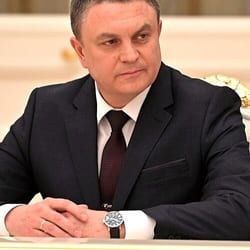 Leonid Pasechnik
 Igor Plotnitsky
 Petro Poroshenko
 Volodymyr Zelenskyy
The Donbass war emerged from the broader 2014 Ukrainian crisis but quickly became its most durable military theater.
After the annexation of Crimea, eastern Ukraine became the place where the crisis hardened into sustained armed conflict. Local unrest, organized separatist formations, Russian backing, and Ukrainian counter-mobilization turned Donetsk and Luhansk into the main front of the unfinished 2014 war.
This matters because Donbass was where ambiguity started to give way to a durable military line. It became the theater that kept the wider Russia-Ukraine conflict alive year after year.
The war moved from irregular and deniable forms of fighting into attritional front-line warfare with increasingly conventional features.
Donbass began with irregular seizures, local armed groups, and unclear chains of command, but over time it developed into trench systems, artillery exchanges, fortified positions, and more recognizable front-line warfare. The result was a conflict that blended deniable intervention with unmistakably military realities.
The conflict became one of the clearest modern examples of hybrid conflict evolving into prolonged attritional warfare.
The conflict's actor map combined formal state forces with separatist structures that depended heavily on Russian material and political support.
The War in Donbass cannot be accurately described as a purely internal Ukrainian conflict. Ukrainian state forces faced separatist entities whose battlefield endurance, logistics, and political viability were deeply linked to Russian support.
Donbass became the proving ground for a conflict model that blurred domestic revolt, proxy war, and interstate coercion.
The war imposed long-term harm through shelling, displacement, legal uncertainty, and years of life under militarized division.
Even when the front appeared static, Donbass remained deeply harmful to civilians. Shelling, displacement, fractured administration, and the normalization of armed boundaries turned the region into a long-duration conflict zone rather than a solved ceasefire space.
So-called frozen conflicts often represent active political-military systems whose violence becomes routinized.
The Donbass war should be treated as the pre-2022 battlefield core of the wider Russia-Ukraine war.
Donbass is often summarized either as separatist conflict or as a prelude to 2022. Both are too narrow. It was a real war in its own right and also the military foundation of the later full-scale invasion.
This dual perspective preserves both the local battlefield reality and the wider strategic continuity.
No analysis & reports about War in Donbass
No discussions about War in Donbass yet
Start the first discussion