J-15 Flying Shark

🇨🇳China
Shenyang
2013 – Present
Spotlight

China's first carrier fighter: a Su-33-derived Flanker that taught the PLAN to fly at sea

Exclusive footage: Chinese J-15 fighter jets take off from the aircraft carrier Liaoning (CGTN)

Watch on YouTube
Overview
J-15 Flying Shark
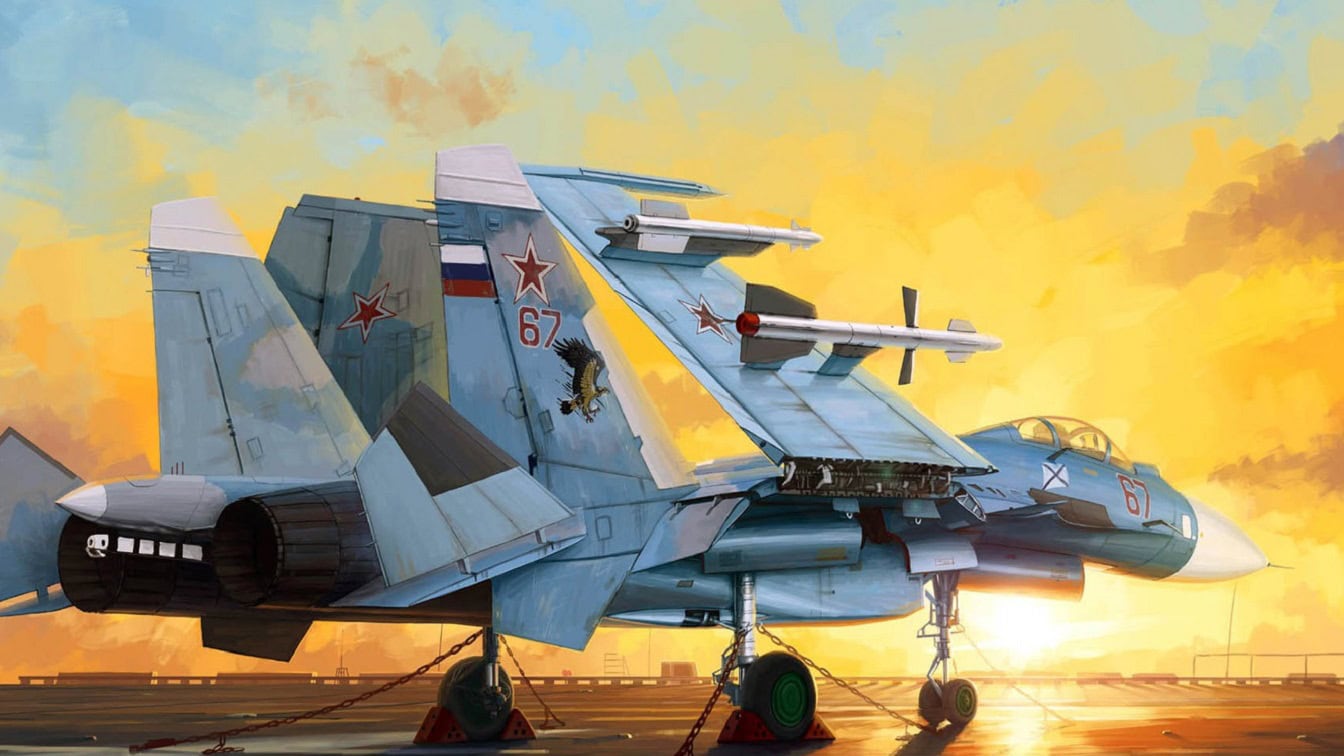
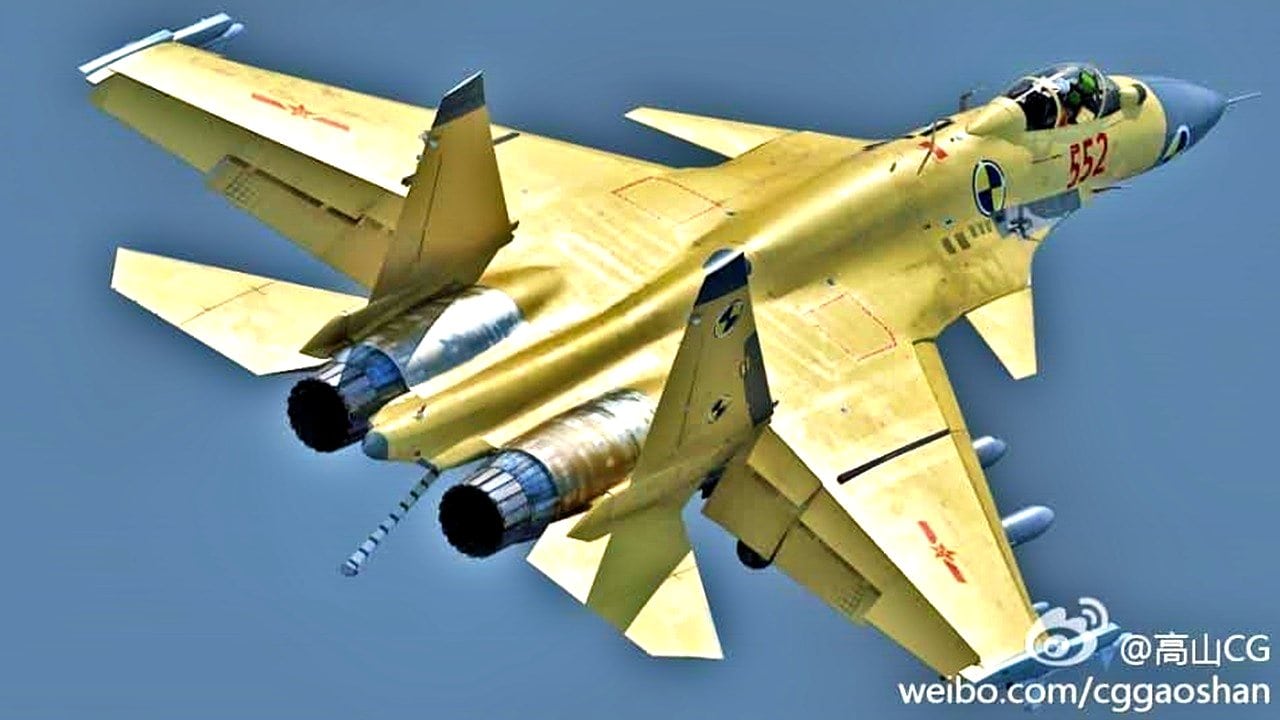
The Shenyang J-15, also known as "Flying Shark" and NATO-codenamed "Flanker-K," is a carrier-based multirole fighter developed for the People's Liberation Army Navy, initiated in 2006 after reverse-engineering a Su-33 prototype. Officially entering service in 2013, the J-15 features a reinforced airframe, advanced avionics, and the capability for air-to-air refueling, with a design optimized for carrier operations and a focus on enhanced performance through the use of composite materials.
Specifications

General

Crew1
RadarChinese multi-mode fire-control radar; AESA set on the J-15T (reported)
Max Speed Mach1.86 Mach
Combat Radius Km~1,200 (est., ski-jump launch on internal fuel)
Service Ceiling M18,000 m

Other

Height M~5.9 (est.)
Length M~21.9 (est.)
Powerplant2 x Saturn AL-31F on early aircraft; 2 x Shenyang WS-10 series turbofans on later production (reported)
Wingspan M14.7 (est.); ~7.4 with wings folded
Empty Weight Kg~17,500 (est.)
Max Takeoff Weight Kg~32,500-33,000 (est.)
Latest Developments
Jul 20, 2026strong signal
China’s Best Aircraft Carrier-Based Fighter Exists Only Because of One Unfinished Jet That Russia Left Behind in Ukraine

Without the J-15 “Flying Shark,” China’s carrier program would have struggled to mature into the force it is today.

Feb 12, 2026strong signal
Why the J-15 “Flying Shark” Fighter Makes China’s Aircraft Carriers A Problem for the U.S. Navy

The J-15 “Flying Shark,” China’s first operational carrier-based fighter, serves as a critical bridge toward maritime aviation competence.

Featured Coverage
Research Notes

China's first operational carrier fighter

The J-15 Flying Shark is a carrier-based fighter developed for China's aircraft carrier air wings.

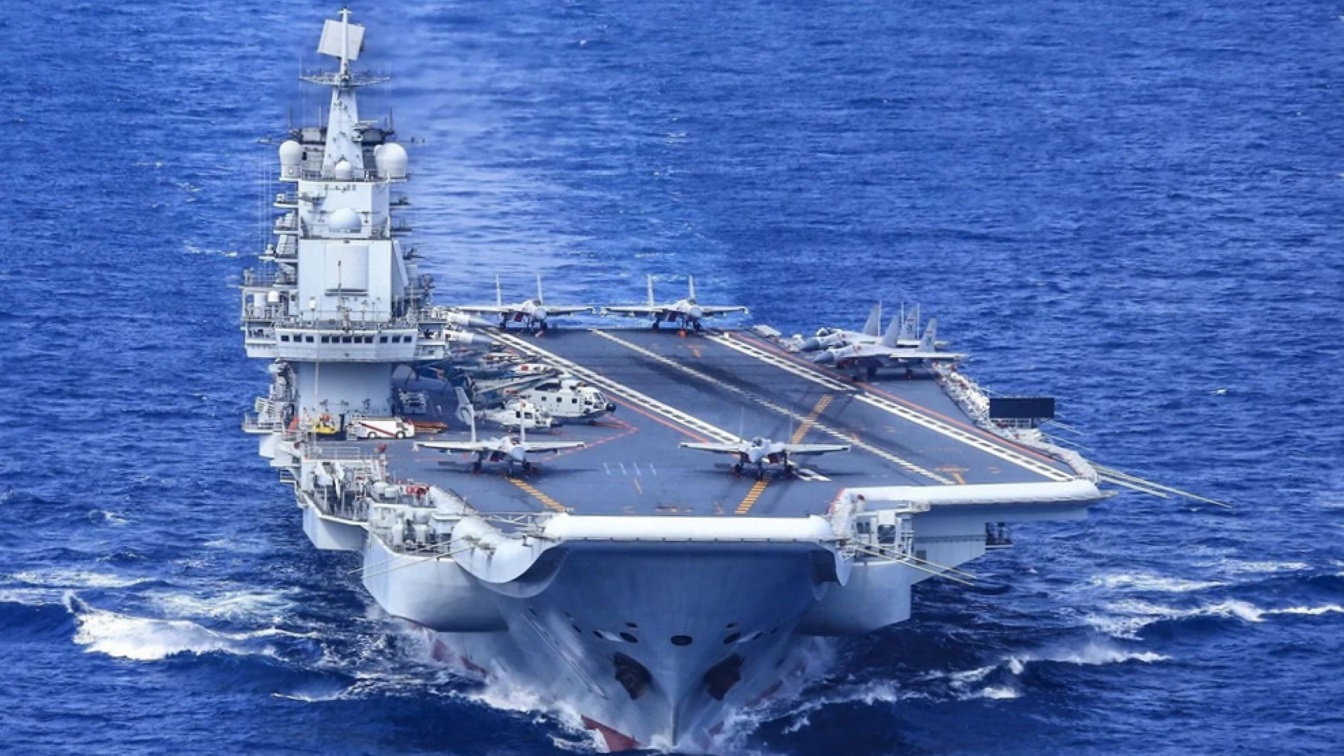
The Shenyang J-15 Flying Shark is China's carrier-based fighter developed for the People's Liberation Army Navy's aircraft carriers. It draws from the Flanker/Su-33 lineage and gives China a fixed-wing naval aviation capability from carriers such as Liaoning and Shandong. Its importance is tied directly to China's move from coastal naval aviation toward carrier operations.

Heavy carrier fighter for fleet air defence and strike

The J-15 provides carrier air defence, maritime strike, and training experience, but faces launch-weight limits on ski-jump carriers.

The J-15's large airframe gives it range and payload potential, but early Chinese ski-jump carriers impose limitations compared with catapult-equipped decks. The aircraft nevertheless provides essential experience in carrier takeoff, arrested recovery, deck handling, and maritime fighter tactics. That makes it both a combat aircraft and a training bridge for China's naval aviation system.

Bridge to a mature carrier air wing

J-15 service lets China build carrier procedures before newer catapult-capable and stealth aircraft mature.

Operationally, the J-15 should be understood as a first-generation operational carrier fighter for China. It enables real carrier air-wing development while later aircraft such as J-35 and catapult-capable J-15 variants emerge. That developmental role is central to why the aircraft matters strategically.

Key parameters at a glance

medium

Programme-level figures for the J-15 family. China has never published official performance data for the type, so dimensions, weights and fleet counts below are open-source estimates and should be treated as indicative rather than authoritative.

Role
Carrier-based heavy multirole fighter for PLA Naval Aviation
Prime contractor
Shenyang Aircraft Corporation with the 601 Institute; NATO reporting name Flanker-D/-X
Design lineage
Shenyang J-11B airframe combined with naval features studied on the ex-Ukrainian Su-33 prototype T-10K-3: canards, folding wings, tailhook, reinforced landing gear
First flight
31 August 2009prototype, Shenyang
First carrier recovery
November 2012arrested landing and ski-jump launch on Liaoning
Service entry
2013PLA Naval Aviation
Launch method
STOBAR ski-jump from Liaoning and Shandong; the J-15T adds catapult launch for Fujian
Powerplant transition
Russian AL-31F on early airframes, Chinese WS-10 series confirmed on operational aircraft from 2022
Variant family
Baseline J-15, two-seat J-15S, electronic-attack J-15D/DT, catapult-capable J-15T
Reported fleet
~100+ airframes across all variants(est., open-source counts)

Program milestones

medium

Publicly reported milestones from the acquisition of the Su-33 prototype to the arrival of catapult-capable derivatives aboard Fujian.

2001T-10K-3 prototype acquired from Ukraine

China obtained T-10K-3, an incomplete Su-27K/Su-33 development airframe left in Ukraine after the Soviet break-up. Chinese engineers studied its folding wing, canard, tailhook and reinforced structure, which shaped the naval conversion of the Flanker line.

2006Flying Shark programme launched

Shenyang formally started the carrier fighter effort under the Flying Shark codename after negotiations to buy production Su-33s from Russia did not conclude. The approach was to navalise the domestic J-11B rather than build the Su-33 under licence.

2009-08First flight

The first J-15 prototype flew on 31 August 2009 with Russian AL-31F engines. Early flight test concentrated on approach handling, low-speed control and the arrested-landing loads that distinguish a carrier airframe from its land-based parent.

2012-11First carrier landing and ski-jump takeoff

State media announced in late November 2012 that a J-15 flown by test pilot Dai Mingmeng had completed an arrested landing and a ski-jump launch aboard Liaoning, giving the PLA Navy its first fixed-wing carrier capability. Flight test was not without incident; CCTV has since aired footage of a recovery stopped only metres from the deck edge.

2013Entry into PLA Naval Aviation service

Serial aircraft began reaching naval aviation units, initially concentrated on the Liaoning air wing and shore training bases. Commissioning of the domestically built Shandong in December 2019 added a second ski-jump deck and roughly doubled the number of embarked J-15 billets.

2022-11Domestic WS-10 engines confirmed on operational aircraft

Chinese state television footage showed in-service J-15s with WS-10 series turbofans, making the naval Flanker the last of the family to shed the Russian AL-31F. Carrier use had been a hard case for the engine because of spool-up response on wave-off and corrosion protection at sea.

2024-11J-15T and J-15D unveiled at Airshow China

The catapult-capable J-15T, previously reported as J-15B, and the two-seat J-15D electronic-attack variant made their public debut at Zhuhai. The J-15T adds a strengthened nose gear with a launch bar, an AESA radar and compatibility with PL-10 and PL-15 missiles; it is covered in detail on its own page.

2025-11Fujian commissioned with catapult-launched Flankers

China commissioned its first CATOBAR carrier, Fujian, on 5 November 2025 at Yulin, Hainan. Its declared air wing pairs the J-15T and J-15DT with the J-35 and the KJ-600, moving the baseline ski-jump J-15 toward a second-line and training role.

Strategic significance

medium

The J-15's most important contribution was institutional rather than technical. When the programme began, the PLA Navy had no fixed-wing carrier aviation of any kind: no deck-qualified pilots, no landing signal officers, no arrested-recovery maintenance practice and no shore-based training pipeline. Building a heavy naval fighter around an existing Flanker airframe was the fastest route to generating that experience, and the 2012 landing aboard Liaoning marked the point at which China began accumulating it. Judged as a machine rather than as a capability-building exercise, the baseline aircraft carries real limits: ski-jump launch from Liaoning and Shandong forces a trade between fuel and ordnance that a catapult removes, and a fighter of roughly 33 tonnes maximum weight pays for that trade more than a lighter type would.

The programme also became a test case for Chinese propulsion independence. The J-15 was the last Flanker derivative still flying on Russian AL-31F engines, largely because carrier recovery is unforgiving of slow throttle response and salt-air corrosion. Confirmation in 2022 that operational aircraft were flying with WS-10 series turbofans removed a supply dependency that would have constrained wartime attrition replacement, and it cleared the way for the catapult-capable J-15T. Reports of airframe fatigue and a shorter-than-expected service life on early batches circulate widely in Chinese and Western commentary, but they rest on inference rather than published data and should be treated cautiously.

With Fujian commissioned in November 2025, the family is splitting into distinct roles. The J-15T and J-15DT are the catapult-era aircraft, paired with the J-35 and the KJ-600; the original ski-jump J-15 is likely to concentrate on the two STOBAR decks and on training the pilot pool that a three-carrier force requires. That leaves the type in a position closer to the F/A-18C in late US Navy service than to a front-line peer of the newest carrier fighters, valuable less for what a single airframe can do than for the trained crews and deck procedures it produced.

Videos

China Reveals Detailed Videos of J-15 Fighter Jets Training on Aircraft Carrier (CCTV Video News Agency)

Watch on YouTube

Rare cockpit-view footage of a J-15 recovering aboard the carrier (CCTV.com)

Watch on Bilibili

CCTV discloses a J-15 flight-test incident: stopped less than five metres from the deck edge (CCTV Military)

Watch on Bilibili
Variants (4)
Service YearName
2022 –J-15S
2024 –J-15B
2024 –J-15D
2024 –J-15T
Sources & References
Related Discussions

No discussions about J-15 Flying Shark yet

Start the first discussion