Gerald R. Ford

🇺🇸United States
Newport News Shipbuilding
2017 – Present
Spotlight

A 10-hull program to retire the Nimitz fleet, still fighting its own build schedule

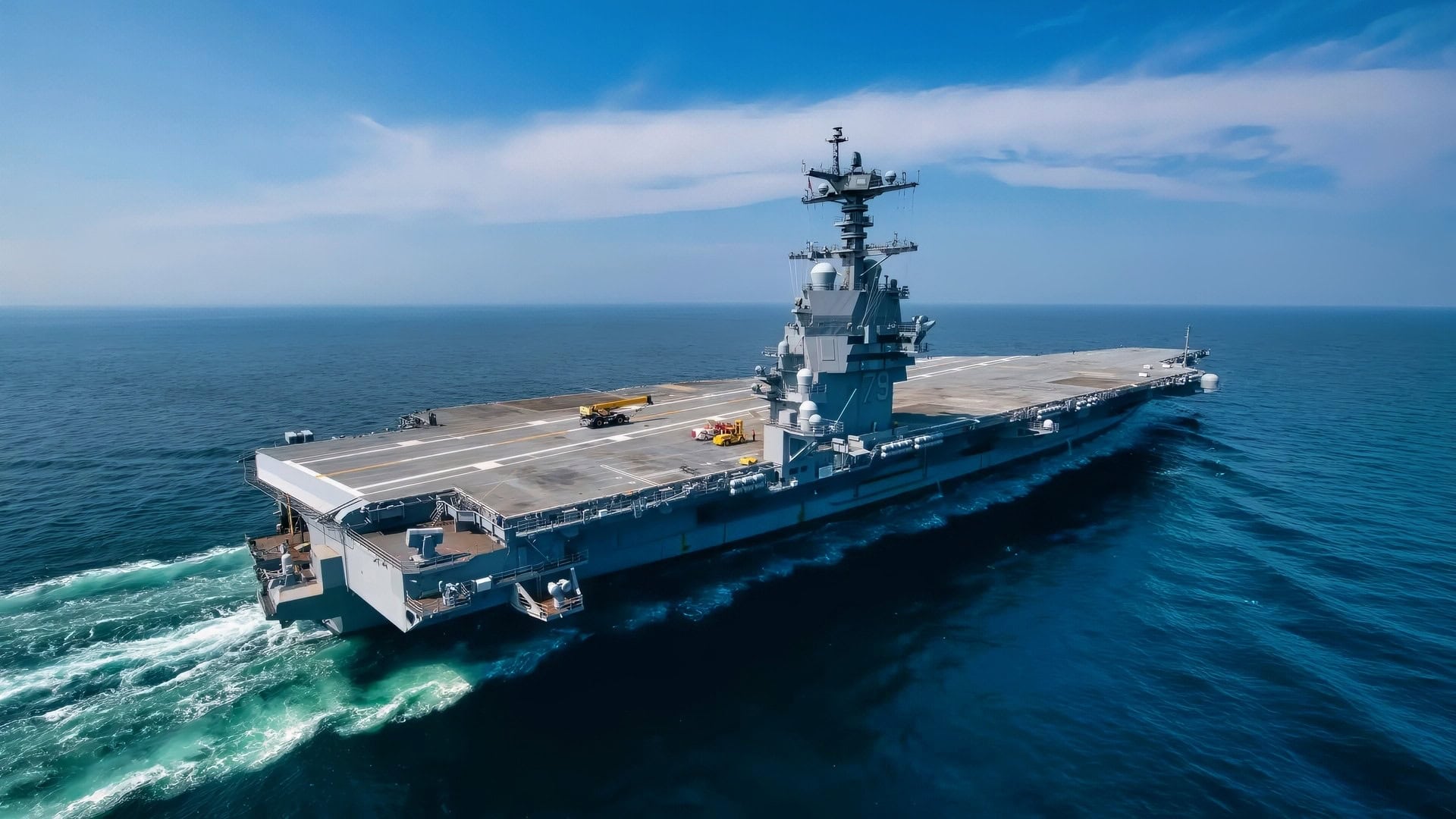
John F. Kennedy (CVN 79) Successfully Completes Builder's Sea Trials (HII)

Watch on YouTube
Overview
Gerald R. Ford
The Gerald R. Ford-class is the United States Navy's newest generation of nuclear-powered aircraft carriers and currently the most advanced and expensive warships in the world. Named after the 38th President of the United States, this class is designed to replace the existing Nimitz-class carriers on a one-for-one basis. The Navy plans to ultimately build 10 Ford-class carriers to maintain its fleet of 11 carriers. The Ford-class incorporates numerous revolutionary technologies, representing the most significant leap in carrier design since the USS Enterprise (CVN-65) in the 1960s.
Specifications

General

Crew4,539
Beam M41 m
Length M337 m
Catapults4
Propulsionnuclear
Speed Knots30 knots
Launch SystemCATOBAR
Aircraft Types75
Aircraft Capacity75
Displacement Tons100,000 tons

Other

Reactors2 x Bechtel A1B pressurised-water reactors, 4 shafts; roughly 3x the electrical generation of a Nimitz-class A4W plant, with margin reserved for future directed-energy and sensor loads
Radar FitCVN-78 only: Dual Band Radar (AN/SPY-3 X-band + AN/SPY-4 S-band). CVN-79 onward: AN/SPY-6(V)3 EASR, first fitted to John F. Kennedy
Class Hulls10 hulls planned (CVN-78 to CVN-87); 5 procured or projected as of 2026 - Gerald R. Ford, John F. Kennedy, Enterprise, Doris Miller and CVN-82
Arresting GearGeneral Atomics Advanced Arresting Gear (AAG), common to the class; cited by CRS alongside the weapons elevators as the largest residual risk to class sortie generation
Catapult System4 x General Atomics EMALS electromagnetic launch tracks, common to every hull of the class (replaces C-13 steam catapults)
Delivery ScheduleCVN-78 delivered 2017; CVN-79 March 2027; CVN-80 July 2030; CVN-81 February 2032; CVN-82 projected 2040 (CRS, Dec 2025). A May 2026 Navy plan shows a later profile of 2027/2031/2034/2039 (reported)
Weapons Elevators11 electromagnetic Advanced Weapons Elevators per hull, replacing cable-and-hydraulic elevators
Procurement Cost CapSection 121, FY2020 NDAA (P.L. 116-92): US$13,224 m (CVN-78), US$11,398 m (CVN-79), US$12,202 m (CVN-80), US$12,451 m (CVN-81), then-year dollars
Latest Developments
Sep 24, 2026strong signal
USS Nimitz Was Supposed to Retire in May After 51 Years. Its Replacement, USS John F. Kennedy, Is Late, So It Serves Until March 2027.

USS Gerald R. Ford (CVN 78) and USS Harry S. Truman (CVN 75) transit the Atlantic Ocean June 4, 2020.

Sep 3, 2026strong signal
The $13,000,000,000 USS Gerald R. Ford Nuclear Aircraft Carrier Has 30 Miles of Sewage Pipe. It Doesn’t Take Much To Clog It

Ford garnered significant media attention when her plumbing systems inevitably failed.

Aug 17, 2026strong signal
Trump Has Demanded the US Navy to Do What Looks Like Aircraft Carrier Mission Impossible with a 100,000-Ton Ford-Class

The first-of-class ship—the first new U.S. aircraft carrier design in 40 years—will spend several days conducting builder’s sea trials, a comprehensive test of many of the ship’s key systems and technologies.

Jul 29, 2026strong signal
The US Navy Put 23 New Technologies on One Nuclear Aircraft Carrier at the Same Time. That Decision Cost Years.

Ford shifts major flight-deck and support functions from steam and hydraulics to electricity.

May 27, 2026strong signal
The U.S. Navy’s Nuclear Ford-Class Almost ‘Broke’ the Aircraft Carrier For Good

The Ford reduced its crew size by roughly 500–700 sailors.

May 14, 2026strong signal
Gerald R. Ford to return from historic deployment on Saturday: CNO

The aircraft carrier Gerald R. Ford will return home on Saturday — wrapping up more than 320 days at sea.

May 13, 2026strong signal
After Middle East ops, Navy to start feeling funding crunch this summer: CNO

the aircraft carrier Gerald R. Ford will likely require significantly more maintenance once it returns home from its nearly 11-month deployment in comparison to a standard, seven-month deployment.

Featured Coverage
Research Notes

Lead ship of a new U.S. carrier generation

high

Gerald R. Ford is the lead ship of the Ford-class carrier program, designed to begin the replacement of Nimitz-class carriers.

Gerald R. Ford refers to USS Gerald R. Ford (CVN-78), the lead ship of the Ford-class aircraft carrier program. The official AIRLANT page describes Ford as the first new U.S. aircraft carrier class in more than 40 years and the beginning of the phased replacement of Nimitz-class carriers.

That makes this page more than a ship entry. It is a technology-transition record covering electromagnetic launch, advanced arresting gear, new weapons-handling arrangements, greater electrical capacity, and changes intended to support future carrier air wings.

For HiWars, this alternate Ford equipment record should clearly point readers toward the same analytical frame as the full CVN-78 entry: the ship is both an operational carrier and a first-of-class modernization case.

First-of-class benefits came with integration risk

high

Ford-class technology aims to improve carrier output, but the lead ship also carried cost, testing, and reliability issues.

The Congressional Research Service report is important because it shows Ford as an acquisition and oversight story as well as a military capability. New launch, recovery, and weapons-handling systems created potential long-term advantages, but they also produced schedule pressure and technical-risk questions.

A useful detail page should not flatten that tension into a simple claim that Ford is the most advanced carrier. It should explain that first-of-class ships often absorb integration problems so later ships can benefit from lessons learned.

This makes Gerald R. Ford a good page for readers trying to understand how procurement, technology maturity, and operational readiness interact in modern naval programs.

Carrier power is a force-package measurement

high

Ford's combat value depends on the ship, air wing, escorts, munitions, logistics, maintenance capacity, and command network.

The U.S. Navy fact file describes aircraft carriers as adaptable airfields at sea. In practical terms, Ford's value comes from a force package: the carrier hull, trained crew, embarked air wing, escorts, replenishment ships, munitions, maintenance support, and command relationships.

This means a Ford-class carrier is not assessed only by displacement or aircraft count. Sortie generation, launch-and-recovery reliability, weapons flow, air-wing readiness, and escort availability all shape what the carrier can actually do.

For HiWars, the page should guide readers away from a specification-only view and toward operational context. Ford matters because it changes how the U.S. Navy intends to generate sea-based air power over the coming decades.

Key parameters at a glance

high

Class-level and program figures; hull data are common to the class, while schedule and cost figures follow the December 2025 CRS report and are marked where later Navy planning differs.

Program role
Successor to the Nimitz class, replacing it one-for-one to hold the statutory 11-carrier force
Hulls planned
10 (CVN-78 to CVN-87); 5 procured or projected through CVN-82 as of 2026
Builder
HII Newport News Shipbuilding - the only US yard able to build nuclear carriers
Common propulsion
2 x A1B reactors, 4 shafts; roughly 3x the electrical output of a Nimitz plant
Common launch/recovery
4 x EMALS catapults and Advanced Arresting Gear on every hull
Ordnance handling
11 electromagnetic Advanced Weapons Elevators per ship
Radar split
Dual Band Radar on CVN-78 only; AN/SPY-6(V)3 EASR from CVN-79 onward
Congressional cost caps
US$13.22 bn / 11.40 bn / 12.20 bn / 12.45 bn for CVN-78/79/80/81 (FY2020 NDAA Sec. 121)
Delivery profile
2017 / Mar 2027 / Jul 2030 / Feb 2032 / ~2040 (CRS, Dec 2025)
Life-cycle claim
~US$5 bn lower ownership cost per hull versus a Nimitz, mainly from reduced manning and automation (Navy estimate, reported)

Program milestones

high

Class-level procurement, contracting and construction milestones across CVN-78 to CVN-82.

2008Lead ship procured under FY2008

The CVN-21 development effort becomes the Ford class when CVN-78 is procured. The design bundles EMALS, the Advanced Arresting Gear, a new A1B reactor plant, electromagnetic weapons elevators and a smaller island into a single new hull rather than phasing them in.

2013CVN-79 procured, keel laid 2015

John F. Kennedy is funded in FY2013 with a two-phase delivery strategy meant to spread cost, and her keel is laid at Newport News in August 2015 while the lead ship is still in trials.

2017-07CVN-78 delivered and commissioned

The lead ship enters service with several class-common systems still incomplete, and the resulting post-delivery test period sets the reference case for how much first-of-class risk the follow-on hulls inherit.

2019-01Two-carrier block buy for CVN-80 and CVN-81

The Navy awards HII a US$15.2 bn fixed-price incentive contract covering Enterprise and Doris Miller together - the first multi-carrier contract at Newport News in over three decades - claiming more than US$4 bn in savings from a design-once, build-twice approach.

2019-12Cost caps legislated; CVN-79 christened

Section 121 of the FY2020 NDAA resets per-hull procurement cost caps for the first four ships, and John F. Kennedy is christened at Newport News.

2022-08Enterprise (CVN-80) keel laid

The third hull enters formal construction. CRS later records a 26-month slip on CVN-80 attributed to material availability, supply-chain performance and workforce turnover at the yard rather than to the new technologies themselves.

2026-01CVN-79 begins sea trials as the first EASR hull

John F. Kennedy sails from Newport News on 28 January 2026 for builder's trials, carrying AN/SPY-6(V)3 in place of the lead ship's Dual Band Radar - the first substantive class configuration change.

2026-08CVN-79 completes acceptance trials

HII announces successful acceptance sea trials ahead of a planned March 2027 delivery, roughly 54 months later than the September 2022 date originally estimated for the second ship of the class.

Strategic significance

medium

The Ford class matters less as a set of individual ships than as the single mechanism by which the United States intends to hold an eleven-carrier fleet into the second half of the century. Every Nimitz-class hull retires against a Ford-class delivery, and there is one shipyard able to make that substitution. The class design decision - concentrating EMALS, the Advanced Arresting Gear, the A1B plant and eleven electromagnetic weapons elevators into the lead hull at once - bought a genuinely different carrier, with the electrical margin to launch heavier unmanned aircraft and to absorb directed-energy weapons that a steam-catapult Nimitz cannot. It also concentrated the schedule and cost risk of five separate developments into one program, and that bill is still being paid on the follow-on ships.

The evidence from the second and third hulls is mixed in an instructive way. John F. Kennedy will deliver around March 2027, roughly 54 months later than originally estimated, and the December 2025 CRS account attributes the residual work to Advanced Arresting Gear completion and weapons-elevator certification - the same two systems that defined the lead ship's troubles. Enterprise (CVN-80) has slipped about 26 months, but for a different reason: material availability, supply-chain performance and workforce turnover at Newport News, plus the discovery of knowingly faulty welds across hulls under construction. The first problem is a design-maturity issue that should decay across the class; the second is an industrial-base problem that will not, and it is the one that also constrains Virginia-class submarine output at the same yard.

The practical consequence is a force-structure gap rather than a capability gap. Navy planning briefed in May 2026 shows only four more Ford-class deliveries before 2040 and years - around 2030, 2033, 2037 and 2038 - in which the fleet drops to ten carriers, below the statutory floor of eleven. CVN-82 is intended to introduce a revised baseline aimed at producibility and cost rather than at new capability, which is a reasonable reading of where the binding constraint now sits. For planners weighing a Pacific contingency, the relevant question about the Ford class is no longer whether electromagnetic launch works - CVN-78's 2025-2026 deployment largely settled that - but whether one yard can deliver hulls fast enough to keep eleven decks in the water while the Nimitz fleet ages out.

Videos

Newport News Shipbuilding Aircraft Carrier Update: March 2024 (HII)

Watch on YouTube

Enterprise (CVN 80) Mid-Body Transfer (HII)

Watch on YouTube

Beyond the lead ship: how many Ford-class hulls the US is actually building (Bilibili)

Watch on Bilibili
Variants (2)
Service YearName
2017 –USS Gerald R. Ford (CVN-78)
2027 –USS John F. Kennedy (CVN-79)
Sources & References
UNITS
NameCountryStatusService YearDescription
USS Enterprise (CVN-80)
🇺🇸United States
ACTIVE—Third Ford-class carrier, under construction
USS John F. Kennedy (CVN-79)
🇺🇸United States
ACTIVE2024 – PresentSecond Ford-class carrier
USS Gerald R. Ford (CVN-78)
🇺🇸United States
ACTIVE2017 – PresentLead ship of Ford class
Related Discussions

No discussions about Gerald R. Ford yet

Start the first discussion