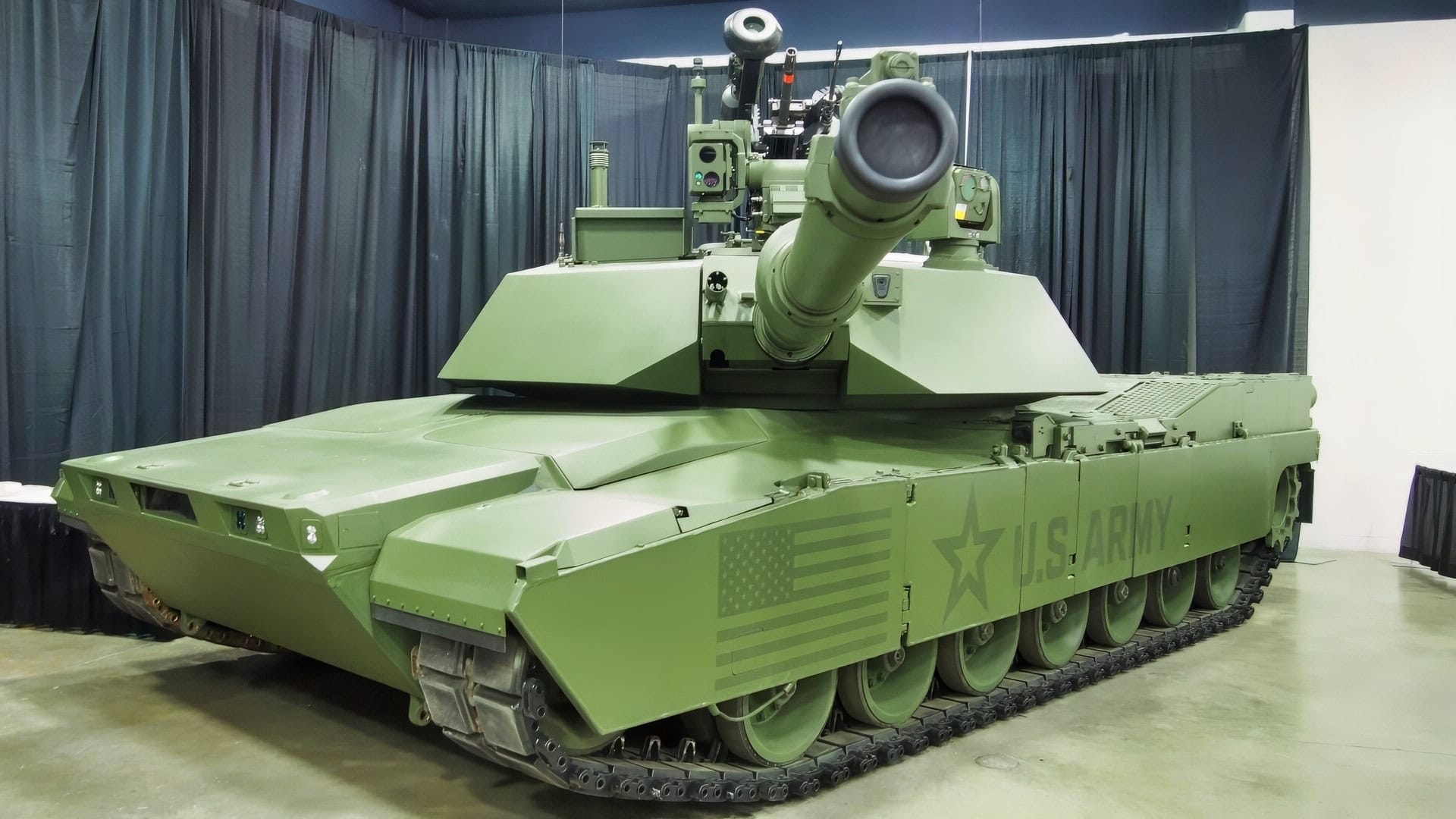
M1E3 Abrams

🇺🇸United States
General Dynamics Land Systems
Spotlight

The Abrams redesigned rather than upgraded: lighter, hybrid, uncrewed turret

U.S. Army unveils prototype M1E3 Abrams tank at Detroit Auto Show (MLive)

Watch on YouTube
Overview
M1E3 Abrams
The M1E3 Abrams is the U.S. Army's next-generation development of the Abrams main battle tank, launched in September 2023 after the service cancelled the incremental M1A2 SEPv4 upgrade. The programme prioritises a substantial weight reduction from the roughly 67-tonne SEPv3, a modular open systems architecture intended to make later upgrades faster and cheaper, and improved protection against top-attack and drone threats. A hybrid or diesel-electric power pack is a stated design goal, and a reduced-crew or unmanned turret has been studied. A first prototype was shown publicly in January 2026; it retains the 120 mm M256 main gun and the legacy AGT1500 turbine for early testing. Initial operational capability is targeted for the early 2030s.
Specifications

General

Crew3
Armor TypeChobham composite
Fire Controlcomputer fire control system
Weight Tonnes60 tonnes
Secondary ArmamentEOS R400 Mk2 remote weapon station with 40 mm Mk19, 7.62 mm MG and Javelin (prototype fit, described as modular)
Main Gun Caliber Mm120 mm

Other

PowerpackDiesel-electric hybrid (planned); transversely mounted Caterpillar diesel with ACT1075LP transmission in automotive trials (reported). Prototype retains a turbine for early testing
Main Armament120 mm M256 smoothbore retained on the prototype
Hull Crew LayoutAll three crew seated in the hull, fully digital and software-configurable stations
Prototype Quantity4 early prototypes planned for soldier testing during 2026 (reported)
Fuel Efficiency Goalup to 50% lower consumption than M1A2 at comparable range (planned)
Systems ArchitectureModular open systems architecture (MOSA) for rapid software, sensor and protection refresh
Turret ConfigurationUncrewed turret with automatic ammunition handling; loader position deleted (prototype configuration)
Latest Developments
Oct 4, 2026strong signal
New U.S. Army tank and fighting vehicles spotted during live-fire testing

the U.S. Army’s next-generation M1E3 Abrams tank and two prototypes competing to replace the Bradley infantry fighting vehicle firing live rounds

Sep 26, 2026strong signal
The New K3 Tank Runs on Hydrogen And Looks the US Air Force B-21 Raider Stealth Bomber

Entity 'M1E3' mentioned in report

Aug 30, 2026strong signal
U.S. Army’s newest tank prototype heads to 1st Cavalry Division

The U.S. Army will send its M1E3 Abrams prototype to the 1st Cavalry Division for testing.

Aug 14, 2026strong signal
Army tells industry: Soldiers need more power, but don’t just offer batteries and generators

Entity 'M1E3 Abrams' mentioned in report

Aug 13, 2026strong signal
‘Not Frozen in Time’: The US Army’s New M1E3 Abrams Tank Looks Like a Powerhouse

the service aims to deliver M1E3 prototype vehicles to soldiers within 24 to 30 months.

Aug 13, 2026strong signal
Army’s Iron Horse brigade prepares to test M1E3, XM30 prototypes

The M1E3 is set to replace the service’s aging M1A2 Abrams tank.

Aug 4, 2026strong signal
U.S. Army scouts learn to fight alongside a sky full of drones

Entity 'M1E3 Abrams tank' mentioned in report

Featured Coverage
Research Notes

Next Abrams Modernization Path

medium

M1E3 Abrams is the U.S. Army’s announced path for a more survivable and sustainable Abrams modernization rather than a continuation of the cancelled M1A2 SEPv4 approach. The Army framed the effort around adapting the tank to future battlefields while reducing weight and improving architecture. This makes the entry a modernization program page, not a fielded legacy variant.

Lighter, More Survivable Architecture

medium

The M1E3 concept focuses on improvements such as reduced logistics burden, better survivability, growth capacity, and integration of modern technologies. The Army’s announcement emphasized that future tanks must adapt faster as threats evolve. For readers, the important point is not a final specification list but the direction of change: modularity, weight control, and upgrade speed.

Why It Matters for Heavy Armor

medium

M1E3 matters because it shows that the U.S. Army still sees a need for heavy armor, but not simply by adding more mass to older Abrams variants. Earlier Abrams modernization contracts kept the fleet viable, while M1E3 signals a deeper redesign pressure. The page should explain that this is part of the larger debate about tanks surviving drones, top-attack missiles, mines, and logistics strain.

Key parameters at a glance

medium

The M1E3 is a development programme, not a fielded tank. Figures below are Army goals or press-reported prototype details and are marked (planned) or (reported) accordingly.

Role
Next-generation main battle tank; intended production designation M1A3 (planned)
Status
Early prototype delivered December 2025; soldier testing from 2026 (reported)
Lead contractor
General Dynamics Land Systems; demonstrator built with Roush Defense, Michigan
Design driver
Reverse the Abrams weight spiral after the M1A2 SEPv4 cancellation
Weight target
roughly 10 tons below the SEPv3 (planned)
Crew
3, all in the hull; loader replaced by automatic ammunition handling
Turret
Uncrewed, no crew hatches or legacy periscopes (prototype)
Propulsion goal
Diesel-electric hybrid, ~50% better fuel economy than M1A2 (planned)
Planned production site
Joint Systems Manufacturing Center, Lima, Ohio (planned)
Target initial operational capability
early 2030s, serial production toward the end of the decade (planned)

Program milestones

medium

Publicly reported milestones from the SEPv4 cancellation to the Detroit prototype reveal.

2022-10AbramsX demonstrator shown at AUSA

General Dynamics Land Systems displayed a company-funded technology demonstrator at roughly 59 tons with a hybrid-electric drive, an uncrewed turret and a three-person crew. It was not a bid vehicle, but it framed the technical options the Army later adopted.

2023-09M1A2 SEPv4 cancelled, M1E3 announced

The Army ended SEPv4 development, arguing that further bolt-on capability was pushing combat weight past the point where mobility and survivability could be sustained. Brig. Gen. Geoffrey Norman framed the pivot as a need to optimise mobility and survivability rather than keep adding mass.

2024Requirements shift to a modular open architecture

The Army defined the M1E3 around a modular open systems architecture, integrated rather than bolt-on active protection, and reduced logistics demand, so that sensors, software and protection could be replaced without a new hull design.

2025-06GDLS placed under contract to lead the design

A contract reported at about USD 150 million tasked General Dynamics Land Systems with leading M1E3 design work, after Army leadership rejected an earlier schedule that would have pushed the tank to 2032.

2025-12First early prototype delivered

GDLS handed the Army its first M1E3 early prototype, built with Roush Defense in Michigan. It is a test article for turret, crew-layout and digital-system risk reduction rather than a production-representative vehicle.

2026-01Prototype shown publicly in Detroit

The Army displayed the prototype at the North American International Auto Show. Reporting noted a modified M1A1 turret shell without crew hatches, two forward hull hatches for the three-man crew, an EOS remote weapon station and a commercial game controller used as the driver interface.

2026Soldier testing with early prototypes

Four early prototypes are planned for delivery to Army units for hands-on evaluation, with feedback intended to shape the design before production configuration is locked. The FY2026 authorisation request for the effort was reported at USD 723.5 million.

2030Target for production and initial operational capability

The Army targets initial operational capability in the early 2030s, with serial manufacture at Lima, Ohio, and the fielded tank expected to carry the M1A3 designation (planned).

Strategic significance

medium

The M1E3 matters less as a new tank than as an admission about the old one. Every Abrams increment since the 1980s bought protection and electronics with mass, and by the SEPv3 the type had passed roughly 73 to 78 tons combat-loaded - heavy enough to strain bridges, transporters, recovery vehicles and the deployment calculus that any expeditionary force depends on. Cancelling SEPv4 in September 2023 in favour of a clean-sheet redesign was the Army choosing to stop paying that bill, and the weight goal of roughly ten tons below SEPv3 is the programme's single clearest measure of success.

The technical bets are individually familiar and collectively unproven for the US Army. An uncrewed turret with automatic ammunition handling removes the loader and moves three crew into the hull, which cuts turret volume and the armour needed to protect it; a diesel-electric hybrid replaces the AGT1500 turbine with commercial automotive components, with a stated goal near fifty per cent lower fuel consumption and a corresponding reduction in the fuel convoys that make armoured formations targetable. Russia's T-14 Armata shows that an uncrewed turret is straightforward to demonstrate and hard to field affordably, and the hybrid path trades a mature if thirsty powerpack for a drivetrain the Army has never sustained in an armoured brigade. The December 2025 prototype hedges accordingly: it uses a modified M1A1 turret shell and still runs a turbine, because its job is to de-risk crew layout, digital stations and turret architecture rather than validate the final vehicle.

The modular open systems architecture is the part most likely to determine whether the programme ages well. Ukraine has compressed the threat cycle for armour from decades to months - FPV drones, top-attack munitions and rapidly iterating electronic warfare - and no hull designed in the 2020s can be armoured against what appears in the 2030s. Building the tank so that sensors, active protection and counter-drone software can be swapped without redesigning the vehicle is a bet that adaptability outperforms specification. That bet remains unresolved: with four early prototypes entering soldier testing in 2026 and initial operational capability targeted for the early 2030s, the M1E3 is currently a set of design goals with one demonstrator behind them, and the Abrams fleet will be carried by SEPv3-standard tanks for at least another decade.

Videos

America's New Tank is Legitimately Insane - M1E3 walkthrough (Task & Purpose)

Watch on YouTube

M1E3 drops the 40-year-old gas turbine; prototype due next year (Hunt Weapons Bureau)

Watch on Bilibili

Design analysis: what the US Army is trying to build with the M1E3 (Red Fantasy)

Watch on Bilibili
Sources & References
Related Discussions

No discussions about M1E3 Abrams yet

Start the first discussion