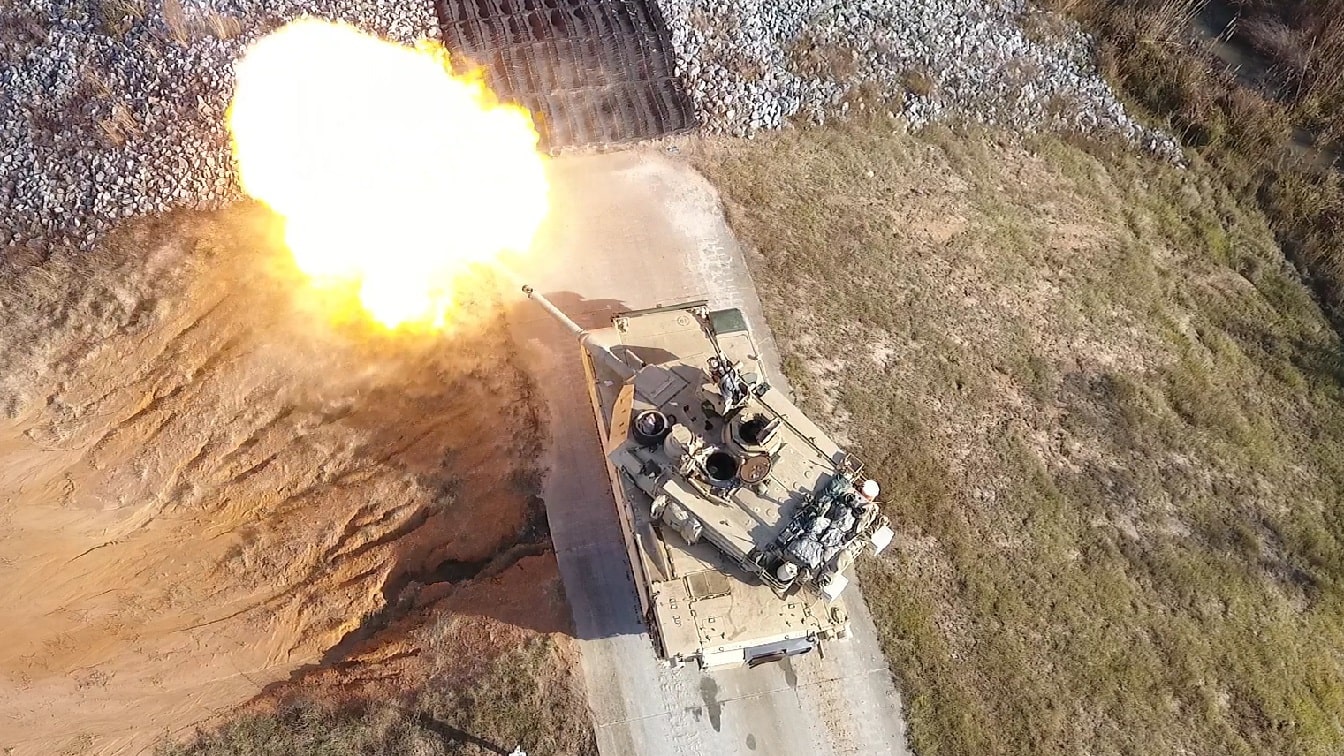
The M1A2's defining contribution to the Abrams line is not firepower but crew information. The Commander's Independent Thermal Viewer gave the tank commander a hunter-killer cycle independent of the gunner, and the IVIS databus - later replaced by FBCB2 and JBC-P - turned individual tanks into nodes of a brigade network. Successive System Enhancement Packages layered second-generation thermal sights, colour terrain displays, ammunition datalink and the low-profile CROWS onto that architecture, so the SEPv3 fielded from 2020 is best understood as a mature electronics and survivability standard rather than a new vehicle.
Survivability has become the binding constraint. Trophy HV was fielded on SEPv2 and SEPv3 brigades from 2020 to counter tandem-warhead ATGMs, but the M1A2 branch reached its practical growth limit when the Army closed out SEPv4 in September 2023 on weight grounds and redirected effort to the lighter, hybrid-powered M1E3. It is worth separating the M1A2 record from Ukraine's experience: the 31 tanks transferred to Kyiv were M1A1SA, not M1A2, and by mid-2025 Ukrainian and Russian sources reported roughly 26-27 of them destroyed, captured or abandoned (reported). Those losses were driven mainly by FPV drones, ATGMs and prepared minefields, and prompted a reported withdrawal of the type from the most exposed sectors in April 2024 - a signal about the operating environment rather than a direct verdict on M1A2 configurations, which never deployed there.
Export demand has nonetheless outrun the US Army's own plans for the type. Poland contracted 250 SEPv3 in 2022 and Australia 75, while Taiwan's 108 M1A2T - a locally designated SEPv3-derivative without depleted-uranium armour inserts - was completed roughly two years early and stood up its first battalion at Hukou in October 2025. For Warsaw the tanks are a NATO eastern-flank mass play; for Taipei they are a comparatively small armoured reserve whose value lies in counter-landing and counter-airborne response on a terrain-constrained island. In both cases the M1A2 buys interoperable, supportable capability now, at the cost of committing to a logistics chain - gas turbine fuel demand, 60-plus-tonne bridging and recovery - that the M1E3 programme is explicitly trying to shed.