M1A1 Abrams

🇺🇸United States
General Dynamics Corp.
1985 – Present
Spotlight

The 120mm rearmament of the Abrams — Desert Storm's benchmark, now a drone-era survivor

4th Tank Battalion Marines demonstrate M1A1 Abrams roles at ITX 4-18 (Marine Forces Reserve)

Watch on YouTube
Overview
M1A1 Abrams
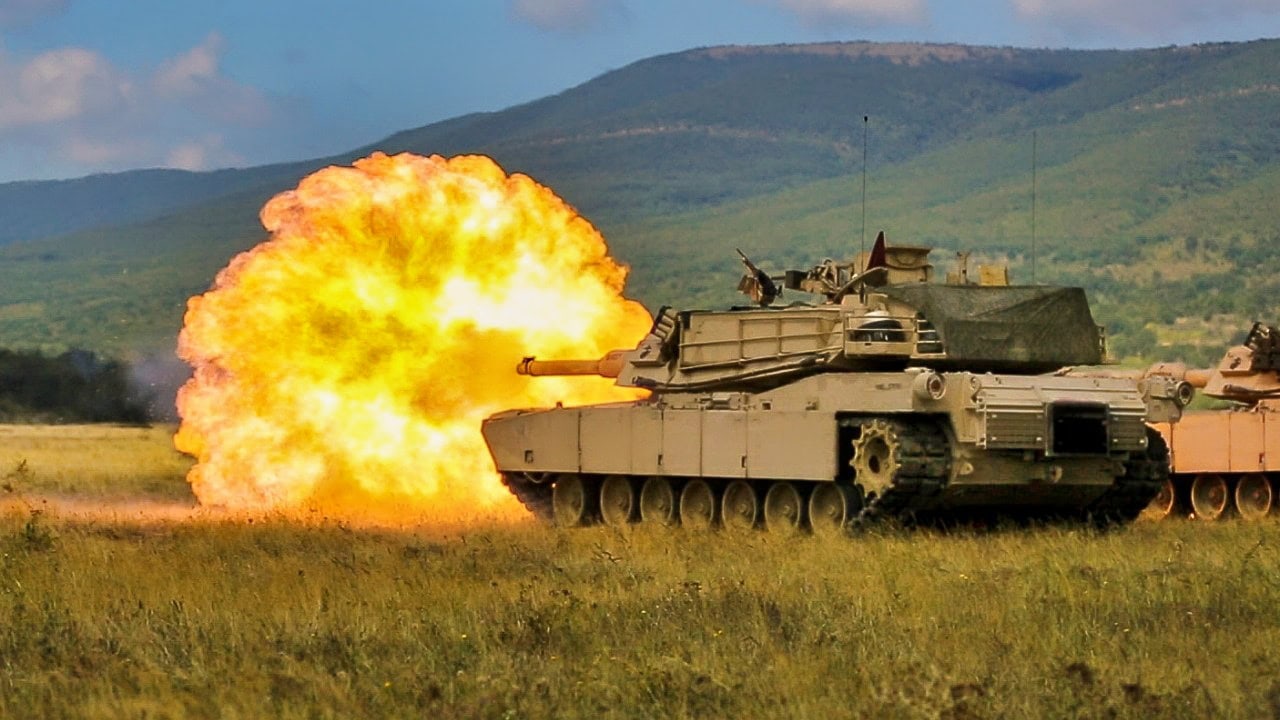
The M1A1 Abrams is an American main battle tank developed by General Dynamics, featuring depleted uranium composite armor, a 120mm M256 smoothbore gun, a 4-man crew, 72 km/h top speed, and a 465km range.
Specifications

General

Crew4
Range Km465 km
Fire ControlThermal imaging gunner's primary sight, Nd:YAG laser rangefinder, digital ballistic computer, two-axis stabilised gun
Max Speed Kmh72 km/h
Weight Tonnes61.4 tonnes
Engine Power Hp1,500 hp
Secondary ArmamentM2 .50 Caliber Machine Gun, 7.62mm M240 Machine Gun
Main Gun Caliber Mm120 mm

Other

ArmorBurlington-type composite; M1A1HA (1988 onward) adds a depleted-uranium mesh layer to the frontal array, withheld from export tanks
Main GunM256 120 mm L/44 smoothbore (licence-built Rheinmetall Rh-120), replacing the M1's 105 mm M68A1 rifled gun
PowerplantHoneywell AGT1500 multi-fuel gas turbine with Allison X-1100-3B hydrokinetic transmission
Dimensions M~9.8 length gun forward x 3.66 width x 2.44 height (est.)
Nbc ProtectionCrew-compartment overpressure system with gas-particulate filtration, introduced with the M1A1
Production Total~4,800 built for the US Army plus 403 for the US Marine Corps, 1985-1992 (est.)
Ammunition Stowage40 rounds of 120 mm, 34 in the turret bustle behind sliding doors with roof blow-off panels
Latest Developments
Sep 5, 2026strong signal
U.S. approves $750M tank engine sale to Saudi Arabia

Entity 'M1A1' mentioned in report

Sep 3, 2026strong signal
Ukraine fits Abrams tank with Russian-style hedgehog armor

In February, an ex-Australian M1A1 Abrams belonging to Ukrainian forces appeared in Zaporizhzhia Oblast wearing a hedgehog frame of unwound aluminum cabling.

Aug 21, 2026strong signal
‘They Need Cages’: The US Army M1 Abrams Was Never Built to Fight In a War Like the Ukraine War

By mid-2025, Military Watch Magazine reports that a staggering 27 of the 31 US-supplied Abrams MBTs have been lost.

Aug 14, 2026strong signal
The US Marine Corps Had More Than 450 M1 Abrams Tanks. Force Design Reduced the Number to Zero

The US Marine Corps began Force Design 2030 with more than 450 M1A1 Abrams tanks.

Jul 29, 2026strong signal
Ukraine Just Got a Brand New Fleet of 49 M1A1 Abrams Tanks — America Isn’t Happy At All

Australia completed the transfer of 49 retired M1A1 Abrams tanks to Ukraine in December 2025.

Jul 21, 2026strong signal
The Only Way to Stop Iran at Sea Is Boots on the Ground

An M1A1 Abrams tank operated by Soldiers with the 2nd Battalion, 70th Armored Regiment, 2nd Armored Brigade Combat Team, 1st Infantry Division, fires while moving at the Douthit Gunnery Complex on Fort Riley, Kansas, Oct. 19, 2022.

Jul 3, 2026strong signal
America’s M1 Abrams Has Lost Exactly 1 Tank Duel in 35 Years of Combat: A Russian T-72 Finally Did It

The Iraqi Army’s M1A1s could not stop the ISIS offensive that took Mosul in June 2014.

Featured Coverage
Research Notes

120 mm Abrams variant that became a major Cold War and post-Cold War standard

high

M1A1 Abrams matters because it moved the Abrams family into the 120 mm smoothbore era and became a widely used baseline for later upgrades.

The M1A1 Abrams is a major development of the Abrams main battle tank family, best known for introducing the 120 mm smoothbore gun and improved armor protection compared with early M1 models. It became a central U.S. armored-force platform during the late Cold War and post-Cold War period.

FAS describes the M1A1 as a jointly produced tank for Army and Marine Corps needs, while Army Technology covers the wider M1A1/M1A2 family and its continuing modernization path. That history makes M1A1 more than a legacy variant.

For HiWars, the M1A1 page should explain the variant as a durable baseline: powerful, heavily protected, and upgradeable, but also demanding in fuel, maintenance, transport, and support.

Firepower, armor, and mobility with a heavy sustainment burden

high

The M1A1 combines high-end tank performance with the logistics costs of a turbine-powered, heavily armored vehicle.

M1A1 capability comes from the interaction of firepower, armor, fire-control systems, mobility, and crew training. The tank's value is not just its gun; it is the ability to find, hit, survive, and maneuver under combined-arms protection.

The same design also creates sustainment demands. Abrams tanks require fuel, maintenance personnel, recovery vehicles, spare parts, ammunition supply, and transport planning. Those support needs shape where and how the vehicle can be used.

A stronger page should explain both sides. M1A1 can be a formidable armored platform, but it performs best when embedded in a capable logistics and combined-arms system.

Drone-heavy battlefields changed the protection problem

high

Recent combat experience shows that even heavily armored tanks need air defense, electronic warfare, infantry support, and tactical adaptation.

Recent reporting from Ukraine shows that M1A1 Abrams tanks can face severe pressure from drone-heavy battlefields. The Associated Press reported that Ukraine pulled U.S.-provided Abrams tanks from front-line use for a period because drones made them difficult to operate without detection or attack.

This does not mean the tank is obsolete. It means modern armor must operate inside a protection ecosystem that includes electronic warfare, short-range air defense, infantry, engineers, camouflage, route planning, and rapid repair.

For HiWars, this is exactly the kind of context that turns a thin tank page into useful analysis. M1A1 should be evaluated as a system within combined arms, not as an invulnerable standalone vehicle.

Key parameters at a glance

high

US Army and General Dynamics figures where available; Ukrainian battlefield data is marked as reported.

Role
Third-generation main battle tank, the 120mm-armed rebuild of the M1 Abrams
Primary change from M1
M256 120 mm smoothbore replaces the 105 mm M68A1 rifled gun
Ammunition
40rounds, 34 in a blow-off-panel bustle magazine
Armor
Composite array; M1A1HA adds a depleted-uranium layer, US-service only
NBC protection
Overpressure clean-air crew compartment, new to the M1A1
Powerplant
AGT1500 gas turbine, 1,500shp
Combat debut
Operation Desert Storm, February 1991
USMC service
1990 to 2021, withdrawn under Force Design 2030
Ukraine
31 M1A1SA delivered from September 2023, 47th Mechanized Brigade (reported)
Export operators
Australia, Egypt, Iraq, Morocco (reported)

Program milestones

high

Publicly reported milestones specific to the M1A1 configuration.

1985First M1A1 accepted

Production shifted from the 105mm M1 to the M1A1, combining the M256 120mm smoothbore, a heavier suspension and the overpressure NBC system in one package.

1988M1A1HA heavy armor

A depleted-uranium mesh was added to the frontal composite array, raising combat weight past 60 tonnes. The layer was reserved for US tanks and omitted from every export configuration.

1990Marine Corps adopts the M1A1

The USMC fielded the M1A1HC with deep-water fording kits and position-navigation gear, replacing the M60A1 across its tank battalions.

1991-02Combat debut in Desert Storm

Roughly 1,850 US Army M1A1s and around 250 Marine Corps tanks fought Iraqi armor. No M1A1 was reported lost to Iraqi tank fire; the handful destroyed or damaged were attributed to mines and friendly fire (reported).

2006AIM and Situational Awareness rebuilds, export orders

Depot rebuilds produced the M1A1 AIM and M1A1SA with improved armor packages and digital electronics. Australia took 59 M1A1 AIM SA from 2007, Iraq 140 M1A1M from 2010, and Morocco 222 M1A1SA from 2016 (reported).

2021Marine Corps completes divestment

Force Design 2030 deleted organic Marine armor entirely; the tank battalions stood down and their M1A1s were transferred to the Army, ending 31 years of Marine Abrams service.

2023-0931 M1A1SA arrive in Ukraine

Washington substituted refurbished M1A1SA hulls for the M1A2s originally pledged, stripping the depleted-uranium armor before transfer. The tanks equipped the 47th Separate Mechanized Brigade (reported).

2024-04Pulled back from the front line

US officials confirmed the surviving Abrams were withdrawn from forward positions after at least five losses, citing saturation FPV and reconnaissance drone coverage that left no ground crossable undetected (reported).

Strategic significance

medium

The M1A1 is where the Abrams became a NATO-standard tank rather than an American experiment. Swapping the 105mm M68A1 for the licence-built M256 120mm smoothbore put US armor on the same ammunition family as the Leopard 2, and the pairing of that gun with a stabilised thermal sight and a digital ballistic computer produced a first-round hit probability at 2,000 metres that Soviet-pattern fire control of the period could not match. Two survivability features introduced at the same time proved equally consequential: crew-compartment overpressure, which allowed sustained operation in a contaminated environment without individual protective posture, and — from 1988 — the depleted-uranium mesh of the M1A1HA. Desert Storm supplied the validation. Roughly 2,100 M1A1s engaged a numerically large but technologically older Iraqi force, and the absence of any confirmed loss to Iraqi tank fire set an expectation of Western armored dominance that shaped a generation of procurement decisions.

That expectation has been tested rather than confirmed by the M1A1's second combat career. The 31 tanks transferred to Ukraine were M1A1SA rebuilds with the depleted-uranium layer removed for export, which left them better protected than a T-72B but without the frontal advantage US-service tanks carry. More decisive than armor composition was the threat axis: FPV and fibre-optic-guided drones attack the roof, engine deck and rear, precisely where the composite array is thinnest. Ukrainian crews responded with field-applied reactive armor tiles and cage or net structures over the turret roof, adding an estimated two to three tonnes, and the 47th Brigade's own commanders credit those additions with crew survival under multiple hits. The blow-off panel magazine also worked as designed, sparing crews the catastrophic turret loss common to carousel-autoloader tanks. Withdrawal from forward positions in April 2024 was therefore less a verdict on the tank than on the practice of moving heavy armor across open ground under persistent aerial surveillance.

The M1A1's institutional trajectory is now diverging by operator. The US Army has consolidated on the M1A2 SEPv3 and is redirecting the fleet toward the M1E3, treating the M1A1 as a source of hulls for rebuild and transfer. The Marine Corps went further and eliminated tanks altogether under Force Design 2030, betting that Pacific island operations would not justify the logistics tail of a gas-turbine fleet — a judgment that remains contested and that Ukraine's experience can be read as supporting or undermining depending on the assumptions applied. Export operators are meanwhile splitting: Australia has handed its M1A1 fleet to Ukraine and moved to the M1A2 SEPv3, while Egypt's locally assembled fleet, Iraq's M1A1M and Morocco's M1A1SA keep the configuration in front-line service well into the 2030s. For those users the practical question is no longer gun or armor parity, but whether affordable top-attack protection and counter-drone measures can be retrofitted to a hull designed when the threat came from the front.

Videos

M1A1 Abrams Tanks on Exercise Diamond Run (Defence Australia)

Watch on YouTube

Ukraine withdraws Abrams tanks from front line amid drone raids (WION)

Watch on YouTube

Ukraine's M1A1SA-UKR Abrams of the 47th Mechanized Brigade (Bilibili)

Watch on Bilibili
Sources & References
Related Discussions

No discussions about M1A1 Abrams yet

Start the first discussion