

In most mainstream discussions about modern Main Battle Tanks (MBTs), the Leclerc is often and somewhat unfairly overshadowed by its peers.
Unlike the M1 Abrams, Challenger 2, or Leopard 2 tanks, all of which have had eventful service lives, the Leclerc has not yet had a chance to prove itself, not even to fight on the front lines in Ukraine.
Despite its more niche position within NATO and its lack of substantial combat experience, the Leclerc is unique among its Western contemporaries.
While it may not be the best tank in the world, it has many qualities that are worth highlighting.
Development History
In the 1960s, the AMX-30 made up the backbone of France’s tank forces.
While it was decent for its time, the tank was becoming obsolete as the Soviet Union fielded newer, more advanced tanks.
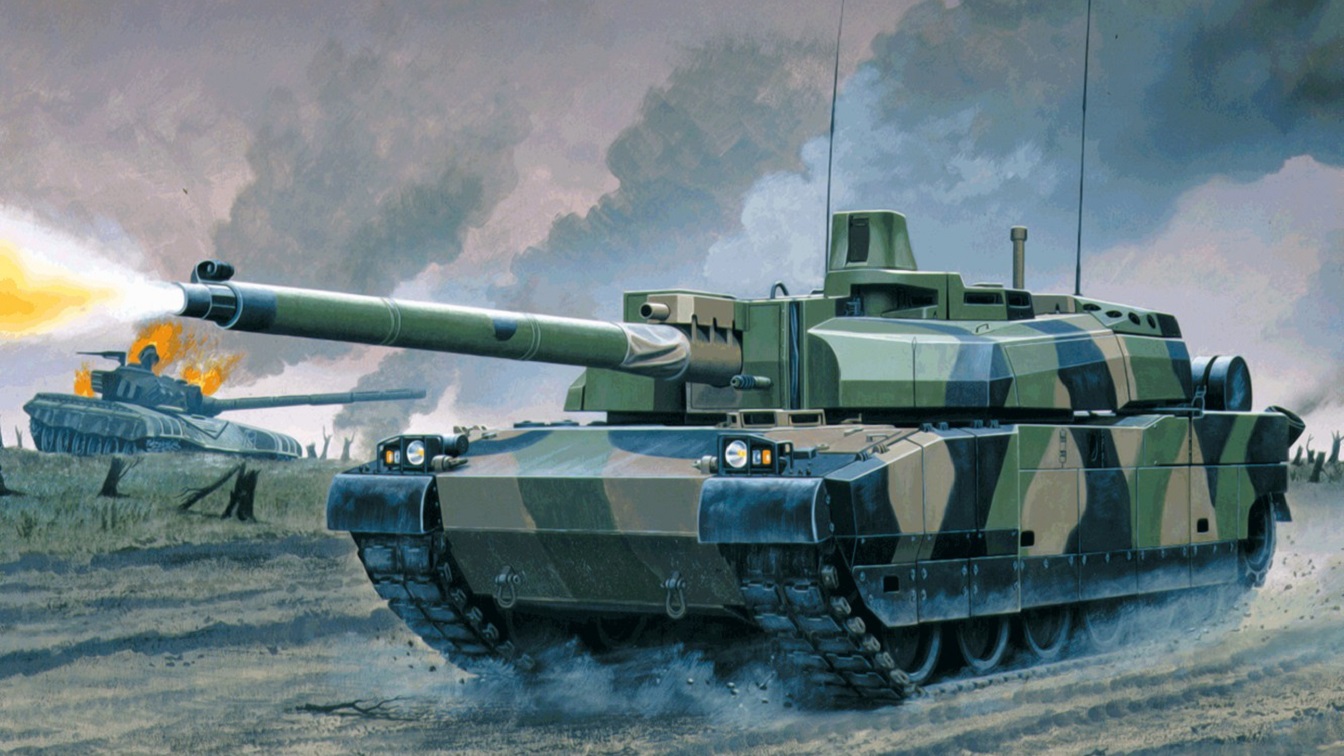
Leclerc Tank Artist Rendering.
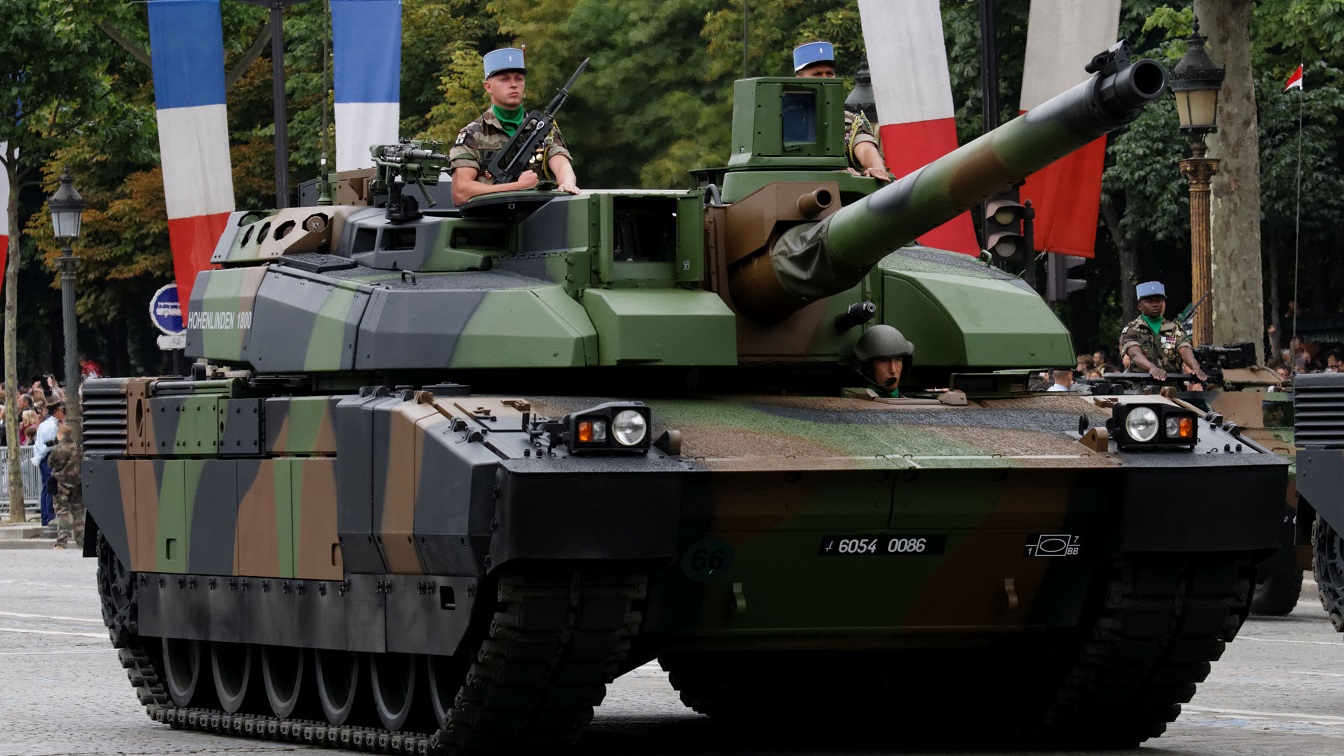
Leclerc Main Battle Tank. Image Credit: Creative Commons.
In 1975, the government launched the Char Futur project and established a new committee to work out the specifications for the new tank.
In 1980, however, Paris signed a Memorandum of Understanding with West Germany for the joint development of a new MBT, the Napoleon I in France and the Kampfpanzer III in Germany.
Like the infamous MBT-70 program, however, the project soon fell apart when neither party could agree on the new tank’s configuration, and it was canceled in 1982.
After the failed collaboration, France once again set out to develop a new tank under the Engin Principal de Combat (EPC) program.
Unlike other Western MBT programs at the time, the French placed less emphasis on heavy protection and thick armor, instead seeking a tank with improved mobility and accuracy.
At the same time, the new tank had to achieve at least twice the protection against modern kinetic-energy armor-piercing and shaped-charge rounds.
Six prototypes were built and tested, with the new tank, now named the Leclerc, entering full-scale production in 1990.
During development, France sought an international partner to help limit the Leclerc’s development costs.
Luckily, the United Arab Emirates, seeking a modern MBT to bolster its tank forces, agreed to split the bill with France and ordered 436 tanks, adding to the 426 units France had already planned.
Since its introduction, the tank has received several upgrade packages, culminating in the Leclerc XLR, the variant we will focus on today.
Technical Profile
The Leclerc is one of the most compact modern tanks in NATO service, measuring 9.87 meters long, 3.60 meters wide, and 2.35 meters high (the XLR is slightly larger due to its newer add-on armor packages).
Although it is smaller than, say, a Leopard 2, the Leclerc XLR’s interior is jam-packed with state-of-the-art communication and digital equipment. Unlike almost every other Western tank design, the Leclerc has a crew of three.
A bustle autoloader replaces the loader and can reload the main gun in under six seconds.
The bustle ammunition storage is protected by two blow-out panels in the event of an ammo cook-off.
Although protection was not the main goal of the Leclerc program, the tank still boasts decent protection, with the turret and frontal hull equipped with sophisticated composite armor.
The XLR takes this further with add-on side composite armor and undercarriage mine-protection plates.
The Leclerc is armed with a GIAT CN120-26/52 120mm smoothbore gun, reloaded by the aforementioned autoloader.
The XLR retains this main gun but replaces the manned, roof-mounted 7.62mm machine gun with a new Remote Weapons System (RWS), which also enhances the commander’s situational awareness.
Moving inside the tank, the XLR is equipped with the SCORPION Information and Command System (SICS) and information displays for the commander and gunner.
Both crewmembers also receive next-generation thermal sights and communication equipment by Thales, along with improved navigation systems.
France’s Underrated but Unproven Tank
Based on all available preliminary information, the Leclerc XLR retains the V8X SACM (now Wartsila) 8-cylinder diesel engine used on previous iterations.
The engine gives the Leclerc a road range of roughly 550 kilometers and a top speed of around 71 km/h on paved roads.
Paired with the engine is the Renk AG automatic transmission system with five forward and two reverse gears.
Thanks to its lighter weight, the Leclerc has one of the best power-to-weight ratios of any Western-made MBT, at 24hp/tonne. The tank uses a hydropneumatic suspension system for better cross-country performance.
While the weight of the Leclerc XLR is unknown, the previous variant, the Leclerc XXI, weighs roughly 57.4 metric tons, which is substantially lighter than the Leopard 2A7 and the M1A2 Abrams, both of which weigh around 66 metric tons.
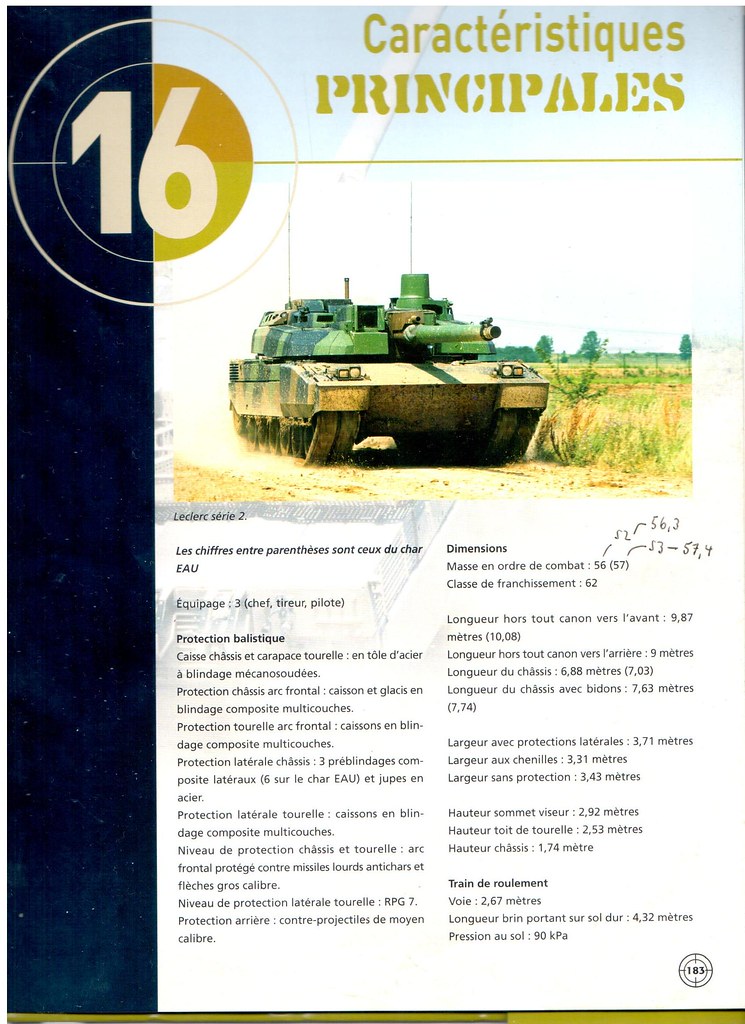
While not as light as Soviet/Russian tanks, the Leclerc is one of the lightest NATO tanks in service, and the XLR likely remains in the 50-ton range.
Unfortunately, this comes at the cost of armor, raising questions about its survivability.
Although its armor is lighter than its peers, the Leclerc has excellent mobility, great onboard electronics, and decent firepower.
While it is worse than the Abrams or the Leopard 2 in some respects, the Leclerc XLR is a competently designed and highly capable tank.
About the Author: Isaac Seitz
Isaac Seitz, a Defense Columnist, graduated from Patrick Henry College’s Strategic Intelligence and National Security program. He has also studied Russian at Middlebury Language Schools and has worked as an intelligence Analyst in the private sector.