
052D Destroyer Squadron Deploys Maritime Command Tent, Eastern Theater 2026 Joint Command Moves Onboard
 Li Minghui
052D Destroyer Squadron Activates Maritime Joint Command, Eastern Theater Command 2026 Shipboard Joint Command Moves Forward
On July 23, the homepage of the China Military Network featured a rather inconspicuous report in a prominent position: a certain destroyer squadron of the Eastern Theater Command Navy is integrating multi-service staff into what is called a "maritime joint command." This term is less eye-catching than the launch of a new ship or missile test, but I find it to be more technically significant. It speaks not to how far a particular ship can strike, but whether a ship can truly become a temporary command node for joint operations at sea.
This clue should be viewed alongside another piece of information from the same day on the Bayi Video. When the Japanese destroyer "Akizuki" transited the Taiwan Strait, the Eastern Theater Command organized naval and air forces to monitor and guard throughout the entire process; recently, the US-Philippines "Shoulder-to-Shoulder-2026" joint exercise was launched, with Japan also sending about 1,400 personnel to participate. The routine monitoring in the strait direction is no longer a low-intensity task of single ships following single ships, but a continuous relay among surface ships, shore-based radars, air forces, electronic reconnaissance, and the theater command chain.
What Multi-Service Staff on Board Indicates
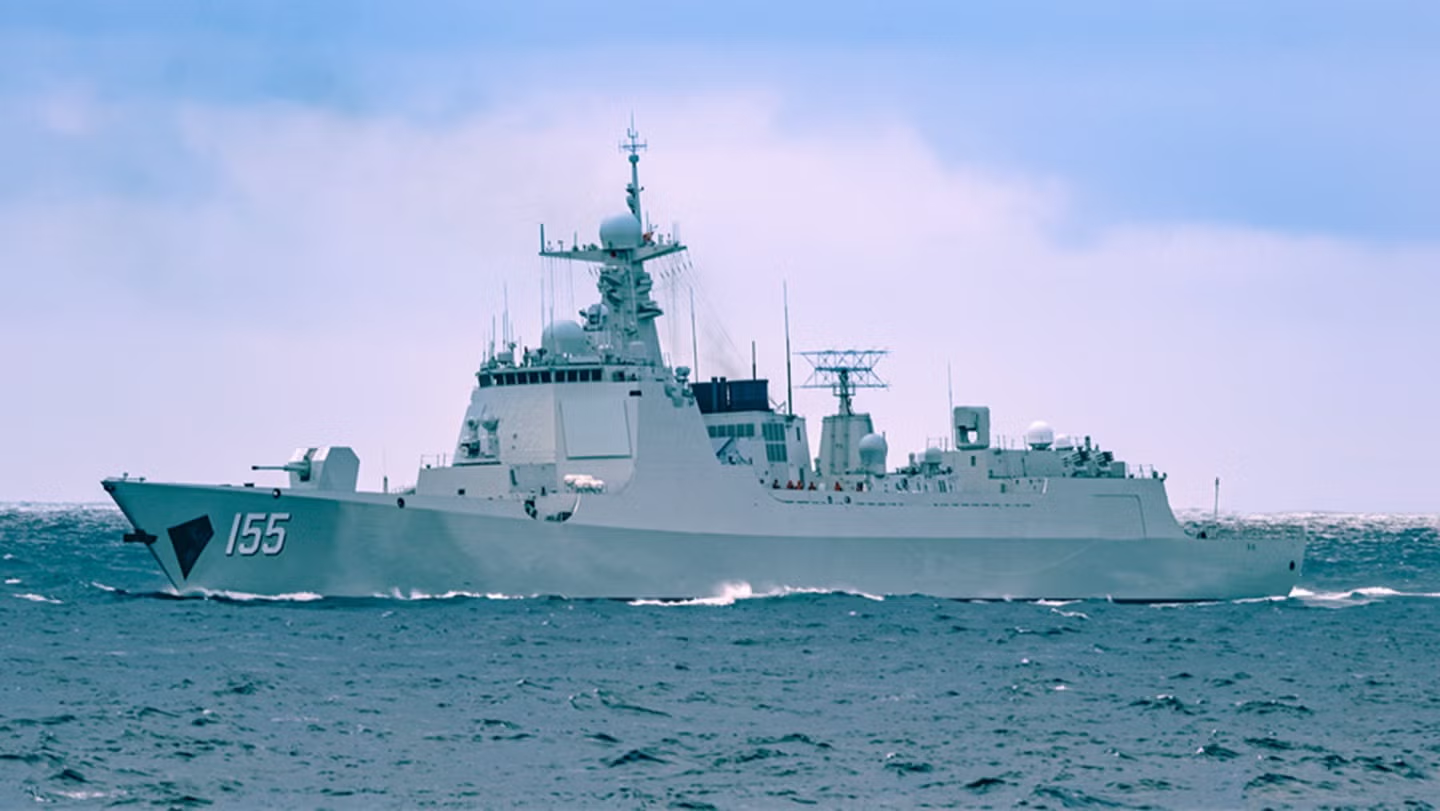
The main platforms of the Eastern Theater Command Navy destroyer squadron likely include the 052C, 052D, and some modernized ships. Taking the 052D as an example, the outside world usually focuses on its approximately 7,500-ton displacement, 64-cell vertical launch system, phased array radar, and weapon combinations like YJ-18 and HQ-9. However, this time the emphasis of the "maritime joint command" is not on firepower, but on command space, data link positions, and staff processes.
A 052D is originally a node for fleet air defense and anti-surface strike, but if it only retains naval internal staff, it resembles an enhanced version of a captain's command post. By embedding air force, air defense, electronic countermeasures, shore-based firepower, and even army amphibious direction staff, the meaning changes: this ship begins to undertake cross-service task distribution, target prioritization, and on-the-spot coordination. In simple terms, it shifts from "how does my ship fight" to "how do several combat units in this direction fight together."
Monitoring Tasks in the Taiwan Strait are Prompting New Processes
In the past, when discussing maritime and aerial monitoring in the Taiwan Strait, many people were accustomed to looking at how many ships and aircraft were deployed. This perspective is not wrong, but it easily overlooks a more critical question: who will synthesize what these sensors see into a coherent picture? When the Japanese destroyer transited the strait, the theater needed to assess its course, speed, accompanying air activities, electronic signal characteristics, and whether surrounding US military platforms were coordinating actions. A single vessel can track a target, but may not be able to independently complete the entire chain of judgment.
Therefore, the value of "multi-service staff on board" primarily lies in shortening the decision-making distance. Shore command posts are certainly more comprehensive, but the tactical windows in the strait, waterways, and island chain edges are often measured in minutes. If the ship already has air force and electronic countermeasure staff on board, when faced with a target suddenly changing course, activating fire control radar, or deploying unmanned platforms, the captain does not need to relay information through multiple layers to the shore and wait for feedback. This process optimization may not look like new equipment, but it could impact real combat more than adding a few more missiles.
Shortcomings are Also Clear
I do not believe this means the PLA has already acquired the mature maritime joint command experience of US aircraft carrier strike groups. There is very little public information, and at least three issues remain unclear: whether the onboard space can long-term accommodate multi-service staff; whether the data links, security levels, and command systems of different services are sufficiently smooth; and whether the backup links between shore, sea, and air can withstand high-intensity electromagnetic suppression.
- At the platform level, the 052D is suitable as a regional air defense and information node, but its tonnage, redundancy, and personnel space are still limited.
- At the process level, embedding staff on board is just the first step; the real challenge is to establish fixed templates for target allocation, firepower authorization, and damage assessment.
- At the production capacity level, the number of destroyers is increasing rapidly, but qualified joint staff cannot be produced in bulk like ship hulls.
This is also why I am more interested in this news. In recent years, discussions about the PLA's modernization have often focused on hardware like the Fujian aircraft carrier, J-20, and Type 055 destroyers. However, once entering the real scenarios of the Taiwan Strait and the first island chain, hardware is merely the foundation; the ability to temporarily integrate various services into an executable process is the second half of modernization.
Systematic Changes Observed from Training News
On the same day, the China Military Network also mentioned that a certain brigade of the 73rd Group Army improved its combat capability through "one training, two reviews," and the Southern Theater Air Force conducted aerial refueling training. These news items belong to the army, navy, and air force, seemingly unrelated, but when viewed together, they share a common thread: the PLA is shifting its training focus from showcasing single-platform performance to closing the loop on task chains.
The judgment in the style of Li Minghui is: the maritime joint command is not just a slogan, but an organizational project. It cannot produce beautiful photos like replacing radars, nor is it as easy to disseminate parameters as new missiles. However, if the Eastern Theater Command can solidify the onboard joint staff, maritime and aerial monitoring, shore-based firepower, and review mechanisms over the long term, daily military friction within the first island chain will become more difficult for adversaries to exploit. The real unanswered question is, when this onboard joint command encounters high-intensity electronic warfare, will it rely on data links, or on already trained personnel and processes?
The Eastern Theater Command Navy is integrating multi-service staff into a naval command structure aboard the 052D destroyer as of July 23, 2023, to enhance joint operational capabilities in the Taiwan Strait. This initiative aims to improve decision-making processes during military operations, particularly in response to activities such as the Japanese destroyer's transit through the Taiwan Strait. However, challenges regarding the long-term effectiveness of this command structure under high-intensity conditions remain.
- The Eastern Theater Command Navy is implementing a multi-service command structure aboard the 052D destroyer.
- This initiative aims to enhance joint operational capabilities in the Taiwan Strait.
- The integration includes personnel from air, naval, and electronic warfare units.
- The report highlights the need for improved decision-making processes during military operations.
- Concerns remain about the long-term viability of this command structure under high-intensity conditions.