
054B Luhe Ship Participates in Far-Sea Training with Liaoning Ship for the First Time, PLA Aircraft Carrier Group Addresses Anti-Submarine Shortcomings
 Li Minghui
054B Luohhe Ship Joins Liaoning Carrier for First High-Seas Training, PLA Aircraft Carrier Group Addresses Anti-Submarine Shortcomings
On May 25 at noon, the Japanese Joint Staff Office detected the Liaoning carrier group approximately 880 kilometers southwest of Okinotorishima. This location itself is not new, as the Liaoning has ventured into the Western Pacific multiple times in recent years; what is truly interesting is the addition of the Luohhe ship, hull number 545, to the group. It is the lead ship of the 054B class frigate, which only entered service in January 2025, and is now included in the carrier group, training alongside the Liaoning, the 055-class Wuxi, the 052D-class Kaifeng, and the 901-class Hulun Lake.
I wrote an article in the morning about military AI design tools, focusing on the R&D side. This article shifts to the operational side of naval equipment, as the inclusion of the 054B in the carrier group is not just a simple vessel update, but a signal that the PLA's aircraft carrier escort system is transitioning from a "large ship scale" to a "layered division of labor."
Japan Observed Not Just a Single Ship's Voyage
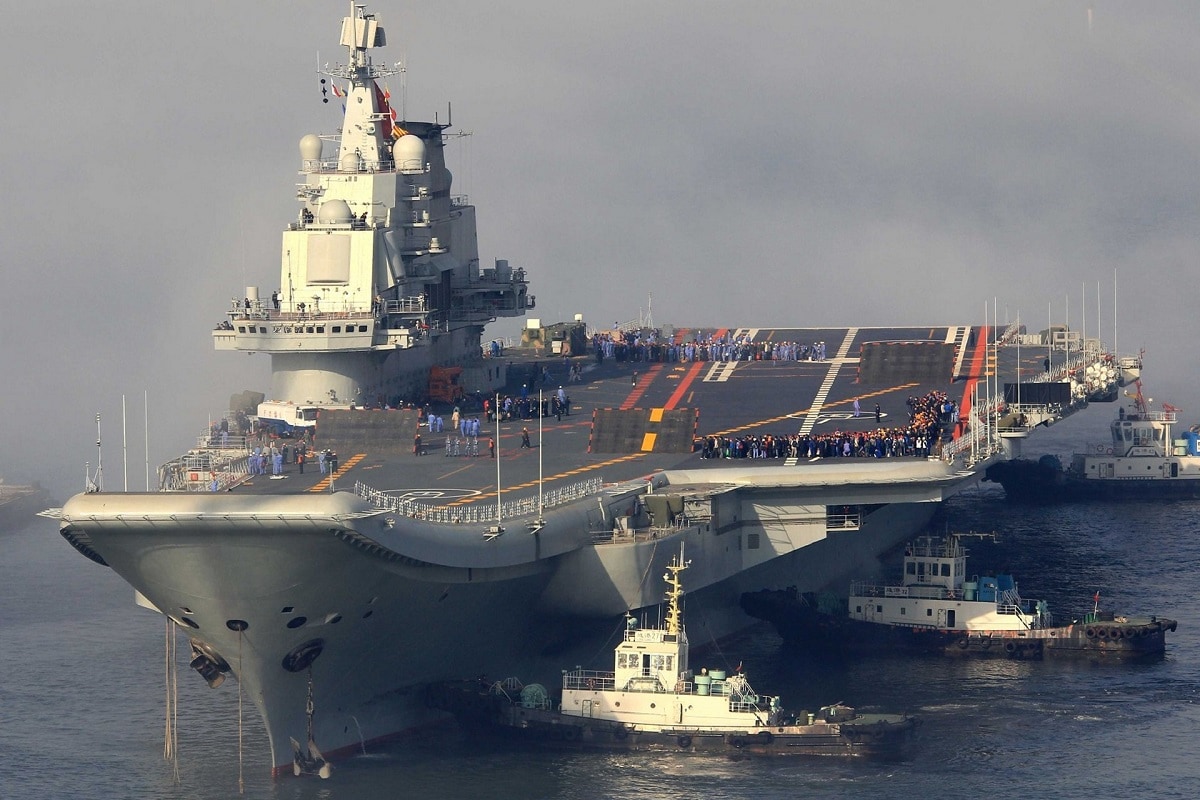
According to Naval News, based on announcements from the Japanese Joint Staff Office, the group tracked from May 25 to 26 included the Liaoning, the 104th 055-class destroyer, the 124th 052D destroyer, the 545th 054B Luohhe, and the 901st fast combat support ship Hulun Lake. The Japan Maritime Self-Defense Force dispatched the Asahi destroyer to monitor the situation, later confirming that the Liaoning conducted fixed-wing carrier-based aircraft and helicopter takeoff and landing training. The South China Morning Post also mentioned that this training took place in the Pacific east of the Philippines, and the Liaoning had previously entered the South China Sea on April 20 to observe the US-Philippines "shoulder-to-shoulder" exercises.
The Chinese Navy publicly stated on May 19 that the Liaoning carrier group was training in relevant areas of the Western Pacific, with subjects including high-seas tactical flight, live-fire shooting, support and cover, and comprehensive rescue. When looking at these items alongside the composition of the vessels observed by Japan, the focus becomes clear: this is not merely training for aircraft takeoff and landing, but testing a replicable configuration for a carrier battle group.
Why the 054B is More Suitable for Carrier Groups than the 054A
The 054A has been in service with over 30 vessels, making it the most typical high-seas frigate of the Chinese Navy in the past fifteen years. However, the 054A is more like a general escort platform, cost-effective, numerous, and capable of undertaking medium to low-intensity tasks. The 054B has a generally estimated displacement of about 5,000 tons, larger than the 054A, with upgrades in hull stealth treatment, integrated mast, phased array radar, and anti-submarine systems. Public information on its electric propulsion or integrated power details remains incomplete, and the claims circulating online should not be taken as conclusions, but from its appearance and mission configuration, the 054B clearly emphasizes quietness, sensor integration, and sustained high-seas operations.
The greatest shortcoming feared by a carrier group is not the visible air defense firepower, but underwater threats. The 055 and 052D can provide area air defense, anti-ship, and land strike capabilities, but they are not the most economical anti-submarine patrol platforms. When the carrier is moving at high speed, it requires a group of frigates capable of long-term towing sonar, deploying anti-submarine helicopters, and handling low-noise submarine contacts on the periphery. In simple terms, the 055 is like a heavy hammer, while the 054B is like a stethoscope; without the latter, the former, no matter how large, cannot clarify the underwater situation for the carrier.
The Five-Ship Group Reveals a Template
The composition of this group is worth breaking down:
- The Liaoning is responsible for training carrier-based aviation, still limited by its ski-jump deck, but can continuously train pilots and deck processes.
- The 055-class Wuxi is responsible for long-range air defense, command, and potential maritime strikes, serving as the high-end node of the group.
- The 052D-class Kaifeng supplements area air defense and general destroyer tasks.
- The 054B Luohhe is focused on anti-submarine operations, close-range escort, and outer-layer underwater vigilance for the group.
- The 901-class Hulun Lake provides fuel, aviation munitions, and supplies, crucial for extended high-seas presence.
This template is more specific than the past description of "an aircraft carrier plus several destroyers and frigates." My judgment is that the PLA is advancing the carrier group from training formations to task formations. Previously, when looking at the Liaoning, people were accustomed to asking how many sorties the J-15 could conduct; now the more pertinent questions should be whether the group has enough anti-submarine nodes, whether supply ships are accompanying throughout, and whether there is a maintained command link in high seas. The deployment of the 054B indicates that the Navy is no longer satisfied with merely showcasing the carrier itself, but is calibrating the system surrounding the carrier.
Rapid Progress but Shortcomings Still Exist
The Luohhe ship's entry into service in January 2025 and its participation in carrier operations in May 2026 occurred in just about 16 months. This pace is relatively fast for a new class of frigate. It may indicate that crew training, system testing, and group coordination have been tightly compressed, or it may suggest that some of the 054B's equipment continues to use mature technology, with risks not as high as perceived. However, I do not believe this means the 054B is fully mature. Anti-submarine capabilities are difficult to prove with a single high-seas appearance; the effectiveness of towed sonar, helicopter coordination efficiency, and low-noise target identification in complex sea conditions all require long-term data accumulation.
Another easily overlooked issue is that the strength of a carrier group's anti-submarine capabilities does not solely depend on a single 054B. The US carrier battle group relies on a combination of nuclear submarines, maritime patrol aircraft, surface ships, helicopters, and fixed underwater acoustic networks. The Chinese Navy can rapidly build surface ships, but high-seas anti-submarine aviation, accompanying nuclear submarines, and cross-domain data links remain more challenging to supplement. The inclusion of the 054B in the group is progress, but it should not be understood as a "one-time solution to shortcomings."
The True Signal of Training in the Western Pacific
Geographically, the area approximately 880 kilometers southwest of Okinotorishima is already outside the first island chain. The Liaoning training here can test supply and communication, while also allowing Japan, the Philippines, and the United States to observe that Chinese carrier activities are becoming normalized. In the same week, USNI News also reported on the incident involving the Dutch frigate De Ruyter being warned and electronically interfered with by Chinese forces near the Paracel Islands. When viewed together, the South China Sea and the Western Pacific are forming a continuous maritime game zone: one end features reefs, electronic warfare, and near-seas denial, while the other end showcases aircraft carriers, escort ships, and high-seas presence.
For the PLA Navy, the appearance of the 054B alongside the Liaoning in the Western Pacific is valuable not because "there is one more new ship," but because it brings to the forefront the parts of the carrier group that are least visible to the camera. The Liaoning is not the Fujian; the ski-jump deck means it will not suddenly transform into a strike platform like the US Nimitz class. However, if the Liaoning can continuously conduct live-fire, support cover, and comprehensive rescue operations with the 055, 052D, 054B, and 901-class supply ships, then its wartime value will not just be as a training ship, but as a practical node capable of consuming, restraining, covering, and validating tactics.
The question that still lacks an answer is: when the Fujian is fully combat-ready, will the 054B be prioritized for the electromagnetic catapult aircraft carrier, or will it continue to allow the Liaoning and Shandong, which are ski-jump carriers, to also have a complete anti-submarine escort layer? This allocation method may better illustrate the maturity level of the Chinese aircraft carrier fleet than the performance parameters of a single 054B.
Main Sources
This article synthesizes reports from Naval News on May 26 regarding the 054B's first entry into the Western Pacific with the Liaoning, the South China Morning Post's report on May 27 about the Liaoning's live-fire training, observations from Japanese media citing the Ministry of Defense's Joint Staff Office, and the Chinese Navy's announcement on May 19 about the Liaoning carrier group's training in the Western Pacific.
The People's Liberation Army Navy conducted training exercises in the West Pacific from May 25-26, 2023, involving the Liaoning aircraft carrier and the newly integrated 054B Luohe frigate. The naval group, which included five ships, performed fixed-wing and helicopter operations, showcasing a shift towards a more integrated naval task force. This exercise highlights the PLA Navy's evolving capabilities and operational strategies in the region.
- The 054B Luohe frigate participated in training with the Liaoning aircraft carrier for the first time.
- The training occurred in the West Pacific, approximately 880 kilometers southwest of Okinotorishima.
- The exercise included fixed-wing aircraft and helicopter operations from the carrier.
- The naval group consisted of five ships, including advanced destroyers and a supply ship.
- This training indicates a shift in the PLA Navy's operational strategy towards a more integrated task force.