
Video: What is the Background of the "Druitt" in Cross-Border Provocation? Military Expert Analysis
The Southern Theater Command recently announced: On May 27, the Dutch Navy frigate "De Ruyter" illegally intruded into China's Xisha Islands, with onboard helicopters repeatedly entering our airspace. The People's Liberation Army Southern Theater Command organized naval and air forces to take necessary measures such as verbal warnings and electronic jamming to drive it away in accordance with the law and regulations.
Latest videos show that the Chinese Navy ships 631 and 626 closely drove away the Dutch Navy frigate "De Ruyter," while the Chinese Navy ship 553 issued warnings in English to the Dutch NH-90 helicopter.
Colonel Zhai Shichen, spokesperson for the Southern Theater Command, stated that the actions of the Dutch side seriously infringe upon China's territorial sovereignty and maritime security, severely violate international law and the basic principles of international relations, and seriously undermine peace and stability in the South China Sea, which could easily lead to misunderstandings and misjudgments. We firmly oppose this and warn the Dutch side to immediately stop its infringing and provocative actions. The theater forces remain on high alert at all times to resolutely defend national sovereignty and security as well as regional peace and stability.
The "De Ruyter" has been in service for over 20 years, with capabilities comparable to a destroyer.
The "De Ruyter," acting as a vanguard of provocation and infringement, belongs to the seven provincial-level air defense frigates and is a main combat vessel of the Dutch Navy. As one of the less prominent European naval powers, this class of frigate is the most advanced warship that the Netherlands can present. Military expert Li Yaqiang explained that this type of ship was designed and built in the early 21st century. Although it is called a frigate, its capabilities are already comparable to those of a destroyer.
Military expert Li Yaqiang: The "De Ruyter" is a type of frigate developed in collaboration with Germany. It is known as a "shield ship," capable of tracking hundreds of targets and has strong air defense capabilities. Theoretically, it may also possess some ballistic missile defense capabilities, with a displacement of nearly 7,000 tons, which should be said to reach the level of a destroyer. Built a bit earlier, with over twenty years of service, its performance cannot match our 052D.
Driving away, the PLA has shown considerable restraint.
According to the announcement from the Southern Theater Command, the "De Ruyter" illegally intruded into China's Xisha Islands, and the Southern Theater Command took necessary measures such as verbal warnings and electronic jamming to drive it away in accordance with the law and regulations. Li Yaqiang analyzed that there are various maritime law enforcement methods, and the PLA has shown considerable restraint in driving away the Dutch warship.
Military expert Li Yaqiang: There are many law enforcement methods for warships at sea. For violations of our territorial waters, we will take the most resolute measures to stop them. We now use very high frequency (VHF) radio for verbal warnings, notifying them: you are infringing on our territorial waters, you must leave immediately, and an expulsion order will be issued. If they continue to infringe, we will resort to radio jamming or even signal flares. In more serious cases, we may fire warning shots, and by the time warning shots are fired, the situation is already very tense. Collision is a method that comes just after the use of force.
Origin of the ship's name: both a famous Dutch naval commander and a notable sunken ship from World War II.
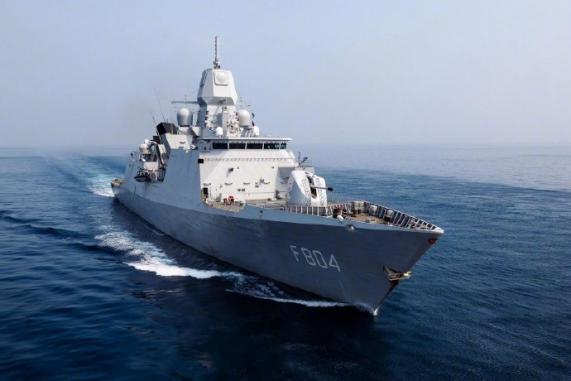
△ "De Ruyter"
De Ruyter was an important naval commander of the Netherlands in the 17th century and is considered the greatest naval commander of the Netherlands. The Dutch Navy uses his name as the highest class of ship name, prioritizing it for flagships, main cruisers, or frigates. The most famous is the seventh-generation De Ruyter light cruiser, which was sunk by Japanese warships during the Battle of the Java Sea in World War II.
Military expert Teng Jianqun pointed out that in response to the infringement by the Dutch warship, the PLA dispatched ships and aircraft to drive it away, which is completely legal and compliant.
Military expert Teng Jianqun: From a legal perspective, we have established baselines for territorial waters around the Xisha Islands, and we have also declared the extent of our territorial waters and airspace. The presence of Dutch warships and aircraft within our territorial waters is clearly an infringement of China's sovereignty and maritime rights. Our dispatch of ships and aircraft to drive them away is also a legitimate defense. We can send vessels and aircraft to counter such provocative actions by the Dutch. This should be seen as a lawful defense of our maritime rights and the protection of our territorial sovereignty.
What is the intention behind the Dutch ship's visit to the Philippines and cross-regional provocation?
According to a report from the Philippine News Agency on the 22nd, the Dutch Navy frigate "De Ruyter" visited Manila for a three-day visit. This visit is part of the Dutch Royal Navy's five-month so-called "Pacific Archer" overseas deployment mission. During its visit to the Philippines, the ship conducted several joint exercises with the Philippine Navy, including communication drills and maneuver exercises.
Far away in Europe, the Netherlands is sending warships deep into the Asia-Pacific to conduct military activities in conjunction with other countries. What hidden motives lie behind such cross-regional military actions?
Military expert Teng Jianqun: The Netherlands has been continuously sending warships to the Western Pacific region, for example, deploying vessels and aircraft in the company of other European countries to operate in the Western Pacific. Although its naval power is not that strong, it sends warships to accompany the fleets of other countries. This clearly indicates an intention to extend its "reach" into the Asia-Pacific region to demonstrate its so-called interests in this area. The Netherlands' policy choice to assert its presence is a blatant provocation of China's territorial sovereignty, and intruding into the Xisha Islands is clearly an absolutely reckless and provocative act. This is intended to make the international community aware of the Netherlands' presence in the region, and such provocations can only be met with a strong counterattack.
Supervised by: Huang Xianwen, Wu Zhehua
Reporter: Yang Jun Tian, Wei Ran
On May 27, 2023, Chinese naval forces drove away the Dutch frigate 'De Ruyter' after it illegally entered Chinese territorial waters near the Xisha Islands. The Chinese People's Liberation Army issued voice warnings and employed electronic interference to ensure the vessel's departure. This incident reflects ongoing tensions in the South China Sea as the Dutch frigate is part of a broader military deployment in the region.
- Dutch frigate 'De Ruyter' illegally entered Chinese territorial waters near the Xisha Islands.
- Chinese naval forces issued warnings and used electronic countermeasures against the Dutch vessel.
- The incident occurred on May 27, 2023, and involved multiple Chinese naval ships.
- The Dutch frigate is part of a broader deployment in the Asia-Pacific region.
- Military experts highlighted the legal justification for China's actions in defending its territorial integrity.