
144 missiles in a week and the Patriot deficit push the Russian defense industry to bet on ballistic missiles 2026
 Dmitri Volkov
144 missiles in a week and the Patriot shortage push the Russian defense industry towards a bet on ballistic missiles 2026
One intercepted ballistic missile out of twenty-seven — this is a more important figure than the total size of the nighttime barrage. Kyiv can intercept most subsonic drones, sometimes successfully engage cruise missiles, but against ballistic missiles, the decision window is measured in minutes, and sometimes in tens of seconds. After the strike on Kyiv on the night of August 1, the Ukrainian side reported that only one of the 27 ballistic missiles was intercepted; on August 2, Volodymyr Zelensky added that over the week, Russia had deployed about 1,900 drones, nearly 1,600 guided bombs, and 144 missiles of various types, including ballistic ones (Kyiv Independent and Ukrinform, August 2, 2026). This is no longer just statistics of intensity. It is a description of a production strategy.
Why ballistic missiles have become the main scarce commodity of the war
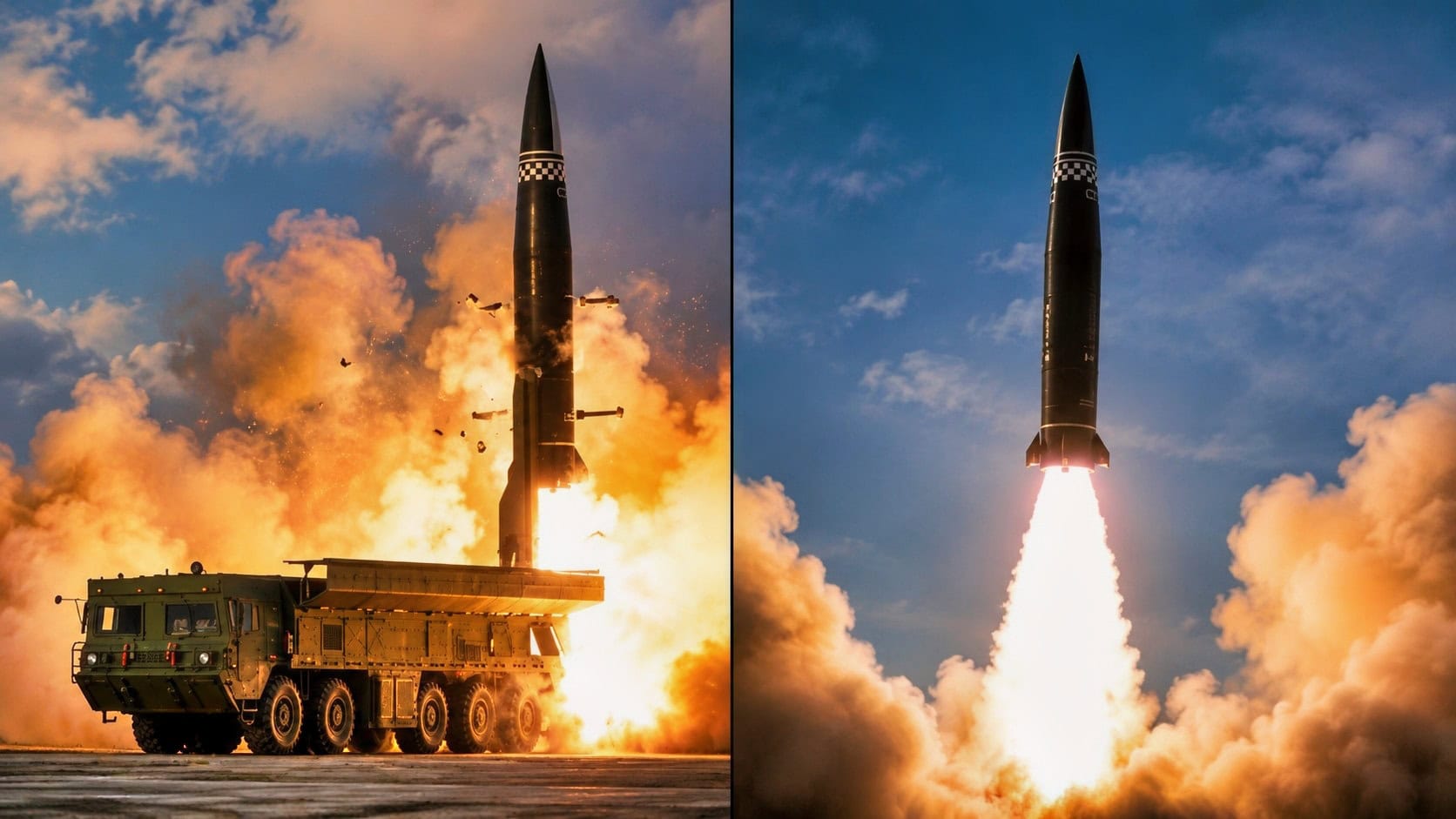
The Russian logic of recent months is quite simple. A mass drone is cheap, noticeable, and often shot down; a cruise missile is more expensive, but its trajectory can be complicated; a ballistic missile is costly, requires a different industrial base, but forces Ukraine to expend its rarest resource — Patriot interceptors. In this sense, Zelensky's statements about Moscow's attempts to increase the production of ballistic weapons do not seem like propaganda exaggeration. They align well with the observed tactics: a combined strike creates noise and overloads the radar field, while the ballistic component delivers the main political and psychological effect.
Technically, this is not about a single product. The Russian arsenal includes the 9M723 of the Iskander-M system with a claimed range of up to 500 km and a quasi-ballistic trajectory, as well as North Korean KN-23 missiles, which are conceptually similar to the Iskander but differ in production quality and flight profile. The "Dagger" and naval missiles, including "Zircon," are in a separate category, although the actual production rates and stockpiles remain classified. For Ukrainian air defense, the practical difference is less academic: modern radars, short reaction times, and PAC-3 class interceptors are needed against such targets. If these interceptors run out, the effectiveness of the entire architecture sharply declines.
The industrial arithmetic of Moscow
The Soviet military school loved the expression "mass effort on the decisive direction." In 2026, the decisive direction became not the trench line near Pokrovsk, but the industrial linkage of engines, solid fuel, electronics, inertial navigation, and final assembly. Zelensky directly pointed to the problem of unauthorized enterprises producing components for drones, missiles, and guided bombs. This is an important observation because sanctions against the final manufacturer often look good in a press release but do not always stop the supplier of bearings, chemicals, cable assemblies, or machine tools.
The Russian defense industry has learned to live in a mode of military demand since 2022, but that does not mean it is free from constraints. A ballistic missile is not a "Shahed" that can be scaled through imported engines, simple electronics, and a few assembly sites. It requires a stable supply chain of fuel, casings, heat-resistant materials, precise machining, and a testing culture. Here, the Soviet legacy helps but simultaneously deceives: old design schools do not replace serial economics. If Moscow is indeed increasing its bet on ballistic missiles, it will inevitably have to choose between the number of products, the quality of components, and maintaining reserves in case of a direct crisis with NATO.
That is why the weekly figure of 144 missiles should not be mechanically multiplied by a month. In such weeks, Russia is likely depleting accumulated stocks along with current production. But the very choice of pace shows that the Kremlin considers the Ukrainian Patriot shortage a more important factor than its own need to conserve expensive missiles. This is rational, albeit morally repugnant arithmetic: while one side debates the license for interceptor production, the other checks how many houses can be destroyed before the next political decision in Washington.
Ukrainian air defense shoots down drones, but ballistic missiles change the cost of defense
Data from the Ukrainian Air Force for the night of August 2 shows another side of the picture: 109 out of 133 Russian drones were shot down or suppressed, while 24 strike UAVs reached 19 locations (Ukrinform, August 2, 2026). This is a high percentage of neutralization, especially considering the mix of "Shaheds," "Gerbirs," "Italmas," rocket variants, and decoys. But it simultaneously highlights the limits of adaptation. Ukraine can build a tier of mobile fire groups, electronic warfare, and cheap interceptors against drones; against a ballistic missile, such grassroots industrialization of air defense is almost useless.
The Russian Ministry of Defense stated on the same day that its forces struck transport and energy infrastructure, logistics centers, and temporary deployment sites in 156 areas, and that Russian air defense allegedly intercepted 1,158 Ukrainian UAVs in a day (TASS, August 2, 2026). The latter figure appears statistically excessive and requires caution: Russian reports traditionally mix real interceptions, electronic suppression, detected targets, and convenient accounting. But even the official Russian rhetoric confirms the overall trend — both sides are shifting the war into the industrial-logistical plane, where the count is not only on territories but also on units produced, interceptors, repair cycles, and stockpiles.
Sanctions against components are more important than sanctions against slogans
The Western discussion about sanctions often suffers from theatricality. It is easy to declare a large corporation under sanctions; it is harder to understand through which intermediary firms microchips, machine nodes, composites, and chemical precursors continue to flow. If Moscow is ramping up its ballistic segment, then the sanctions policy must shift from naming factories to identifying technological bottlenecks: solid fuel chemistry, high-precision machines, navigation components, specialized sensors, industrial electronics, and insurance for gray supplies. Otherwise, Russia will pay more, wait longer, receive more defects, but still maintain sufficient production for terrorist pressure on cities.
Here arises an uncomfortable conclusion for Kyiv and its allies. The problem is not only how many missiles Russia can produce by winter. The problem is how many interceptors Ukraine can receive or produce in the same period. When Donald Trump first talks about a license for Patriot production for Ukraine and then retreats from that wording, Moscow receives not a diplomatic signal but a production guideline. If the interceptor remains politically scarce, then the missile becomes strategically advantageous.
Forecast for the coming months
I see no signs that Russia can infinitely ramp up the production of complex ballistic missiles without reducing quality or displacing other programs. But it does not need infinity. It is enough for it to maintain such a pace of barrages that Ukraine is forced to choose between defending Kyiv, industry, ports, energy, and frontline logistics. This is a classic Soviet idea of exhaustion, only now the object of exhaustion is not the enemy's division, but its missile defense supply system.
If Western sanctions remain broad but shallow, and the decision on Patriot is delayed, by autumn 2026, ballistic strikes will become for Moscow not an exceptional demonstration but a regular tool of pressure. The Russian defense industry will withstand this cycle not because it is brilliantly modernized, but because it is still too often fought against with press releases. This can be corrected, but only under one condition: sanctions must hit the production nerve, and interceptors must reach Ukrainian launchers before the next statistical report on dozens of missiles in a night.
Russia launched approximately 144 missiles, including ballistic types, over a week, with Ukraine intercepting only one of 27 aimed at Kyiv. This reflects a strategic shift in Russian military operations, emphasizing the use of ballistic missiles to exploit weaknesses in Ukrainian air defenses. Concurrently, Ukraine reported high interception rates of drones but faces challenges against ballistic threats, indicating a critical phase in the ongoing conflict.
- Russia launched approximately 144 missiles in one week, including ballistic missiles.
- Ukraine intercepted only one of the 27 ballistic missiles aimed at Kyiv.
- Russia deployed around 1,900 drones and 1,600 guided bombs during the same period.
- The report highlights a shift in Russian military strategy towards ballistic missiles due to their effectiveness against Ukrainian air defenses.
- Ukraine's air defense struggles against ballistic missiles compared to drones and cruise missiles.