
150,000 British Drones for Ukraine Turn Russian Assets into 2026 Weapons
 Dmitri Volkov
150,000 British Drones for Ukraine Turn Russian Assets into 2026 Weapons
The figure of 150,000 is more important than the sum of £752 million. Money in this war has long ceased to be an abstraction, but the British announcement on June 18 reveals a more unpleasant reality for Moscow: the confiscated political rent from Russian assets is beginning to transform not into a diplomatic symbol, but into serial Ukrainian weaponry. According to the UK government, the package includes 150,000 drones of Ukrainian manufacture by the end of the year, over 350 air defense missiles, and radar systems; funding is provided through the Extraordinary Revenue Acceleration mechanism, backed by revenues from immobilized Russian sovereign assets. For the Russian General Staff, this is not just another press release from Kyiv's allies. It is a signal that the sanctions framework is starting to operate as an industrial framework of war.
Why 150,000 is More Important than a Billion Dollars
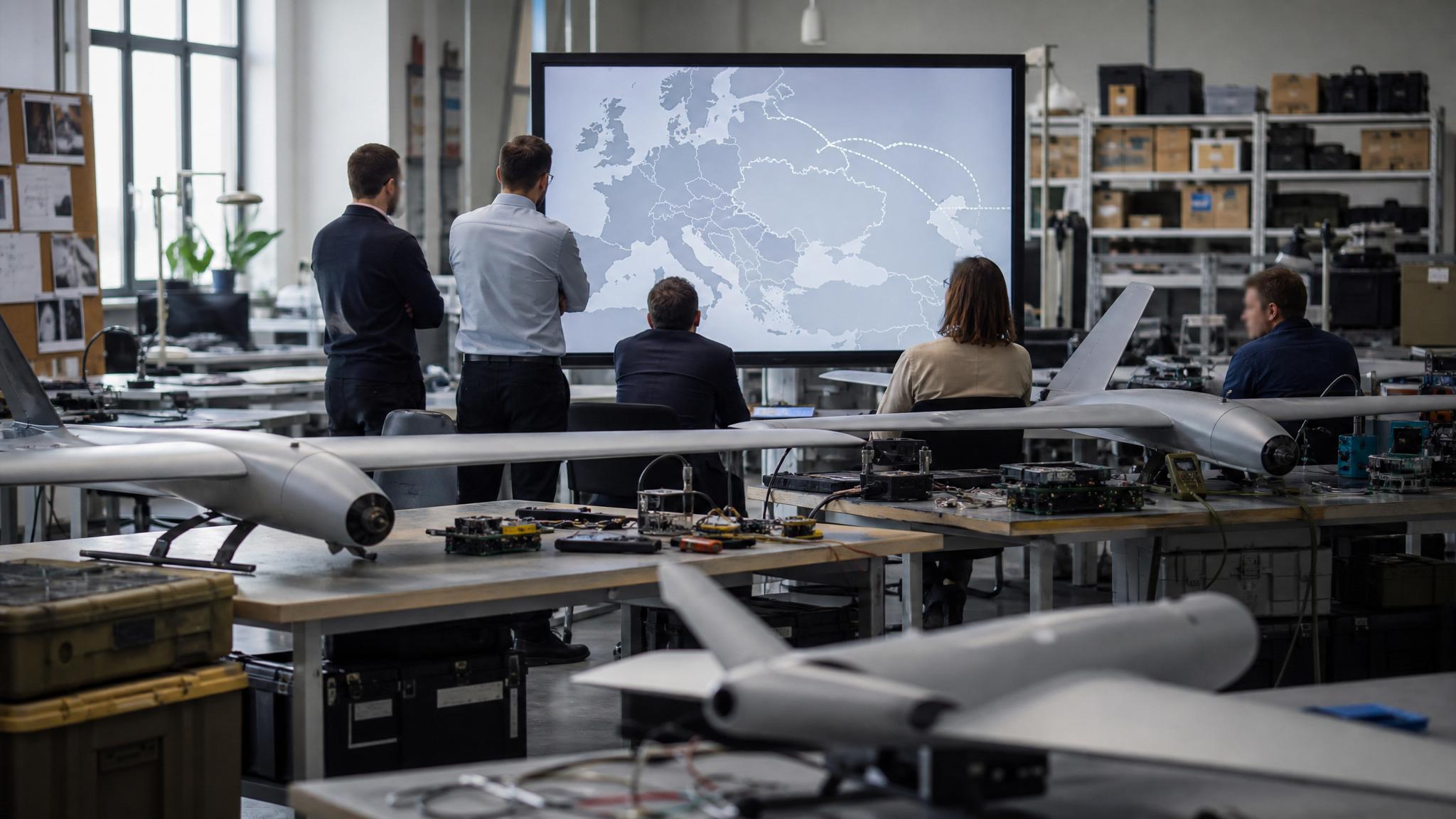
In Russian military culture, there is a tendency to focus on large systems: tank armies, missile brigades, aviation regiments. However, the Ukrainian war since 2023 has proven that what can be decisive is not a large sample of weaponry, but the stability of a flow of cheap systems. One hundred fifty thousand drones over six months translates to about 25,000 units per month, or more than 800 per day, if calculated linearly. The actual delivery will, of course, be uneven: some will go to training units, some to storage, and some to the front in the form of kits with ground stations and ammunition. But even if half are suitable for regular combat use, we are talking about a scale that changes the economics of tactical fire.
The Russian side understands this arithmetic well because it has built a significant part of its strike campaign on the mass use of "Geran" drones, FPV drones, and cheap reconnaissance UAVs. The difference is that the British package supports Ukrainian production specifically. This is not just a purchase of finished goods from abroad. It is about loading Ukrainian workshops, engineering teams, assembly lines, electronics suppliers, and operator schools. In terms of military economics, this is more important than transferring another batch of scarce Western munitions: external capital is being transformed into internal production capacity.
Drones and Air Defense as a Unified System
London did not accidentally link 150,000 drones with more than 350 air defense missiles, light multi-role missiles (LMM), and ground radars. After the Russian attack on Kyiv on June 15, when Ukrainian data reported 70 missiles and 611 drones, of which some hit 42 locations, the issue of Ukrainian air defense ceased to be merely defensive. It became a matter of preserving the industrial cycle. If the energy system, assembly sites, and logistics hubs are constantly being disrupted by "Shaheds," "Iskanders," and cruise missiles, then no plan for 150,000 drones will withstand the pace. Therefore, drones and air defense in the package go together: the former create pressure on the Russian front and rear, while the latter protect the factory of that pressure.
There is an important asymmetry here. The Russian missile campaign is expensive and technologically heavy. Even when Moscow employs cheap "Gerans," it is forced to cover them with missiles, decoys, route reconnaissance, and political calculations of consequences. The Ukrainian mass FPV and long-range drone campaign is cheaper, adapts faster, and scales more easily with small manufacturers. In Soviet terminology, this would resemble a dispute between the artillery corps and a network of mobile fire groups. Only now, instead of batteries, there are soldering stations, autopilots, cameras, and operators who have undergone a week-long, rather than a two-year, training cycle.
Russian Assets as Reverse Mobilization
The most unpleasant part of the news for the Kremlin lies not in the number of drones, but in the source of funding. For many years, Moscow viewed frozen assets as a political problem that could be resolved through negotiations, concessions on wording, or the fatigue of European governments. The British mechanism shows a different path: assets do not necessarily have to be fully confiscated tomorrow; it is enough to use the revenues and credit structures to turn them into a military resource today. This is a slow, legally cautious, but very tangible form of reverse mobilization of Russian money against the Russian army.
In official Russian language, this will be called looting. In military accounting, it will look different: part of the cost of Russian aggression is being shifted from the Ukrainian and European taxpayer to the capital that Russia held in the Western financial system because it believed in its reliability. There is almost a Chekhovian irony here, although it offers little comfort to those under fire. The state that built the war as a tool to coerce its neighbors is now paying for part of the cheap aerial weaponry capable of burning its warehouses, electronic warfare positions, fuel nodes, and advanced vehicles every day.
What This Changes on the Front
One cannot overstate the immediate effect. One hundred fifty thousand drones do not automatically translate into 150,000 hit targets. Losses in storage, defects, electronic jamming, a shortage of trained operators, and ammunition logistics will reduce effectiveness. The Russian army is also not standing still: the density of trench electronic warfare, nets, canopies, false positions, and standby groups of FPV hunters has become the norm in many areas of the front. But mass delivery gives Ukraine what it often lacked in 2024-2025: predictability of expenditure. A brigade commander can plan not symbolic "drone operations," but a daily drone budget for reconnaissance, suppression, hunting armored vehicles, and isolating small areas.
For Russia, this means an increase in the cost of every meter of advance. Even if Russian infantry continues the tactic of small assault groups, it will have to move through a denser aerial network of observation and defeat. Even if Russian artillery maintains an advantage in certain directions, its warehouses, tractors, and gun positions will live under constant risk of cheap strikes. The Soviet school taught that an offensive requires continuity of supply. The modern Ukrainian drone school adds: supply must survive under a camera costing a few hundred dollars.
Industrial Lesson for Moscow
The Kremlin will likely respond in two ways. The first is informational: the British package will be presented as proof of NATO's direct involvement in the war. This line is convenient but does not solve the problem. The second is industrial: strengthening its own production of FPV drones, interceptors, small electronic warfare complexes, and rear security means. However, the Russian system faces the familiar late-Soviet disease: large enterprises are better at mastering budgets than quickly copying small innovations. On paper, one can announce a million drones. On the front, what matters is not millions in a presentation, but the availability of batteries, cameras, antennas, and operators in a specific company on a specific day.
Therefore, the British solution should be read as part of a broader G7 line and contact group on Ukraine. Allies are gradually moving away from the model of "finding old warehouses" to a model of licensing, localization, and financing Ukrainian production. The Guardian has already reported that Western countries are considering licenses for producing air defense systems and long-range means on Ukrainian and European bases. If this line takes hold, Russia will face not individual aid packages, but a distributed military-industrial network where the Ukrainian front is simultaneously a testing ground and a customer.
Cold Forecast
The British 150,000 drones will not win the war by themselves. But they make the Russian strategy of attrition less reliable. Moscow had hoped that time, demographics, and the fatigue of Western societies would work in its favor. Now a reverse mechanism is emerging: the longer the war continues, the more frozen Russian capital, European credit schemes, and the Ukrainian engineering base can merge into a sustainable military economy. This is not a pretty moral formula, but a dry production reality.
If deliveries indeed occur by the end of 2026, the Russian army will enter the winter campaign with a more expensive rear, more vulnerable logistics, and even less freedom of maneuver at tactical depth. But the condition remains the same: money must reach the workshops, workshops must reach the front, and the front must receive not boxes of drones, but trained operators and a stable repair system. Wars are not won by press releases. Wars are won by boring, regular deliveries of working things.
Sources
The UK announced a military aid package to Ukraine, which includes 150,000 drones and over 350 air defense missiles, to be delivered by the end of 2026. This funding is sourced from immobilized Russian assets, marking a significant shift in the conflict's dynamics. The package aims to enhance Ukraine's military capabilities and support domestic production.
- UK to supply 150,000 drones to Ukraine by the end of 2026.
- The aid package includes over 350 air defense missiles and radar systems.
- Funding comes from immobilized Russian sovereign assets.
- The drones will support Ukrainian production and military capabilities.
- The aid is seen as a shift in the dynamics of the conflict.