
200 thousand rubles for the sky over the oil refinery — Gazprom gets involved in Russian air defense 2026
 Dmitri Volkov
200 thousand rubles for the sky over the oil refinery — Gazprom gets involved in Russian air defense 2026
The most important military news of early July is not that Ukrainian drones have once again targeted an oil refinery hundreds of kilometers from the border. Moscow has already gotten used to this, although it publicly pretends that these are unfortunate episodes. Much more important is another fact: according to ISW, citing the German publication Echo, the state gas giant "Gazprom" has signed a contract with the Russian Ministry of Defense to create mobile fire groups to protect gas infrastructure. Participants are promised 200 thousand rubles per month during a two-month training period, separate payments from the military department, and a three-year inclusion in the mobilization reserve. Thus, the Russian air defense, once built as a hierarchical state system, is turning into a network of corporate-military firefighting teams.
Corporate air defense instead of a unified umbrella
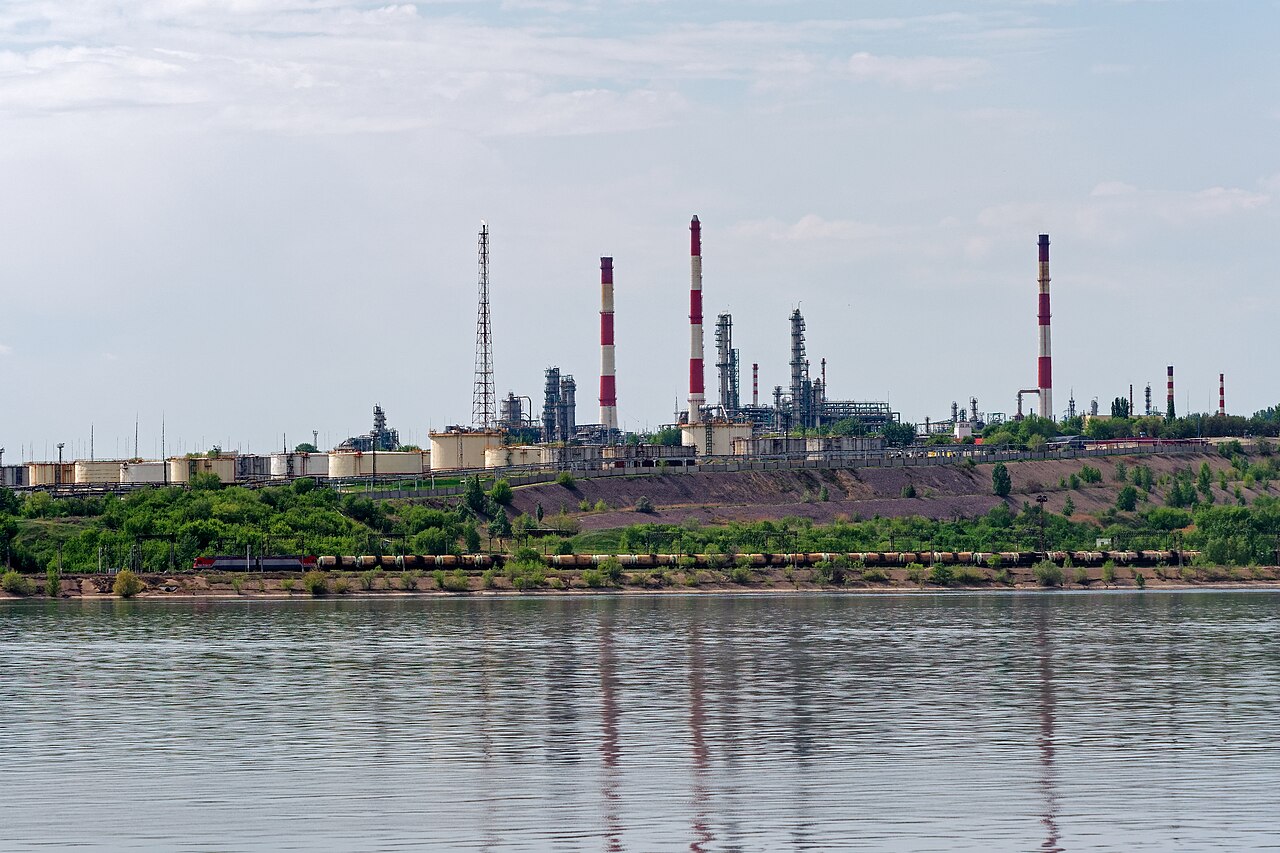
The Soviet air defense school was based on a simple, almost crude idea: strategic objects are covered in layers, and responsibility is distributed from top to bottom. The radar field, fighter aviation, anti-aircraft missile units, and object defense troops were supposed to work as a single machine. Current Russian practice shows the opposite. If separate mobile groups with special payment conditions have to be created to protect the gas monopoly's infrastructure, it means that the regular military and National Guard system does not cover the emerging threat. This does not necessarily mean collapse; the Russian state knows how to improvise. But it does mean that the cost of rear protection has become a separate budget line for corporations, not just a task for the General Staff.
Formally, mobile fire groups seem rational. Ukrainian long-range drones are cheaper than air defense missiles, fly low, and choose not always military but strategically sensitive targets: oil depots, oil refineries, electrical substations, ammunition depots, airfields. Against such targets, an expensive missile from the S-300 or S-400 complex is often economically unfeasible, and sometimes simply unavailable in the right place. A pickup truck with a heavy machine gun, thermal imager, spotlight, portable air defense system, and a crew familiar with the terrain can cover some gaps. Ukraine itself built a similar system to protect cities from "Shaheds." The difference is that Kyiv did this as a forced territorial defense under fire, while Moscow is now forced to transfer such logic to its own energy depth.
Why the strike on Yaroslavl is more important than the front line map
On July 6, The Kyiv Independent reported on a supposed Ukrainian strike on an oil refinery in Yaroslavl, about 700 kilometers from the Ukrainian border. The publication cautiously noted that it could not independently confirm all the details, but the pattern itself is well known: Ukrainian forces regularly use long-range drones against Russian oil infrastructure. Even more importantly, these are no longer isolated symbolic attacks. According to Ukrainian Defense Minister Mykhailo Fedorov, the number of successful strikes on targets more than 50 kilometers from the contact line nearly doubled in June; over the month, more than 200 thousand targets of various types were hit, according to Ukrainian estimates. Even if these figures are inflated in the military rhetoric of Kyiv, the direction of change is hard to deny.
In Crimea, the picture is even more telling. Ukrainian sources reported hits on the Gvardeyskoye airfield, supply bridges, ammunition depots, and 16 electrical substations within 48 hours. The commander of the Drone Forces, Robert Brovdi, published a list of targets and visual materials indicating a decrease in the illumination of the peninsula. For Russia, Crimea is not just an occupied territory, but a showcase of military integration, a base for the Black Sea Fleet, and a logistics hub for the southern theater. If it has to extinguish the consequences of strikes on power grids there, then the talk of a "reliable rear" becomes a ritual formula rather than an operational description.
Personnel as the bottleneck
The key issue is not technology, but people. ISW notes that the Russian "Nevsky" brigade is also recruiting fighters for mobile fire groups, and Russian military bloggers claim that elements of the 810th Marine Brigade of the Black Sea Fleet are already participating in counter-drone defense in Crimea. This is an important detail. The 810th Brigade is not a security company at a factory, but a unit that Moscow has regularly used on the front. If its elements are needed to fight drones over Crimea, it means that rear defense is competing with the front for trained personnel, communications, transport, and command resources.
The Russian mobilization system has previously been built on hidden redistribution of the load. Volunteer battalions, regional payments, contract schemes of enterprises, private military structures — all of this allowed the Kremlin to avoid large-scale open mobilization. But mobile fire groups around gas and oil infrastructure add a new level: now not only the front absorbs society, but the rear industry begins to live in a military organizational logic. A worker can retain a civilian job, undergo training, and simultaneously become a reservist. From the state's perspective, this is convenient. From the economic perspective, it is a slow militarization of the workforce, especially in regions where energy enterprises are the main employer.
The cost of defense and the vulnerability of the economy
The Russian government continues to speak the language of technological sovereignty. On the same day, TASS quoted Mikhail Mishustin: machine engineering grew by almost 8% in the first five months of 2026, and the manufacturing industry added almost 23% over three years. Uralvagonzavod informed TASS about the continuation of comprehensive modernization of the T-80BV, including firepower, protection, mobility, and crew management. These reports should not be automatically dismissed as propaganda: Russian industry has indeed adapted better than many Western observers expected in 2022. But industrial growth does not negate the question of the war's margin. If factories produce more but simultaneously require additional protection from cheap drones, the cost of military production rises not only in the shop but also around the shop.
There is an unpleasant arithmetic for Moscow here. A drone that reaches an oil refinery or substation can cost an order of magnitude less than the damage from halting a technological line, a fire, insurance costs, redeployment of repair crews, and the introduction of fuel restrictions. The Kyiv Independent reminded that Russia has already faced queues at gas stations, export restrictions, rising prices, and even a softening of gasoline quality standards. Putin has publicly acknowledged that "queues at gas stations" and shortages of necessary fuel grades persist. In a normal economy, this is a business problem. In a wartime economy, it is a question of operational resilience: fuel is the blood of the army, railways, agriculture, and internal logistics.
What this means for the war
One should not make the cheap conclusion that Russian air defense has "failed." Such a formula is convenient for headlines but poorly explains reality. Russia remains one of the most saturated countries with air defense systems in the world, and Ukrainian strikes occur not because the sky is empty, but because the territory is vast, there are too many objects, and the threat has become mass and cheap. In Soviet textbooks, this was called the problem of the ratio of forces and means. You cannot place an S-400 division at every tank, every pumping station, and every transformer. Therefore, Moscow is forced to lower air defense down — to enterprises, reservists, volunteer units, former front-line units.
The Russian army is not so much losing the ability to protect the rear as it is being forced to acknowledge that the rear has ceased to be a separate category. For a country used to thinking in terms of strategic depth, this is a painful change.
In the coming months, we are likely to see an expansion of such schemes: more corporate contracts, more local fire groups, more mixing of civilian infrastructure and military service. This may reduce some damage from Ukrainian drones, especially against single devices. But it will not solve the main problem — the competition between the front, industry, and rear defense for the same limited human resource. The Russian system knows how to stretch. History shows that sometimes for a very long time. But elasticity does not equal infinity, and it is on this limit that the Ukrainian campaign of long strikes is now trying to play.
Sources
- Institute for the Study of War, Russian Offensive Campaign Assessment, July 5, 2026.
- The Kyiv Independent, reports from July 5–6, 2026, on Yaroslavl, Crimea, and Ukraine's long strikes.
- TASS, publications from July 6, 2026, on the modernization of the T-80BV, industrial growth, and Russian-Chinese exercises with drone systems.
Gazprom signed a contract with the Russian Ministry of Defense to establish mobile fire groups for protecting gas infrastructure in July 2026. Participants will receive 200,000 rubles per month during training. Ukrainian forces have reportedly increased successful strikes on Russian infrastructure, prompting a shift in defense strategy that now includes corporate entities. This indicates a significant adaptation in Russia's military logistics and defense approach.
- Gazprom has contracted with the Russian Ministry of Defense for mobile fire groups.
- Participants in the program will receive 200,000 rubles per month during training.
- Ukrainian forces have increased successful strikes on Russian infrastructure.
- The Russian military is adapting its defense strategy to include corporate entities.
- The situation indicates a shift in the defense of critical infrastructure in Russia.