
2026 ADMM Plus Maritime Cooperation Activities with USS Canberra and P-8A: Japan, the United States, and the Philippines Operationalizing Maritime Cooperation Among Eight Countries
 S.W
S.WUSS Canberra and P-8A in 2026 ADMM Plus Maritime Cooperation Activities: Japan, the U.S., and the Philippines Operationalizing Maritime Cooperation Among Eight Countries
On September 20, the joint cooperative activities of the ADMM Plus Maritime Security Experts Meeting (MS JCA) began, starting from Yokosuka. Co-hosted by Japan and the Philippines, eight countries including Australia, Brunei, India, New Zealand, Singapore, and the United States deployed vessels, aircraft, and personnel. While it may seem like a mere goodwill event, for the Japan Maritime Self-Defense Force, it serves as practical training to transition peacetime connections into crisis response.
The Reality of Training Demonstrated by USS Canberra and P-8A
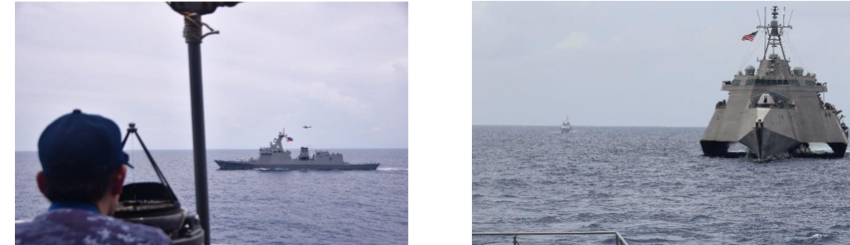
The U.S. Navy participated with the Independence-class littoral combat ship USS Canberra (LCS 30) and the P-8A Poseidon. From the Philippine Navy, the Jose Rizal-class frigate BRP Jose Rizal and the Tarlac-class landing ship BRP Tarlac joined, along with the Anzac-class HMAS Perth from Australia. The first half involved a tabletop exercise for disaster response, expert exchanges, and vessel exhibitions in Subic Bay, Philippines, followed by a maritime phase to confirm information sharing and interoperability of maritime skills.
In the South China Sea, Common Procedures Matter More Than the Number of Vessels
For Japan, the key takeaway is not to present the fleets of eight countries as a single operational force. The focus is on using disaster relief as an entry point to align communication procedures, share imagery and location information, and synchronize command systems at sea. In the event of an incident in the South China Sea or around the Philippines, the first thing that will be lacking is not firepower, but the time it takes for each country to make judgments based on the same maritime situation map.
The U.S. 7th Fleet explains that by conducting joint training before a crisis, actual responses can be facilitated.
However, the MS JCA is an activity aimed at humanitarian assistance and disaster relief, and it does not directly verify anti-submarine warfare or missile defense. Therefore, it is premature to label this as a containment strategy against China. Nevertheless, the effect of expanding the habit of maritime situational awareness centered on Japan, the U.S., and the Philippines cannot be ignored. Japan's challenge is not to increase the number of participating countries, but to what extent it can unify information classification and communication standards on-site. The true weakness lies not in the lack of vessels, but in the thinness of procedures to convert peacetime goodwill into decision-making in times of crisis.
Main Information Sources
On September 20, 2026, the USS Canberra and P-8A Poseidon participated in a joint maritime cooperation exercise in Yokosuka, involving eight countries including Japan and the Philippines. The exercise included disaster response tabletop exercises and aimed to enhance interoperability among naval forces in the South China Sea. The focus was on establishing common procedures and information sharing among the participating nations.
- Joint maritime cooperation exercise involving 8 countries
- USS Canberra and P-8A Poseidon participated
- Exercise included disaster response tabletop exercises and interoperability training
- Focus on information sharing and command systems
- Not directly related to anti-submarine warfare or missile defense