
2026 NATO F-16 Drone Shootdown Exposes the Baltic Problem
 Alexandra Reeves
2026 NATO F-16 Drone Shootdown Exposes the Baltic Problem
A Romanian F-16 shooting down a suspected Ukrainian drone over Estonia is the kind of incident NATO planners used to file under air policing. That category is starting to look too small.
According to Defense News, Estonian radars detected the drone before it entered Estonian airspace on May 19, and a Romanian F-16 flying from Siauliai Air Base in Lithuania under NATO Baltic Air Policing shot it down shortly before 13:00 local time. BBC reporting, citing Estonian Defence Minister Hanno Pevkur, says the debris fell in a marshy area in central Estonia and no damage was reported. Local reporting placed the crash roughly 30 metres from the nearest residential building.
Ukraine apologised quickly. Foreign ministry spokesman Heorhii Tykhyi said Russia was deliberately using electronic warfare to redirect Ukrainian drones launched against legitimate military targets inside Russia. Moscow has not commented on this specific case, but Russian officials have been accusing Estonia, Latvia and Lithuania of providing air corridors for Ukrainian strikes. Latvia, Estonia and Ukraine all deny that claim.
Here is the uncomfortable part. Even if Ukraine is right, and Russian jamming pushed the drone off course, NATO still had to put a fighter in the sky and fire a missile over allied territory to solve the problem. That is not a clean defensive success. It is evidence that the Baltic airspace problem has moved faster than NATO doctrine.
The Air Policing Mission Did Its Job
NATO Air Policing exists for exactly this kind of scramble-and-intercept mission. NATO says the system has been on duty 24 hours a day, 365 days a year since the Cold War, with Allied Air Command at Ramstein overseeing operations through Combined Air Operations Centres. The Baltic mission began in 2004, when Estonia, Latvia and Lithuania joined the alliance, and fighters have long rotated through Siauliai in Lithuania and Amari in Estonia.
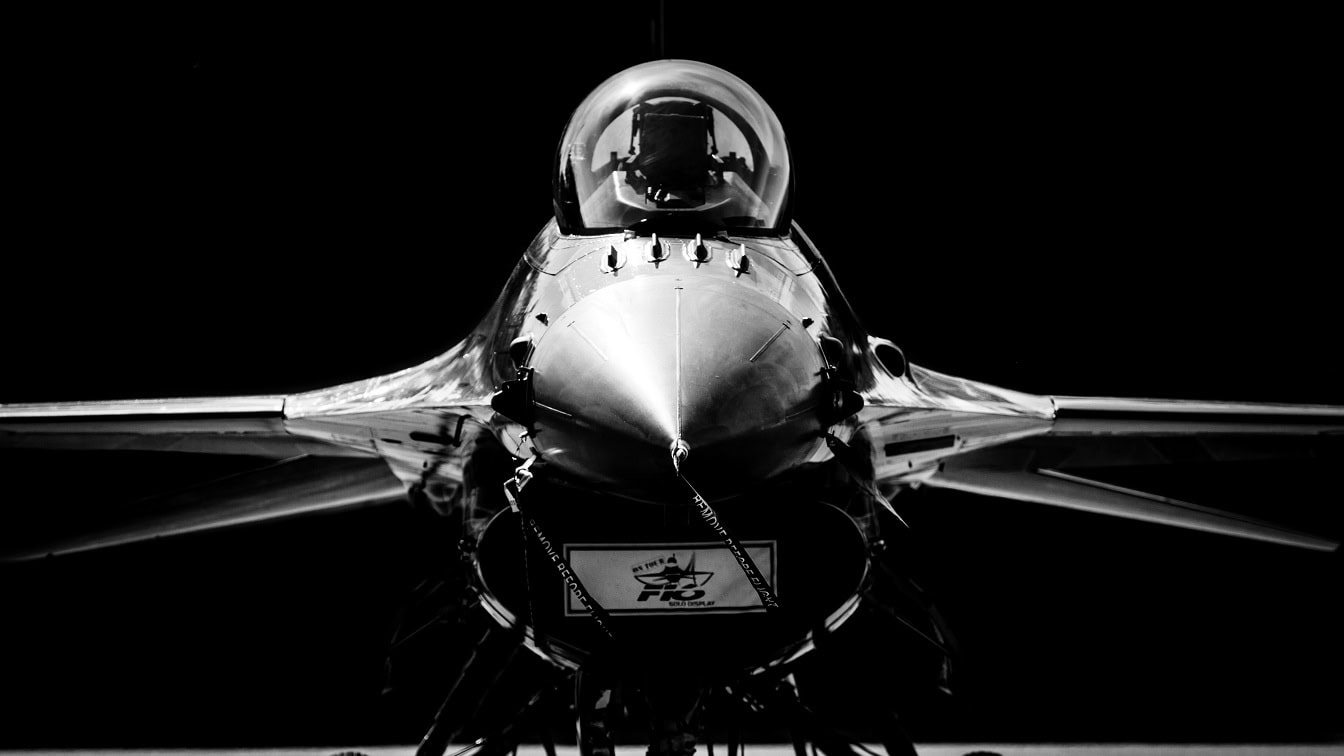
The Romanian F-16 was a sensible tool for the job. The US Air Force describes the F-16 Fighting Falcon as a compact multirole fighter with all-weather capability, a speed of roughly Mach 2 at altitude, a ceiling above 50,000 feet, and an armament fit that can include the 20mm M61A1 cannon and up to six air-to-air missiles. In other words, it is fast enough to reach a small airspace violation quickly and flexible enough to deal with a drone, aircraft, or ambiguous target.
On the narrow question, NATO passed the test. The drone was detected, tracked, engaged, and brought down without reported casualties. Estonia also did the politically smart thing by making clear that it had not granted anyone permission to use its airspace for attacks on Russia.
But successful interception is not the same thing as strategic control.
Russia Has Found a Cheap Way to Create Expensive Decisions
The Baltic states now face a pattern, not a one-off. BBC notes that earlier this month two Ukrainian drones hit an empty oil storage site in Latvia. Defense News has also reported previous incidents involving drones striking or crashing in Estonia, Latvia and Lithuania, including a power plant chimney in Estonia and a lake in Lithuania. Last week, a political crisis over drone incursions contributed to the resignation of Latvia's prime minister and defence minister.
That is why the suspected electronic warfare angle matters. If Russian jamming can push Ukrainian long-range drones away from Russian targets and toward NATO airspace, Moscow gets several effects at once. It disrupts Ukrainian strike operations. It forces NATO to spend high-end attention on low-end objects. It creates local fear in Baltic communities. Then Russian information channels can claim that the Baltics are secretly hosting Ukrainian attacks.
This is classic grey-zone arithmetic. Russia does not need to prove the accusation. It only needs to make every future Ukrainian drone that appears near the Baltic frontier politically toxic.
The military cost equation is also ugly. A long-range Ukrainian drone may be relatively cheap. Scrambling an F-16 is not. Firing an air-to-air missile is not. Closing civilian airspace, warning residents not to touch debris, and managing alliance consultations are not free either. Moscow can turn electronic interference into a bill that NATO and Ukraine both have to pay.
The Real Weakness Is the Rulebook
Everyone in Brussels likes to talk about deterrence as if it is mostly about posture: more battalions, more aircraft, more exercises, more flags on maps. The Estonian shootdown points to a messier problem. What are the rules when a friendly drone becomes a hostile object because an adversary has manipulated its flight path?
The answer cannot simply be shoot everything down. Estonia was lucky this time that debris landed in marshland and caused no reported damage. A missile fired over allied territory can solve one hazard while creating another. A drone falling near a house is bad. A larger interceptor engagement over a town could be worse.
Nor can NATO treat every incursion as Ukraine's problem. Kyiv can apologise, and it should. But if Russian electronic warfare is part of the cause, the alliance is already inside the contest whether it wants to be or not. The border between Ukrainian strike operations and NATO air defence is being blurred from the Russian side.
This is where the new NATO debate over an eastern autonomous zone becomes relevant. Defense News reported on May 20 that NATO officials in Latvia are shaping a deterrence concept built around connected sensors, unmanned systems, counter-drone tools and long-range fires along the eastern flank. Brig. Gen. Chris Gent of Allied Land Command described a zone where machines take risk before humans do. That is the right direction, but the Estonian incident shows the first use case may not be a Russian tank column. It may be a confused drone in peacetime airspace.
What NATO Should Watch Next
The immediate priority is technical. Estonia, Latvia, Lithuania, Finland, Poland and Ukraine need a tighter shared picture of drone routes, jamming zones, telemetry loss and recovery patterns. If the same Russian electronic warfare sites are repeatedly pushing drones into NATO airspace, that should become an intelligence target, not just an incident report.
The second priority is layered interception. F-16s are necessary, but they are a poor default answer for every drone. The Baltic states need more ground-based counter-UAS systems, short-range air defence, passive sensors and cheap effectors that can bring down drones without turning each incursion into a fighter-missile event.
The third priority is political language. NATO should be careful not to let Moscow frame the issue as Baltic complicity in Ukrainian attacks. The more precise line is this: Ukraine is responsible for its weapons, Russia is responsible for electronic warfare that deliberately redirects them toward NATO territory, and NATO is responsible for protecting its airspace without overreacting.
This incident will not trigger Article 5, and it should not. That is not the point. The point is that Russia may have found a way to make NATO defend itself against the side it is trying to help. The next test is whether the alliance can build a cheaper, clearer, and less politically explosive answer before the swamp is replaced by a suburb.
A Romanian F-16 intercepted and shot down a suspected Ukrainian drone over Estonia on May 19, 2026, shortly before 13:00 local time. The drone was detected by Estonian radars prior to entering airspace, and no damage was reported. Ukraine attributed the incident to Russian electronic warfare, raising concerns about the implications for NATO's airspace security in the Baltic region.
- A Romanian F-16 shot down a suspected Ukrainian drone over Estonia on May 19, 2026.
- The drone was detected by Estonian radars before entering airspace.
- No damage or casualties were reported from the incident.
- Ukraine apologized, attributing the incident to Russian electronic warfare.
- The event highlights ongoing tensions and operational challenges in Baltic airspace.