
2026 Nine Sky Drones Enter Verification Phase, PLA Swarm Warfare Still Faces Three Hurdles Before Mass Production
 Li Minghui
2026 Jiutian Drone Enters Verification Phase, PLA Swarm Operations Face Three Hurdles Before Mass Production
On April 15, the northwest civil aviation regulatory authority inspected the Weinan test flight center. This news may not seem like military news at first glance, but it is quite interesting when placed on the timeline of the "Jiutian" drone. On December 11 last year, this 16-ton large drone completed its maiden flight in Pucheng, Shaanxi; by April of this year, the project has shifted from "being able to fly" to parallel advancements in test flights, airspace, airworthiness, and regulation. I believe this is closer to the core issue than simply stating that "the aerial mothership can launch 100 small drones."
Not a Larger Version of the Reconnaissance-Strike Drone
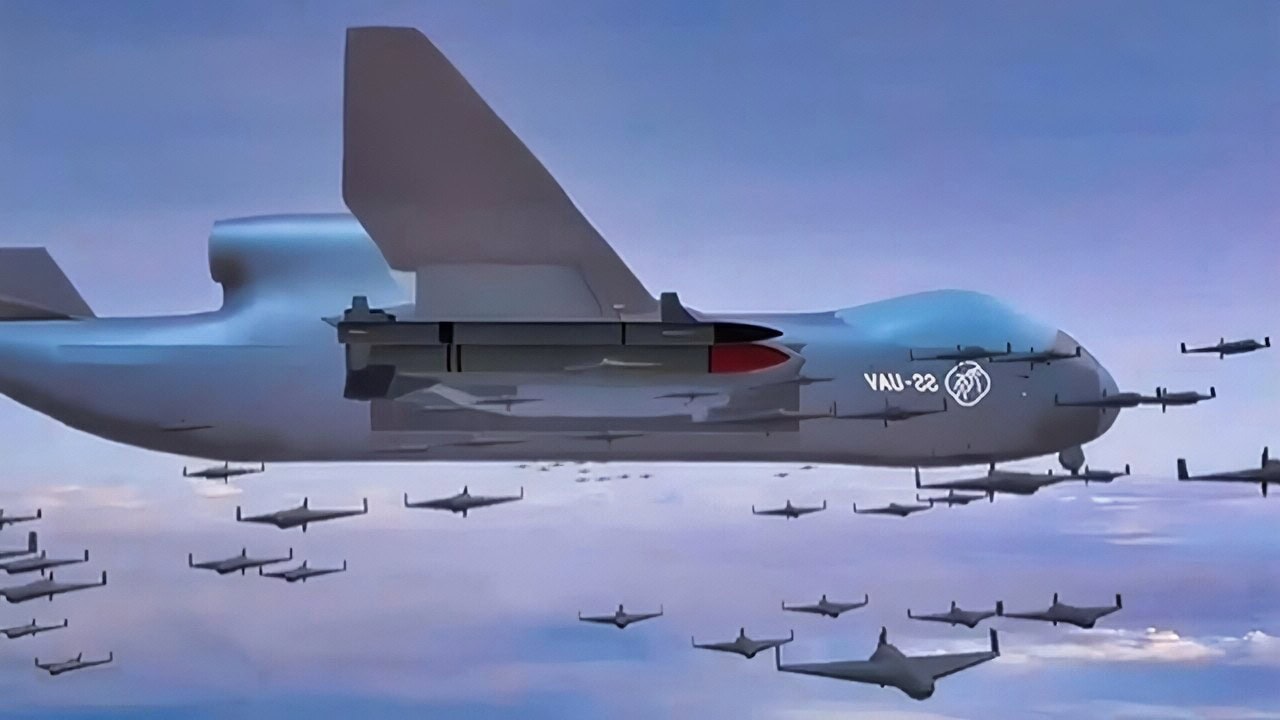
Publicly available information gives the Jiutian parameters as follows: a length of approximately 16.35 meters, a wingspan of 25 meters, a maximum takeoff weight of about 16 tons, a payload of around 6 tons, a range of up to 7000 kilometers, and an endurance of about 12 hours. Shaanxi emphasizes the modular configuration of "aircraft platform + mission cabin," which can be used for logistics, communication relay, weather intervention, and air transport airdrop; military media are more concerned with the possibility of the side mission cabins releasing small drones or loitering munitions, as well as the potential for external hardpoints to carry reconnaissance, electronic warfare, and strike payloads.
In simple terms, the Jiutian resembles a flying modular truck. In peacetime, it can be used for low-altitude economy and emergency rescue, while in wartime, it could transform into a communication relay, decoy deployment platform, long-range reconnaissance node, or even an aerial launch platform for swarm munitions. This approach aligns with a recent trend in Chinese military industry: first using dual-use scenarios to dilute costs, and then integrating mature platforms into combat systems.
The Real Challenge of Swarms Lies in the Linkage
Outsiders are easily attracted by the "100 small drones" figure, but this number alone does not equate to combat capability. After the mothership releases the drones at high altitude, it still needs to address formation reorganization, data link strength, target allocation, and anti-jamming. If used in the Taiwan Strait or the Western Pacific, the Jiutian itself is not stealthy, and its speed cannot approach that of a fighter jet; once it enters a heavily defended airspace, it becomes a high-value slow target.
A more reasonable use would be to deploy reconnaissance drones, decoys, communication relays, or expendable loitering munitions outside the defense zone, pressuring the opponent's radar and air defense munition stockpiles. The key here is not how many the mothership can carry, but whether the small drones can continue to coordinate under strong electromagnetic interference. There is very little public information on this aspect, and I remain skeptical of the claim that "swarm attacks are indefensible."
Three Hurdles to Mass Production
It is said that the Jiutian took 24 months from project initiation to its maiden flight, indicating that the organization efficiency of Shaanxi's unmanned equipment technology, Aviation Industry Corporation of China, and local test flight resources is quite high. However, there are still three hurdles to overcome from prototype to deliverable equipment: the first is the reliability of the engine and avionics; a 16-ton unmanned platform cannot be maintained according to model aircraft logic; the second is the standardization of the mission cabin; stable interfaces are necessary for rapid switching between reconnaissance, cargo, electronic warfare, or drone deployment modules; the third is training and regulations; military units must be willing to use it, and civil regulations must also allow it to fly in complex airspace.
What It Means for the PLA
For the PLA, the most realistic value of the Jiutian may lie in three types of missions: long-range communication relay, unmanned resupply in island and plateau areas, and swarm deployment outside the defense zone. It will not replace the H-6, Y-20, or J-20, nor should it be imagined as a true aerial aircraft carrier. A more accurate description is that it provides the PLA with a low-cost, high-payload aerial node that can withstand higher risks.
What is truly worth questioning is whether the next step for the Jiutian will be the public release of military test footage, such as data link joint testing with small loitering munitions, electronic warfare pods, or the Army's long-range rocket forces. If it remains at the level of logistics and exhibition models, it will be a star product of the low-altitude economy; if system joint training occurs, that would indicate the PLA is beginning to seriously test the operational loop of "mothership + swarm."
Sources
- Shaanxi Provincial People's Government, December 12, 2025, "Jiutian Cangqiong" unmanned aviation general platform successfully completes its maiden flight in Shaanxi.
- South China Morning Post, December 11, 2025, First flight of China’s giant drone carrier Jiu Tian signals PLA swarm capacity boost.
- Army Recognition, April 17, 2026, China Advances Jiutian Drone Mothership for Battlefield Logistics and Swarm Deployment.
- AeroTime, January 2, 2026, China flies large unmanned mothership designed to deploy drone swarms.
The People's Liberation Army (PLA) is testing the Jiu Tian drone at the Weinan flight test center as of April 15, 2026. This 16-ton drone is designed for military applications, including logistics and communication relay. It faces three major challenges before mass production: ensuring engine reliability, standardizing mission modules, and obtaining regulatory approval for operation in complex airspace.
- The Jiu Tian drone has a maximum takeoff weight of 16 tons and can carry a payload of approximately 6 tons.
- It is designed for various applications including logistics, communication relay, and military operations.
- The drone is currently undergoing testing and validation as of April 15, 2026.
- There are three major hurdles to overcome before mass production can begin: engine reliability, standardization of mission modules, and regulatory approval.