
The Hazelnut in Yasynuvata Shows the Limits of Russian Missile Demonstration 2026
 S.W
S.WThe Oreshnik over Yasynuvata Shows the Limits of Russian Missile Demonstration 2026
The fourth launch of the "Oreshnik" turned out to be, apparently, the most indicative precisely because it was not successful. According to Le Monde on June 5, one of the two launches on May 23 targeted not a Ukrainian objective, but the area of Yasynuvata in the Donbas, which Moscow itself considers its own. Vladimir Putin, on June 4, at a meeting with heads of news agencies in St. Petersburg, referred to these strikes not as combat use, but as a test chosen because it was "convenient to observe the results" (Le Monde; "Ukrainian Truth" citing Russian media, June 4-5, 2026). This formulation sounds like an attempt to explain a miss in hindsight. But for military analysis, another aspect is more important: Russia uses a strategic carrier not only as a weapon but also as a public instrument for measuring fear.
Testing Instead of Operation
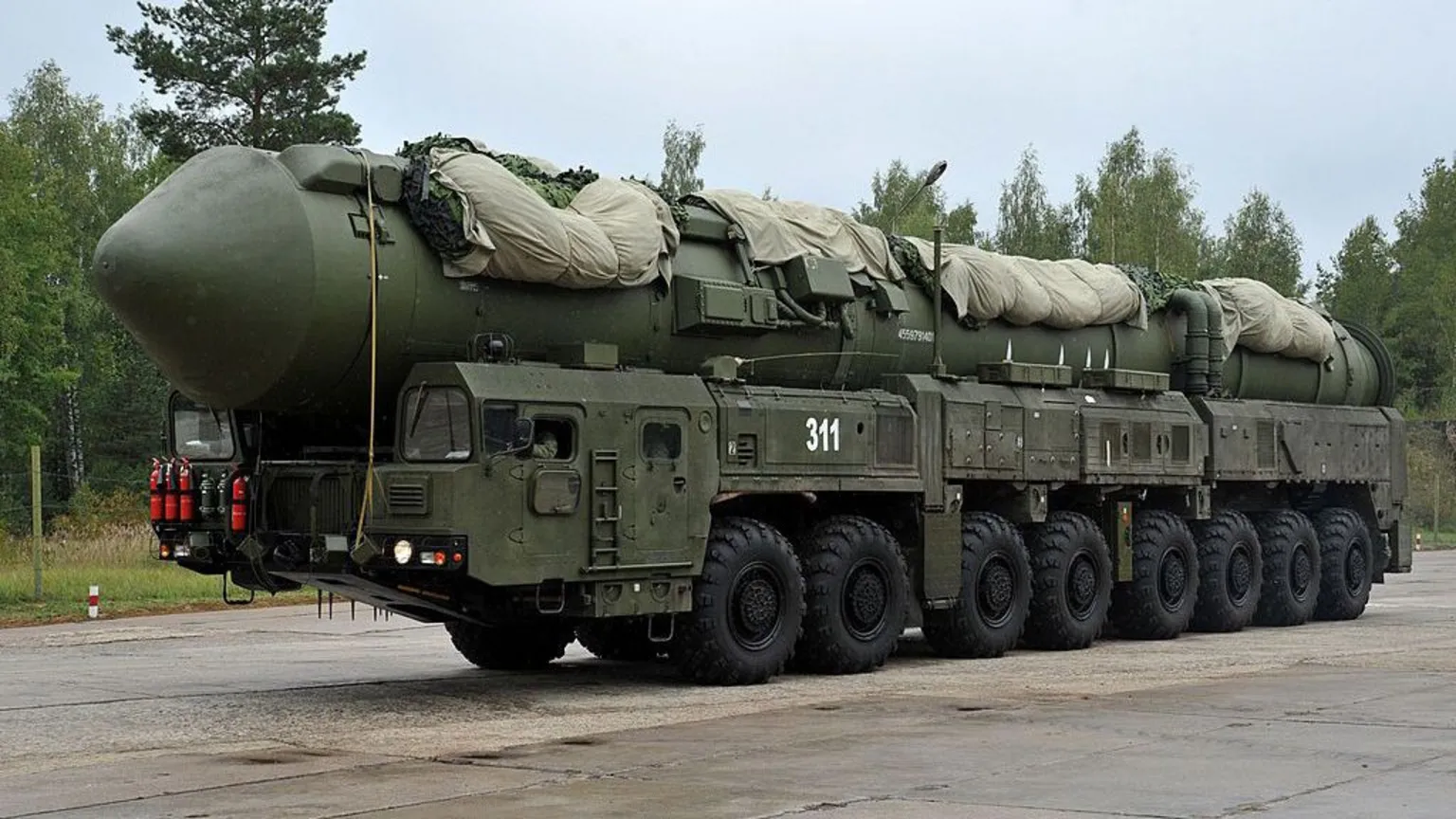
Putin's explanation contains an internal contradiction that cannot be attributed to journalistic inaccuracy. If the "Oreshnik" was not used in a combat sense, then why was it launched at populated areas of Ukraine and occupied Donbas, rather than at the Kapustin Yar test site, Sary-Shagan, or any other zone where results could indeed be measured without political and humanitarian risk? If the goal was to test the deployment of warheads in real air defense conditions, then this is no longer a laboratory test but combat use with an experimental task. The Soviet military school distinguished between experimental-combat operation and demonstration launch. In this case, Moscow has mixed both categories: a technical check is presented as a strategic warning, and a strategic warning is justified as a technical check.
According to published data, previous launches of the "Oreshnik" came from the Kapustin Yar area. The missile belongs to the intermediate class and, as emphasized by European sources in Le Monde, was originally designed for multiple independently targetable reentry vehicles (MIRVs), where the accuracy of individual hits is not the main criterion for nuclear armament. This is a key point. In conventional armament, such a system creates an impressive picture of warheads falling at hypersonic speeds, but its military effectiveness depends on accuracy, type of warhead, and intelligence cycle. When instead of a destroyed military object, there is a version of hitting a "convenient" observation point, it speaks not of a new level of Russian precision weapons, but of an old Soviet ailment: to consider the mere fact of launch as proof of result.
The Cost of Psychological Weapons
The "Oreshnik" is needed by the Kremlin as a means of political communication. It demonstrates to Europe that theoretically not only Kyiv or Dnipro are under threat, but also infrastructure deep beyond the Ukrainian theater. It must convince Russian society that technological superiority still exists, even when Ukrainian long-range drones regularly reach St. Petersburg, Novorossiysk, and oil infrastructure facilities. And it must psychologically pressure Ukrainians: if Patriot and the future SAMP/T NG are limited in the number of interceptors, then Moscow will increase the share of ballistic and quasi-ballistic threats.
However, psychological weapons become expensive when they have to be used to explain one's own failures. Le Monde reported on June 3 that in a major strike on June 2, Russia used 33 "Iskander-M" and eight "Zircons," with 41 missiles reaching Ukrainian territory; the problem of a shortage of PAC-3 and the yet-to-be-deployed SAMP/T NG was noted separately. This is a rational military line: saturating air defense with those means against which Ukraine has few interceptors. The "Oreshnik" is close to this logic but does not coincide with it. The "Iskander" and "Zircon" provide operational effects, even if some strikes miss. The "Oreshnik," in its conventional variant, primarily creates a political effect, and therefore its miss or strike on occupied territory turns into political damage.
What Yasynuvata Shows
If the report about the Yasynuvata area is correct, it reveals three problems. The first is navigational and intelligence-related. For a missile with multiple independently targetable reentry vehicles, the trajectory itself may be executed normally, but the choice of the impact area, the quality of target designation, and subsequent confirmation of the hit remain weak links. Putin spoke of drones that allegedly calculated results "to the millimeter." For occupied Yasynuvata, such intelligence is possible. For Bila Tserkva, located far behind the Ukrainian front line and covered by layered air defense, this statement appears much less convincing.
The second problem is institutional. The Russian decision-making system loves demonstration strikes because they easily translate into television language: launch, flame, hypersonic, "response." But the war of 2026 is increasingly intolerant of symbolic acts without measurable results. Ukrainian drones strike at oil logistics and force governors to limit city life; Russian massive strikes expend hundreds of "Shaheds," dozens of missiles, and rare ballistic products to maintain pressure on the air defense system. Against this backdrop, the "Oreshnik" remains too expensive a gesture if it does not provide a sustainable military effect.
The third problem is legal and political. Moscow annexed the Donetsk region on paper, but then, according to the published version, struck with a strategic missile system at territory it itself declared part of Russia. In imperial logic, this is not a paradox: the periphery is always expendable. In military logic, this is a sign that demonstration is more important than risk management. For residents of occupied areas, this is a cold reminder: a passport and a declaration of "protection" do not provide protection from one's own decision-making center.
Forecast
Most likely, Russia will not abandon the "Oreshnik." On the contrary, it will be periodically used as a missile equivalent of a press conference: rarely, loudly, and with an eye on the European nervous system. But its practical significance will remain limited as long as the conventional warhead does not ensure predictable destruction of military targets, and production does not allow for serial application of the system. The main threat to Ukraine in the coming months will not come from the "Oreshnik" itself, but from a combination of "Iskanders," "Zircons," "Kinzhal," and hundreds of drones, where the shortage of interceptors becomes a mathematical problem. The "Oreshnik," however, will remain what Russian wonder-weapons often are: not a solution to the war, but a way to explain why the war is still unresolved.
Russia conducted missile tests in June 2026, with one Oreshnik missile reportedly missing its target and hitting Yasynuvata in Donetsk Oblast. President Putin characterized these strikes as tests rather than combat actions, raising questions about the accuracy and effectiveness of Russian missile systems. The Oreshnik is utilized as a political tool to convey threats to Europe and maintain a perception of military superiority.
- One of the Oreshnik missile tests on May 23 missed its target and hit Yasynuvata.
- Putin described the missile strikes as tests rather than combat operations.
- The Oreshnik missile is used as a tool for political communication by Russia.
- The report highlights issues with navigation and targeting accuracy of Russian missiles.
- Russia's missile strategy aims to demonstrate technological superiority despite Ukrainian drone capabilities.