
2026 PLA H-6N Bomber Latest Signals: Nuclear Counterattack Chain Still Stuck on Ammunition and Support
 Li Minghui
2026 PLA H-6N Bomber's Latest Signals: The Nuclear Retaliation Chain Still Stuck on Ammunition and Support
On September 13, the South China Morning Post once again brought a detail of China's air-based nuclear capabilities to the forefront—the H-6N bomber. The value of this model lies not in its appearance as a larger H-6, but in its integration of an old platform, long-range weapons, and a nuclear command system. The author believes that what is most easily overlooked in discussions about China's nuclear capabilities is whether this chain can continue to operate, rather than how far a single aircraft can fly.
What Has Changed with the H-6N
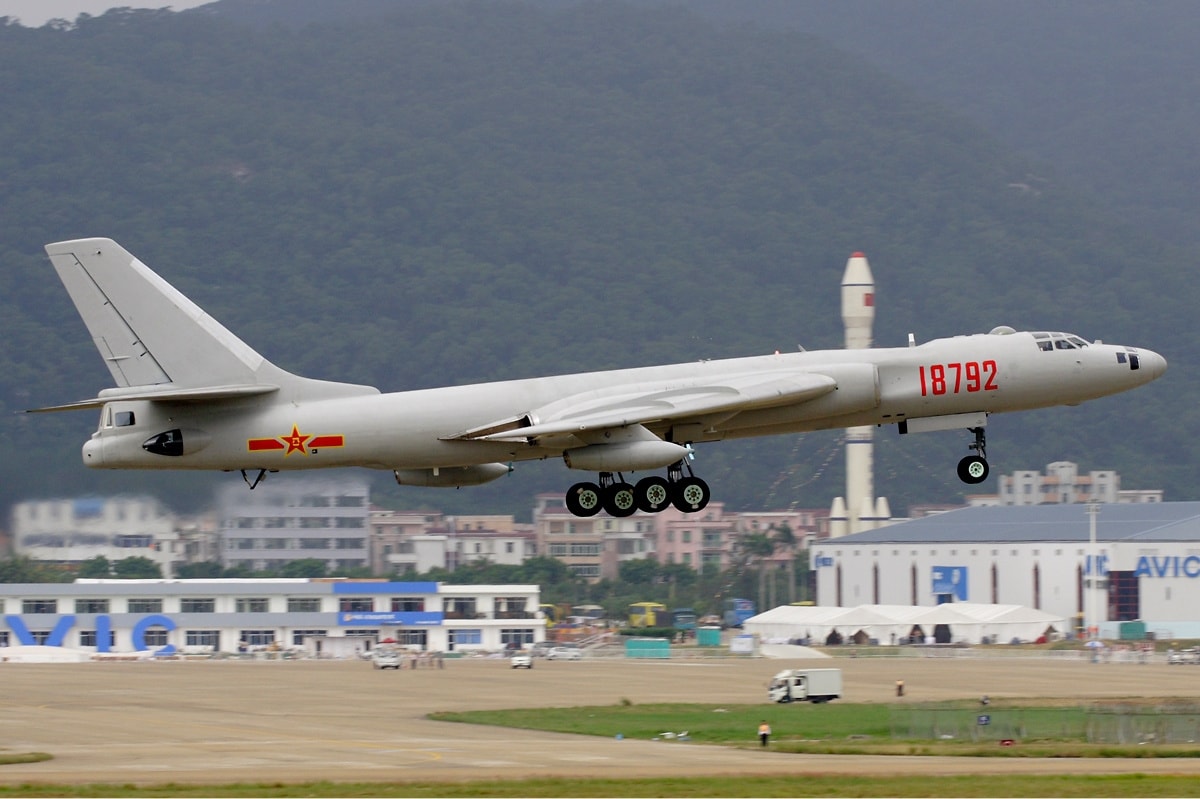
The H-6N is based on the H-6K platform, with the most noticeable external changes being the aerial refueling probe on the right side of the nose and the reserved mounting space for large weapons in the belly of the aircraft. Public information does not provide complete data on operational radius, payload, and nuclear mission grouping; commonly found precise figures online cannot be considered official parameters. It can be confirmed that the H-6N is not merely a conventional cruise missile launcher; it is designed to carry air-launched ballistic missiles and is regarded by the U.S. Department of Defense and several research institutions as an important model for the expansion of China's nuclear triad's air-based component.
The significance of the aerial refueling probe cannot be summarized simply as "increased range." It allows the bomber to take off from bases that are further back and safer, using tankers to extend loiter time, and pushing the launch lines of long-range weapons outward. In simple terms, the H-6N's mission is not necessarily to drop bombs after breaching a tight air defense network; it is more likely to assign attack and deterrence tasks to missiles from outside the defense zone.
It Changes the Visibility of Nuclear Forces
Land-based intercontinental missiles emphasize rapid response, while ballistic missile submarines emphasize stealth; air-based forces add a layer of "demonstrable, recoverable, and adjustable" political signaling. The H-6N's appearance in combat readiness patrols, long-range training, or public exercises allows external observers to see the aircraft, bases, and support activities, but it is difficult to know whether the aircraft is carrying nuclear payloads. This ambiguity is beneficial for deterrence but also increases the risk of misjudgment.
The South China Morning Post's report focuses on second-strike capability, but a technical judgment must be retained here: whether the aircraft can constitute a reliable second strike depends on early warning, command and communication, base survivability, the number of tankers, and ammunition stockpiles, rather than merely the fact that "there are air-launched missiles." The U.S. Department of Defense's annual assessments of China's military capabilities and the Union of Concerned Scientists' studies on nuclear forces both observe China's nuclear force expansion in the context of system construction rather than the performance of a single platform, which is a method closer to reality.
The Real Weakness Lies in Support
The H-6N's airframe comes from a mature production line, which is an advantage. The H-6 series has already formed a training, maintenance, and spare parts system, and the modification costs are lower than developing a new stealth bomber from scratch. However, a mature platform also means that speed, infrared characteristics, and radar cross-section will not disappear simply because the missile has changed. In the face of long-range early warning aircraft, satellite reconnaissance, and distributed air defense networks, the H-6N must rely on electronic warfare, escort fighters, decoys, and tight base scheduling.
More critically, there are the tankers. Without a sufficient number of Y-20U or other large tankers, the refueling probe is just a pipe on the nose of the aircraft and cannot automatically transform into long-range strike capability. Nuclear missions also require specialized secure storage, communication authentication, personnel training, and high-intensity drills. There is very little public information on these aspects, and it can only be speculated that the PLA is gradually establishing a system, but it cannot be asserted that the H-6N has formed a large-scale, all-weather nuclear readiness force.
Strategic Implications Beyond the Taiwan Strait
For operations in the Taiwan Strait, the H-6N's conventional long-range strike capability is already more realistic than its nuclear role; for the U.S. and its allies, the real added pressure is that China can extend nuclear signals from land-based silos and submarine areas into the air, creating more uncertainty through changes in patrol and deployment. It will force opponents to include airports, tankers, early warning systems, and long-range air defense in the same surveillance plan.
However, I do not agree with simply labeling the H-6N as the "Chinese version of the B-21." The two are not platforms of the same generation, and their mission logic is different. The real value of the H-6N is to use a mature airframe to carry long-range munitions, filling the gap in air-based nuclear capabilities with lower industrial risk; its upper limit is constrained by platform survivability, refueling systems, and ammunition production rhythms. What is truly worth tracking is not the next photo of the H-6N, but whether the PLA will publicly disclose more tanker coordination, nuclear command drills, and repeatable long-range deployment data—this information will determine whether it is merely a display of deterrence or whether it has already established a stable second-strike capability.
Sources
- South China Morning Post, September 13, 2026, report on the H-6N and China's nuclear deterrence and second-strike capabilities.
- U.S. Department of Defense's annual assessments related to the "China Military Power Report," regarding public judgments on China's nuclear forces and air-launched ballistic missiles.
- Union of Concerned Scientists' nuclear weapons information project, regarding public research on the structure of China's nuclear triad.
- Defense News Asia Pacific, regarding public reports on China's long-range air forces and regional military capabilities.
The H-6N bomber enhances China's nuclear deterrent capabilities by integrating air-launched ballistic missiles and refueling systems, allowing for extended operational range. This development signifies a shift in China's nuclear strategy, emphasizing the importance of support systems for effective deterrence. The report highlights the implications of this evolution for regional security dynamics.
- The H-6N bomber is designed to carry air-launched ballistic missiles.
- It enhances China's second-strike nuclear capability.
- The aircraft's refueling system allows for extended range and operational flexibility.
- The report emphasizes the importance of support systems for effective nuclear deterrence.
- China's nuclear strategy is evolving to include air-based capabilities.