
"2026 Resolute Dragon 26: 9,700 Japan-U.S. Personnel Activate Southwest Islands Defense"
 Tanaka Takashi
In Resolute Dragon 26, 9,700 Japanese and U.S. Personnel Activate Defense of the Southwestern Islands
The photo of the Japan Ground Self-Defense Force V-22 and the U.S. Marine Corps MV-22B flying over Kumamoto well illustrates the nature of this exercise. According to DVIDS, this formation flight took place on June 21 and was part of Resolute Dragon 26, with the objective not merely being goodwill, but confirming command and control and multi-domain maneuver to control and defend critical maritime terrain.
Exercise Line Stretching from Kyushu to the Southwestern Islands
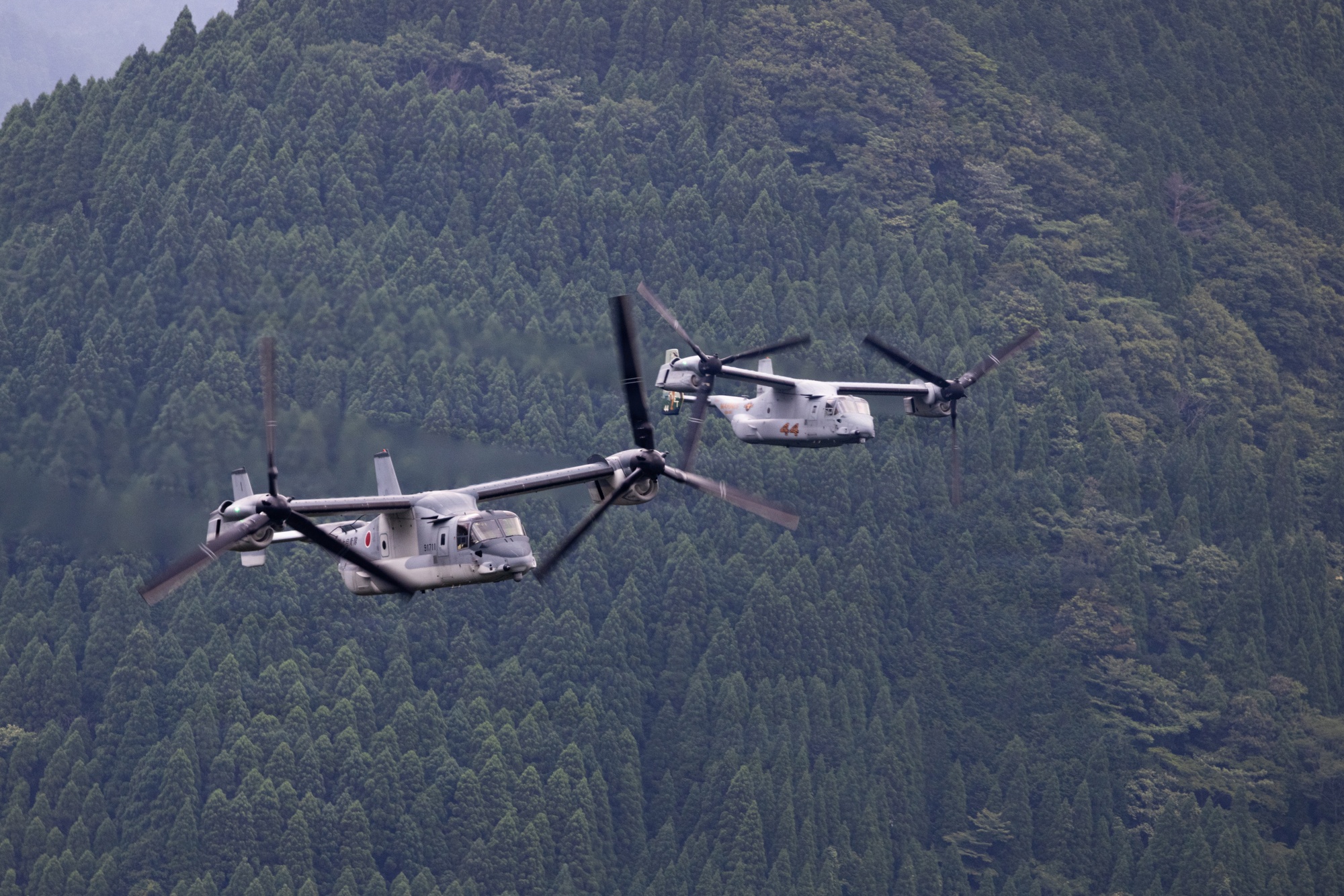
According to the announcement from the U.S. Marine Corps Pacific Command, Resolute Dragon 26 was conducted from June 20 to 30, stretching from Kyushu to the Southwestern Islands. The scale of participation included approximately 1,700 U.S. Marines from the 3rd Marine Expeditionary Force and about 7,300 Self-Defense Forces personnel, totaling around 9,700. This sixth iteration saw the Western Army Command of the Ground Self-Defense Force taking the lead, with the U.S. Navy, U.S. Army, and Japan Maritime Self-Defense Force also participating.
The training items included opposing force engagements, logistics movement between Japan and the U.S., live-fire exercises with combined arms, medical training, and all-domain sensing. Notably, the exercise did not focus solely on "island recapture," but simultaneously addressed detection, movement, resupply, and casualty evacuation. Unlike the Cold War-era defense of Hokkaido, merely stationing troops in the Southwestern Islands does not provide deterrence. The ability to continuously manage ammunition, fuel, communications, and runway repairs along narrow island lines is being tested.
The U.S. Intent of Two Marine Expeditionary Forces
At the same time, KAMANDAG 10 was conducted in the Philippines from June 15 to July 1. The U.S. referred to this as "Two MEFs Abreast." This concept involves moving the 3rd Marine Expeditionary Force, which is forward-deployed in Japan, alongside the 1st Marine Expeditionary Force, which is continuously deployed in the region, treating the northern and southern parts of the first island chain as a single operational area.
This framework provides a convenient explanation for the Japan-U.S. alliance, while also leaving a burden on the Japanese side. The defense of the Southwestern Islands cannot be completed solely by the mobility of the U.S. Marine Corps. If the Japan Maritime Self-Defense Force's escort ships, patrol aircraft, minesweeping, and responses in the boundary areas with the Japan Coast Guard are not connected, the forces that enter the island areas will not be able to sustain themselves. On July 1, the U.S. Indo-Pacific Command announced Pacific Atlas 26-1, in which the Japan Maritime Self-Defense Force, Japan Coast Guard, and U.S. Coast Guard confirmed vertical resupply and communication procedures in Japan's coastal waters. Although this is a separate exercise, the awareness of the issues is the same.
The Weakness on the Japanese Side Lies in Continuity Rather Than Speed
In my view, the most commendable aspect of this exercise is not the mere presence of the V-22. It is the fact that the Japan Ground Self-Defense Force, Japan Maritime Self-Defense Force, U.S. Marine Corps, U.S. Navy, and U.S. Army operated on the same map spanning from Kyushu to the Southwestern Islands. This is more practical than the rhetoric of deterrence against China and distances itself somewhat from the simplistic discussions that only consider a Taiwan contingency.
However, whether a 9,700-person exercise can be replicated in actual combat is a different question. The exercise utilized pre-coordinated airspace, ports, roads, and communication frequencies. In a crisis, civilian transport, local government coordination, resident evacuation, and maintaining communications under cyber attack will occur simultaneously. The true blind spot in the defense of the Southwestern Islands may not be the bravery of combat troops, but rather the endurance of administration and logistics that can keep those troops moving for ten or twenty days.
Resolute Dragon 26 indicated that the Japan-U.S. alliance is transitioning from a stage of "waiting for assistance" to one of joint operations along the first island chain. However, this transition has only been successfully achieved within the exercise environment.
From June 20 to June 30, 2026, approximately 9700 personnel from the U.S. Marine Corps and Japan Self-Defense Forces conducted a joint military exercise named Resolute Dragon 26 in the Southwest Islands and Kyushu. The exercise focused on enhancing defense capabilities and control of maritime terrain, involving live-fire training and logistical operations. This marks a significant step in U.S.-Japan military cooperation in the region.
- The exercise involved approximately 9700 personnel from the U.S. and Japan.
- The exercise took place from June 20 to June 30, 2026.
- Key activities included live-fire training and logistics operations.
- The exercise aimed to enhance joint operational capabilities in the Southwest Islands.
- The presence of both U.S. and Japanese forces indicates a strategic partnership in regional defense.