
2026 YFQ-48A Taxi Test Changes the Pacific Airpower Math
 Marcus Chen
2026 YFQ-48A Taxi Test Changes the Pacific Airpower Math
One uncrewed fighter taxiing under its own software is not airpower. It is, however, the first piece of a different arithmetic problem for the Pacific. Northrop Grumman said on May 18 that its YFQ-48A Talon Blue completed autonomous taxi testing for the U.S. Air Force's Collaborative Combat Aircraft program. That sounds modest until you remember what the Air Force is trying to buy: combat mass without adding pilots, million fighters, or another generation of tanker dependency.
The taxi test validated ground steering, braking, propulsion response, flight-control computers, autonomy software, communications links, landing gear behavior, and onboard safety functions. In a manned aircraft, a pilot can correct a bad brake response or a wandering centerline. In an uncrewed fighter, that behavior has to be predictable before the aircraft ever leaves the runway. For a future Pacific fight, this is less about a press release milestone than about whether the United States can operate useful combat aircraft from crowded, damaged, or dispersed airfields without creating another fragile maintenance burden.
The Test Article Matters Because It Is a Fighter Drone
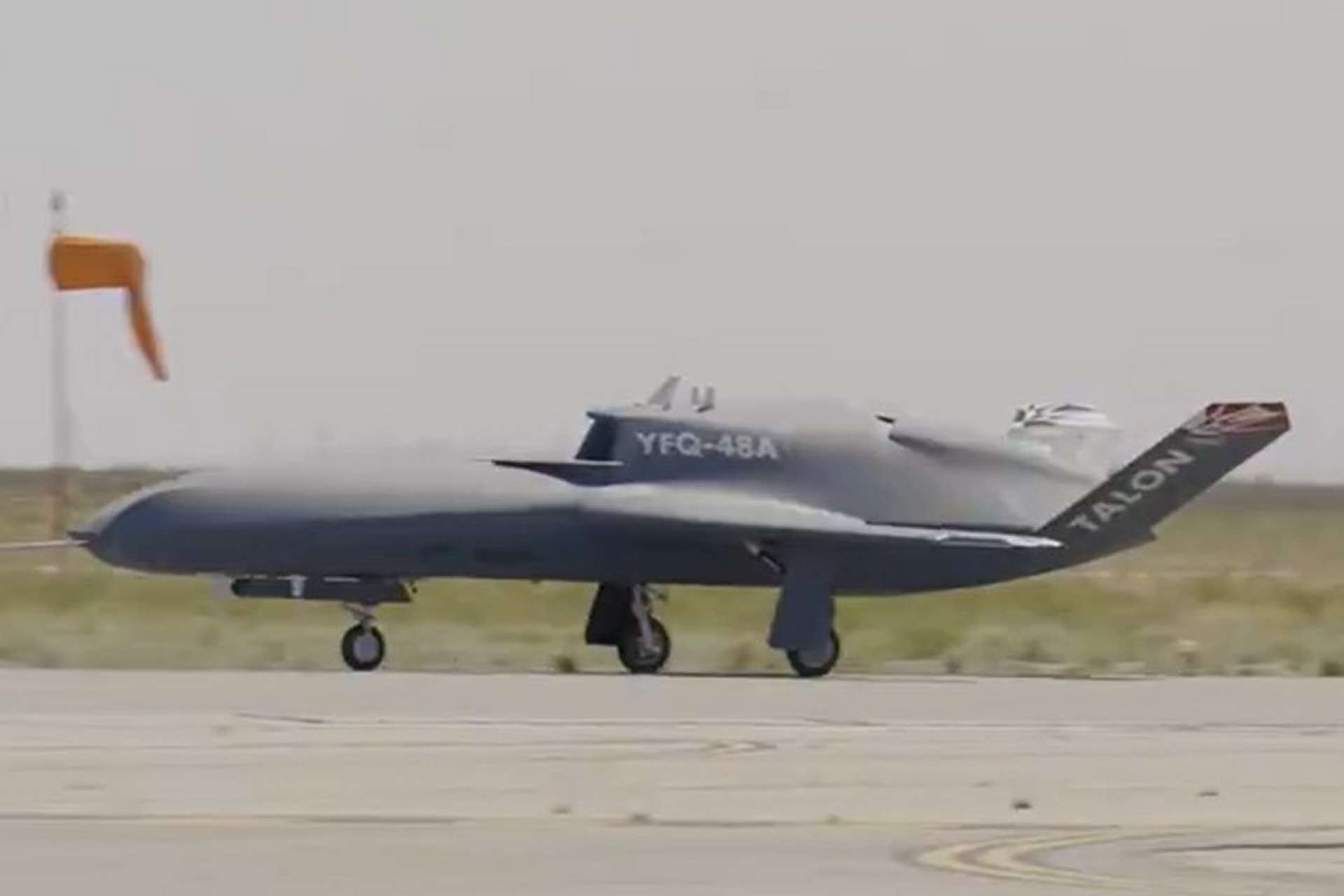
The YFQ-48A designation is doing real work. "Y" marks a prototype, "F" marks a fighter mission, "Q" marks an unmanned aircraft, and "A" marks the first series. This is not a Reaper replacement wearing a new label. The Air Force is putting Talon Blue in the same family of future combat aviation as General Atomics' YFQ-42A and Anduril's YFQ-44A, even though Northrop Grumman built Talon Blue after missing the first funded CCA increment.
According to Army Recognition's account of the May 18 announcement, Northrop says the aircraft uses composite materials, reduces parts by roughly 50 percent, and is about 1,000 pounds lighter than earlier design approaches. Those are not trivia points. A Pacific air campaign would punish complexity. If a drone fighter needs the same hangar time, contractor support, and exquisite supply chain as a crewed stealth aircraft, it adds targets more than it adds combat power.
The visible airframe also tells us what Northrop is aiming at. Talon Blue has a long fuselage, low-aspect-ratio lambda wing, dorsal inlet, canted twin tails, and a shielded rear exhaust arrangement. Northrop has not disclosed range, speed, weapons-bay dimensions, radar cross-section, ceiling, or payload, so anyone claiming a precise dogfight or missile-truck role is guessing. But the shape is clearly not optimized for slow permissive surveillance. It is built to operate near a fighter package and survive long enough to matter.
The Pacific Problem Is Mass, Not Just Technology
The United States does not lack beautiful aircraft. It lacks enough aircraft in the right places after the first week of a missile war. Andersen Air Force Base, Kadena, Misawa, Iwakuni, Tinian, Darwin, and Philippine operating locations are all useful, but none can be treated as untouchable. China has built a missile force precisely to make sortie generation from fixed bases unreliable. That is where CCA starts to make operational sense.
A crewed F-35A brings a trained pilot, a mature sensor suite, weapons, and judgment. It also brings a training pipeline, human risk, support equipment, tanker demand, and a price tag that limits fleet size. A CCA does not replace that aircraft. It changes what one crewed fighter can bring into the fight. If two or three uncrewed aircraft can move ahead as sensors, decoys, jammers, or missile carriers, the manned fighter's cockpit becomes less of a single point of failure.
That matters over the Philippine Sea and the East China Sea. The distances are ugly. Guam to Taiwan is roughly 1,700 miles. Northern Australia to the South China Sea is farther than most briefing slides want to admit. Even from Japan, U.S. aircraft need tanker support, hardened ramps, rapid repair, and enough munitions at the base to keep flying after the first salvos. A lower-cost uncrewed aircraft will not solve the distance problem. It may let commanders spend risk differently.
A Commercial Engine Is a Clue
Pratt & Whitney is supplying a member of the PW500 commercial turbofan family for YFQ-48A, according to Army Recognition's report. That is an interesting choice. It probably does not maximize dash speed or thermal margin. It suggests the program is putting availability, cost, and production realism ahead of building a miniature F-22.
That is the right instinct. The CCA program fails if it becomes another exquisite aircraft procurement wearing an autonomy badge. For Indo-Pacific Command, the relevant question is not whether Talon Blue can win a clean one-on-one engagement. The question is whether the Air Force can buy, base, maintain, update, and lose enough of them to complicate Chinese targeting without bankrupting the fighter force.
Boeing's public AH-64E data, Navy missile ranges, or CCA designations are easy to recite. The harder question is always sustainment. How many engines can be replaced on a hot ramp? How many spare flight-control computers are forward? How quickly can software be patched after an electronic-warfare surprise? How many aircraft can be launched with a reduced ground crew when a runway has just been cratered and patched? Any pilot who has watched a flight schedule fall apart because of one missing part understands the point.
The Weapons Question Is Still Open
No confirmed Talon Blue armament package has been released. The aircraft should not be described as operational, armed, or ready for squadron service. The reasonable mission set is still provisional: air-to-air missile carriage, passive sensing, electronic attack, communications relay, decoy work, or limited precision strike. An underside panel may indicate provision for an internal bay, but that has not been confirmed publicly.
That uncertainty is not a weakness yet. The first job is to prove the aircraft can fly reliably, recover safely, communicate under realistic conditions, and behave sensibly when the datalink degrades. After that comes the real test: whether CCA can be integrated into fighter tactics without overloading pilots. A wingman that requires constant babysitting is not a wingman. It is another cockpit task in an already saturated fight.
The useful CCA is not the one that looks most like a fighter. It is the one a squadron can launch, trust, redirect, repair, and replace under wartime pressure.
The Test Changes the Timeline
The May 18 taxi test does not prove that YFQ-48A will become the Air Force's preferred CCA. It does prove that Northrop Grumman has moved from mockup and engine-run territory into integrated aircraft behavior. That keeps Talon Blue relevant as the Air Force evaluates future increments beyond the first funded vendors.
For the Pacific, that is the important part. Washington has spent years talking about distributed operations, agile combat employment, and affordable mass. Those concepts only become military power when aircraft can actually launch, survive, and be sustained in numbers. Talon Blue has not answered that question. But it has moved the question from briefing slides to a runway. That is where the math starts to get serious.
Northrop Grumman's YFQ-48A Talon Blue completed autonomous taxi testing on May 18, 2026, marking a significant step in the U.S. Air Force's Collaborative Combat Aircraft program. This uncrewed fighter aims to enhance combat capabilities without increasing pilot numbers or tanker dependency. The aircraft's design focuses on operational efficiency, reducing complexity and maintenance burdens in potential Pacific operations. However, no confirmed armament package has been disclosed yet.
- YFQ-48A Talon Blue completed autonomous taxi testing for the U.S. Air Force.
- The aircraft aims to provide combat mass without adding pilots or increasing tanker dependency.
- The design reduces parts by roughly 50% and is about 1,000 pounds lighter than earlier designs.
- The aircraft's capabilities include ground steering, braking, and autonomy software validation.
- No confirmed armament package has been released for the Talon Blue.