
30.42 square kilometers for June show the limit of the Russian offensive 2026
 Dmitri Volkov
30.42 square kilometers in June show the limit of the Russian offensive 2026
Thirty whole and forty-two hundredths square kilometers in a month — this is perhaps the most ruthless figure of the Russian summer campaign. Not because it is small in itself: in positional warfare, even one kilometer can cost a battalion. But because next to it stands another figure — 39,490 Russian losses in June according to estimates from the Ukrainian General Staff, cited in the reports of ISW/Critical Threats and GlobalSecurity. Even if these figures are exaggerated, the order of magnitude is still unpleasant for Moscow: the offensive, declared as a continuation of the pressure from 2025, is currently yielding not operational results, but an accounting statement of depletion.
Arithmetic that is disliked in the headquarters
According to a consolidated estimate by GlobalSecurity for July, based on materials from ISW/Critical Threats, Russian troops in June 2026 occupied or infiltrated about 30.42 square kilometers — an average of 1.01 square kilometers per day. For comparison, in June 2025, the figure was 481.25 square kilometers. The difference is almost sixteen times. Even more importantly: in the first half of 2026, the Russian army captured only 28.43% of the territory compared to the results of the same period last year. This is not a collapse of the front, but it marks the end of the previous inertia, when the Kremlin could expect that numerical pressure would automatically translate into territory.
In the Soviet military school, such indicators would be called not "slowing the pace," but a loss of operational density. An offensive exists not in slogans and not in television maps, but in the ratio of three things: people, ammunition, and logistical support. If infantry is still being sent to the line of contact, but artillery support, rotation, evacuation, and fuel supply are becoming increasingly expensive, the attack turns into a series of local infiltrations. This is exactly what we see near Konstantinovka and north of Pokrovsk: Russian groups enter the urban fabric or forest belts, but do not always secure themselves there as a force capable of developing success.
Konstantinovka instead of a breakthrough
Konstantinovka remains the main focus of the Russian spring-summer campaign. ISW assessed that Russian forces have a presence of about 36.98% in the urban area through advances or infiltrations, but this does not equate to sustainable control. It is important to distinguish between two things that Russian propaganda deliberately conflates: the appearance of a small assault group in a neighborhood and the establishment of a controlled foothold with rear support, engineering cover, and the ability to introduce reserves. The first looks good in videos with flags. The second wins wars.
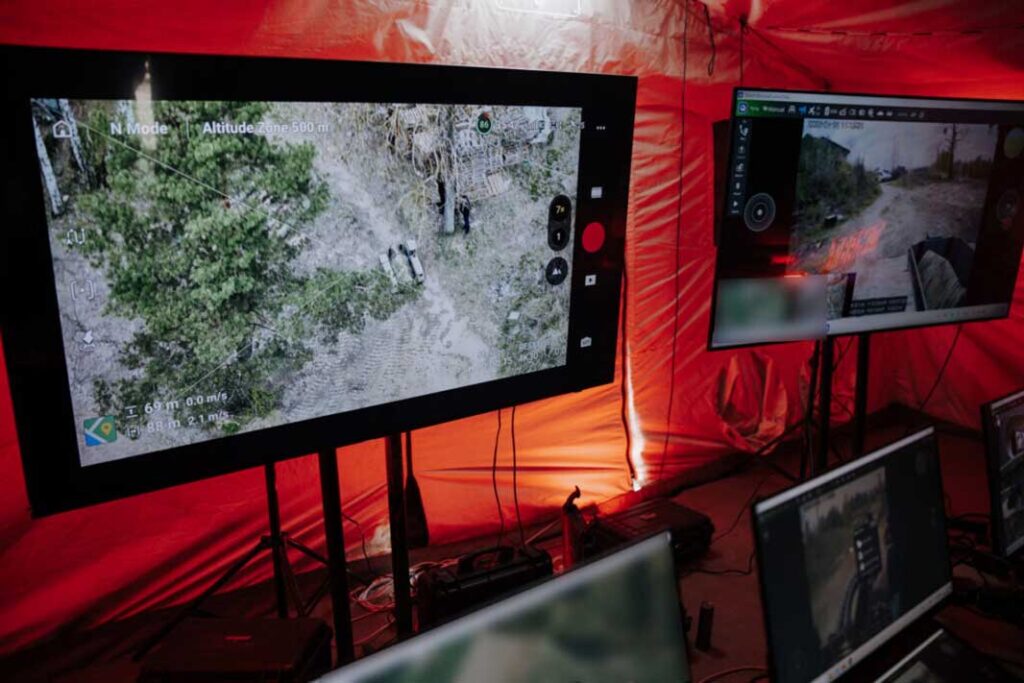
The situation resembles late Soviet attempts to compensate for maneuver weakness with a mass of motorized rifle units. In Afghanistan, this led to control of the road during the day and loss of surrounding territory at night. On the Ukrainian front in 2026, the role of nighttime terrain is played by FPV drones, reconnaissance UAVs, strike groups, and long-range strikes on warehouses. The Ukrainian 7th Rapid Reaction Corps reported on July 6 about the destruction of Russian warehouses of drones, fuel, and ammunition south of Pokrovsk, as well as a temporary deployment point and logistics facility in the Novooleksandrivka area. Even if some of the claims require independent verification, the logic of such strikes is clear: not to stop every assault soldier in the trench, but to make their presence there too costly.
Long-range strikes change the cost of a kilometer
The same day sent a broader signal to Moscow. The Russian Ministry of Defense stated that over 12 hours on July 6, air defense intercepted 116 Ukrainian UAVs over Belgorod, Bryansk, Kaluga, Kursk, Leningrad, Omsk, Smolensk, Tver, Tula, Krasnodar, and Moscow regions, Bashkortostan, Crimea, as well as over the Black and Azov Seas (TASS, July 6). This is no longer an episodic demonstration of reach. It is a distributed burden on the air defense system, transport, energy services, and the gubernatorial vertical. When one front stretches to Omsk, Bashkortostan, and Leningrad region, the war ceases to be just a line in Donbas.
A notable episode involves the Kursk NPP-2. Governor Alexander Khinshtein stated that 12 Ukrainian UAVs were neutralized while approaching Kurchatov, and one drone hit the cooling tower of the second power unit, which is under construction; according to Russian reports, the operation of the station was not disrupted, and the radiation background remained within natural values (TASS, July 6). From a military point of view, this is not a nuclear attack in the literal sense. But it is a blow to the Russian sense of strategic depth. For many years, Moscow built its doctrine on the assumption that its critical infrastructure is in a different category of protection than Ukraine's. July 2026 shows that the category has changed.
Why the Russian mass no longer works as before
The Russian army still has an advantage in numbers, artillery stocks of certain types, and a willingness to endure losses that would be politically intolerable for a European army. But mass has a cost. If in 2024-2025 Moscow could exchange battalions for villages, in 2026 it increasingly exchanges battalions for landings and gray zones. Official Russian statements about advances should be read alongside logistical data: strikes on oil refineries, warehouse facilities, railway hubs, and drone control points. Without this second column, the military picture turns into a map with beautiful arrows drawn over an empty fuel tank.
There is no simple conclusion that Russia is "losing." Serious military assessments do not write that way. The Russian system knows how to live with excessive losses, mobilize regional budgets, patch deficits with imports, and apply pressure locally where Ukrainian defenses are tired. But its problem has become structural: each subsequent kilometer requires not linearly, but almost exponentially more effort because the Ukrainian side attacks not only the front line but the very economy of the offensive. In this sense, 30.42 square kilometers is not territory. It is an indicator of the war's margin.
Forecast until the end of summer
By the end of August, the Russian command will likely continue to pressure Konstantinovka and adjacent areas of the Donetsk region, trying to achieve a symbolic success before the autumn mud season and before the next political window for negotiations. However, without a sharp deterioration in the Ukrainian supply situation, a rapid operational breakthrough is unlikely. A more probable scenario is one of slow pushing with significant losses, increased strikes on Ukrainian cities, and a parallel expansion of the Ukrainian campaign against Russian logistics and energy. The Russian army may still take land. The question is how many square meters will remain in the account after deducting people, fuel, and time.
Russian forces attempted to advance in the Donetsk region, gaining 30.42 square kilometers in June 2026 but suffering 39,490 casualties. The situation around Konstantinovka shows a 36.98% presence of Russian troops, yet they lack sustainable control. Ukrainian forces successfully targeted Russian logistics, complicating their operational capabilities. The ongoing conflict reflects a significant shift in the dynamics of the war, with increasing costs for territorial gains.
- Russian forces gained 30.42 square kilometers in June 2026, averaging 1.01 square kilometers per day.
- Russian casualties in June 2026 are estimated at 39,490 according to Ukrainian General Staff.
- Russian presence in Konstantinovka is approximately 36.98% but lacks sustainable control.
- Ukrainian forces targeted Russian supply depots and logistics points, impacting operational capabilities.
- The situation indicates a structural problem for Russian forces in maintaining operational momentum.