
4 Russian ships in Qingdao showcase the new price of the alliance with China for the Russian Navy
 Dmitri Volkov
4 Russian Ships in Qingdao Show New Price of Alliance with China for the Russian Navy
Four Russian ships at the dock in Qingdao appear more modest than the former Soviet squadrons in the Pacific, but it is precisely in this modesty that the main military significance of the exercise "Maritime Interaction-2026" lies. According to Chinese reports from July 5-6, the Russian group includes the missile cruiser "Varyag," the corvette "Razyary," the large diesel-electric submarine "Ufa," and the rescue vessel "Igor Belousov." China has deployed the destroyers "Kaifeng" and "Anshan," the frigate "Wuhu," the comprehensive supply ship "Kekesilihulu," the rescue vessel "Yanchenghu," and a submarine. On paper, this is a routine annual exercise. In reality, it is an indicator of how the Russian Pacific Fleet is learning to maintain a political presence with a limited material base.
Facts of the Exercise and Composition of Forces
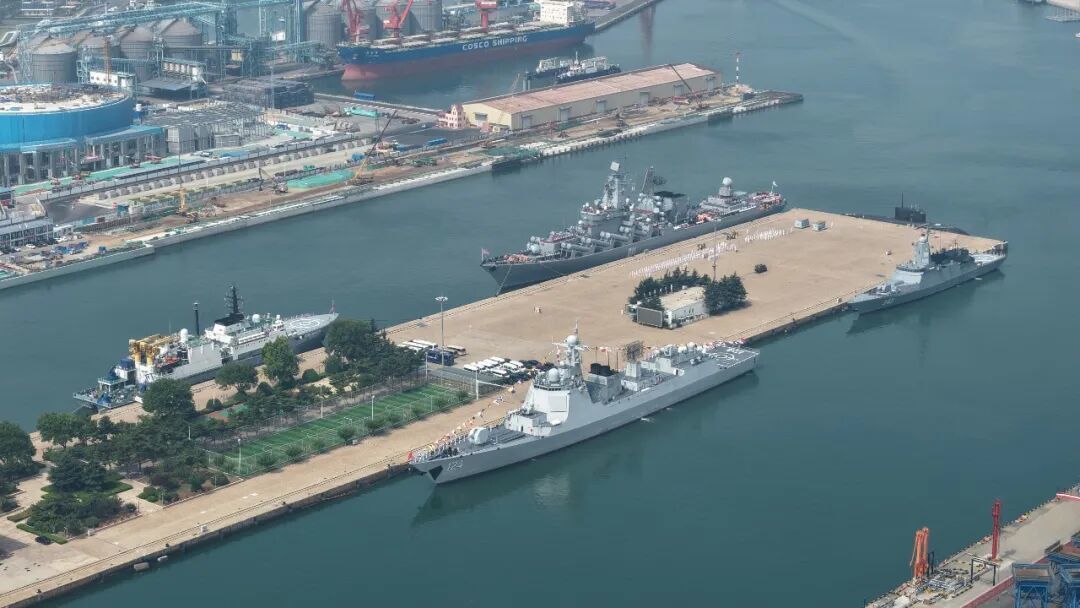
According to Huanqiu and publications from the Chinese defense ministry, the forces of the two fleets completed their assembly on July 5, and on July 6, they opened the active phase in Qingdao. The exercise is divided into three stages: force assembly, port planning, and maritime training. After the ceremony, the staffs began command and staff procedures and coordination of tactical episodes. Next, the ships are to head out to the maritime and aerial areas near Qingdao for joint reconnaissance, warning, air defense, missile defense, strikes on maritime targets, and practical weapon application. After completing part of the forces, a transition to joint patrolling in "relevant areas of the Pacific Ocean" is announced.
The last formulation is more important than it may seem. An exercise off the Chinese coast does not itself change the balance of power. But a joint sortie after the exercise turns a port demonstration into a test of routes, communications, the resilience of the operational order, and the political reaction of Japan, South Korea, and the USA. The Russian side gets the opportunity to show the flag where it would do so less frequently and at a higher cost. The Chinese side gains a Russian partner that adds political weight, historical maritime symbolism, and experience from the anti-submarine school, although it no longer possesses Soviet mass.
What the Composition of the Group Says About Russia
"Varyag" remains the most notable symbol of Russian power in the Pacific. This is a Project 1164 cruiser with heavy anti-ship armament, a long-range air defense system, and a significant political biography. But the entire logic of 2026 is that the symbol must be supported by ships of a much more practical purpose: a corvette, a submarine, and a rescue vessel. For a Soviet admiral of the 1980s, such a group would appear incomplete. For the Russian Navy of the 2020s, this is already a rational combination: one flagship for demonstration, one modern unit for the near maritime zone, one underwater component, and a mandatory element of emergency and rescue support.
There is nothing humiliating here when viewed without propaganda glasses. The Russian Navy is not falling apart, but it has become a fleet of choice rather than a fleet of excess. Each long voyage competes with repairs, crew training, the resource of gas turbine units, the needs of the Black Sea and Northern theaters, as well as the financial pressure of the war against Ukraine. In the Soviet formula of "presence fleet," it was built on seriality. In the modern Russian formula, it is built on selecting a few operational units and their politically advantageous placement. This is less visually appealing on parade, but it more honestly reflects the real economy of the fleet.
The Chinese Framework and Russian Necessity
Chinese formulations speak of "strategic mutual trust" and a joint response to maritime threats. They should not be read as empty diplomatic fluff. Over the past ten years, the "Maritime Interaction" mechanism has indeed evolved from ceremonial exchanges of visits to procedures where staffs coordinate reconnaissance, air defense, missile defense, anti-submarine episodes, communications, and subsequent patrolling. However, the degree of dependence of the parties is different. For China, this is one of the tools to demonstrate that its fleet does not operate alone and can link Russian naval experience with its own growth in long-range capabilities. For Russia, it is a way to avoid disappearing from the western part of the Pacific at a time when the main strategic oxygen is consumed by the war in the European direction.
In this regard, the current exercise resembles not the Warsaw Pact, but the late Soviet practice of "limited presence" where the political effect was supposed to exceed the tonnage. The difference is that back then, Moscow was the senior partner. Now, seniority has carefully, without unnecessary words, shifted to Beijing. China provides geography, port infrastructure, the mass of surface forces, and economic resilience. Russia provides experience, the status of a nuclear power, a counterbalance to the USA, and a certain degree of unpredictability, which in diplomacy is sometimes valued almost as much as an aircraft carrier. The Russians have an old habit of calling this equality. In staff tables, it probably looks less romantic.
Military Significance for the Region
From a military perspective, the main test will not be in the salvo, but in management. Joint reconnaissance and air defense require a common understanding of the air picture, target distribution, procedures for preventing friendly fire, and stable communication between ships with different equipment and different command language cultures. The missile defense episode near Qingdao may be conditional, but it trains precisely that layer of interaction that will become politically sensitive in a crisis around Taiwan, the Korean Peninsula, or the Sea of Japan. Even if Moscow does not intend to automatically fight for Chinese interests, the very possibility of synchronized demonstration forces the adversary to expend more observation resources.
For Japan and the USA, the most important aspect is the subsequent patrolling. The sortie from Qingdao to the Pacific almost inevitably raises the question of routes through areas where Japanese Self-Defense Forces must track Chinese and Russian ships simultaneously. This does not create a new war, but stretches the everyday resource of observation: P-1 and P-3C patrol aircraft, escort destroyers, coastal posts, electronic reconnaissance. In modern maritime strategy, pressure often looks like this — not as a battle, but as a forced distribution of attention. A ship that does not fire also consumes someone else's fuel.
Limits of Closeness
However, from "Maritime Interaction-2026," one should not conclude a full-fledged Russian-Chinese military alliance. Compatibility in a peaceful exercise and commitment in a real conflict are different things. China will use the Russian presence as much as it helps it expand operational depth and complicate American planning. Russia will use the Chinese platform as much as it allows it to maintain the status of a great maritime power amid a shrinking fleet due to repairs and sanctions. This is not a brotherhood of fleets, but an exchange of deficits: China needs a political partner against the USA, Russia needs a material stage to demonstrate that it is still playing in the Pacific.
My forecast is cautious. In 2026-2027, similar exercises will increasingly transition from the port phase to patrolling, but not necessarily to deep combat integration. The Russian Pacific Fleet will retain the ability for symbolic long sorties; however, its real value for China will be measured not by the number of ships but by the readiness to tie Japanese and American observation resources to a joint route. This is the new price of the alliance: Russia gains the appearance of breadth, China gains an additional direction of pressure, and the region gains yet another mechanism for the slow, almost bureaucratic increase of military risk.
Four Russian ships participated in joint naval exercises with the Chinese Navy in Qingdao on July 5-6, 2023. The exercise, named 'Maritime Interaction-2026', involved a variety of naval operations, including reconnaissance and air defense. This collaboration aims to strengthen political ties and operational capabilities in the Pacific region, showcasing both nations' naval presence.
- Four Russian ships docked in Qingdao for joint exercises with China.
- The exercise is named 'Maritime Interaction-2026' and includes various phases.
- The Russian group consists of a cruiser, corvette, submarine, and rescue ship.
- The exercise aims to enhance political presence and operational cooperation in the Pacific.
- China's naval forces are also participating with multiple ships.