
477 Drones and 60 Missiles Over Ukraine Show the Limits of Russian Pressure Strategy
 Dmitri Volkov
477 drones and 60 missiles over Ukraine show the limits of the Russian pressure strategy
The figure of 477 appears to be a demonstration of strength, but in military statistics, sometimes the most important aspect is not the scale of the barrage, but what it is forced to conceal. On the night of June 29, Russia, according to the Ukrainian Air Force data cited by the Kyiv Independent, launched 477 drones and 60 missiles at Ukrainian cities. This has been called the most massive airstrike since February 2022. Almost simultaneously, Vladimir Putin publicly acknowledged the existence of problems related to Ukrainian strikes on Russian infrastructure and specifically pointed out the need to enhance air defense and ensure fuel supplies, especially in Crimea (The Independent citing Reuters, June 29). Such synchronicity is not accidental: the Russian army is capable of increasing the volume of long-range fire pressure, but the Russian state can no longer pretend that the war remains exclusively an external operation.
Massive barrage and its technical logic
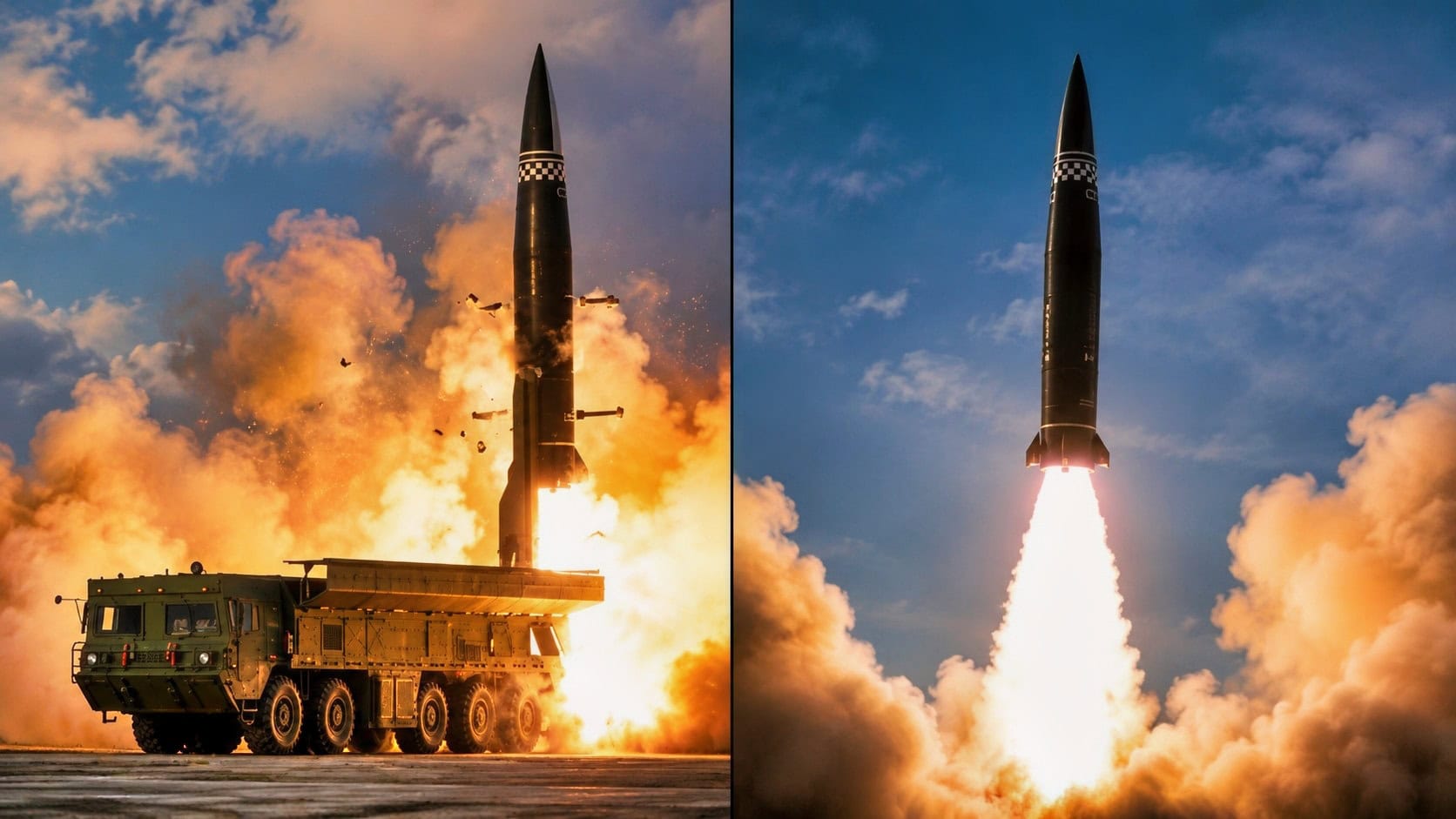
The combined strike on June 29 was built on a familiar scheme: first, long waves of strike UAVs of the "Geran" type and target imitators, then the involvement of cruise and ballistic missiles, including threats from MiG-31K carriers capable of deploying the "Dagger." Ukrainian warnings recorded the takeoffs of Tu-95s from the Olenya airfield in the Murmansk region and subsequent missile trajectories towards the western regions of Ukraine — Ternopil, Lviv, and Ivano-Frankivsk. The Polish armed forces raised aviation and activated ground air defense systems at their border, indicating that even when the Russian strike is aimed at Ukraine, its operational perimeter already extends beyond Ukrainian skies.
From a military perspective, 477 UAVs is not just a number. It is a bet on saturating the Ukrainian detection and interception system. The "Geran-2" carries a relatively small warhead, but its range and low cost allow Russia to use such devices as expendables to probe air defense routes. Missiles of the X-101, "Kalibr," "Iskander-M," S-400 in a ground strike role, or North Korean KN-23s, when used, serve a different purpose: to hit protected or remote targets while Ukrainian crews are occupied with the cheap mass. The Soviet school would not call this "drone terror," but rather reconnaissance-fire impact on the enemy's system. The difference is that the Soviet school assumed industrial discipline and staff clarity, while current Russian practice increasingly relies on crude saturation.
Why the increase in barrages does not equal strategic success
The Russian long-range campaign noticeably intensified in May-June. ISW noted in its summary for June 28 that the previous night Russia had already launched 142 drones, two "Zircon" or "Onyx" missiles, and six ballistic "Iskander-M" or S-400 missiles. Less than a day later, the scale grew to 477 UAVs and 60 missiles. Formally, this is a demonstration of increased production and launch discipline. But the result of such an approach is measured not only by the number of launches. Kyiv, Lviv, Mykolaiv, Kremenchuk, Zaporizhzhia, and Cherkasy region sustained damage and injuries; however, Ukrainian infrastructure was not paralyzed, and the political effect turned out to be dual: the more Russia expands the geography of strikes, the easier it is for Kyiv to explain to allies the need for additional air defense systems and long-range means.
Here, an old Russian problem manifests itself — the mixing of operational tasks with political signals. If the goal is to destroy a specific energy or defense facility, then intelligence, repeated strikes, and damage assessment are important. If the goal is to pressure society and negotiators, then scale and fear are important. The Russian command tries to do both at the same time, which is why it spends expensive missiles alongside cheap UAVs, and then is forced to explain why, after the "most massive strike," the war has not moved closer to resolution. In the Soviet General Staff, such uncertainty would have led to long curses, but at least they would have known what for.
The Ukrainian response strikes at the Russian depth
The main difference in June 2026 from previous stages of the war is that the Russian massive strike is no longer a one-sided tool of escalation. ISW reported that Ukrainian forces struck the Slavyansk Oil Refinery in Krasnodar Krai, one of the largest plants in southern Russia, with a capacity of about 5.2 million tons per year, and the Yaroslavl Oil Refinery with a capacity of about 15 million tons per year on the night of June 27-28. The Ukrainian side also links this campaign to a declared 40-day series of long-range strikes aimed at affecting Moscow's ability to continue the war. These are no longer symbolic raids on border warehouses. This is systemic pressure on processing, fuel logistics, and aviation support.
Putin's acknowledgment of a "certain shortage" of fuel, even if termed non-critical, is important precisely because Russian public rhetoric usually does not like to acknowledge material limitations. He could have spoken about the heroism of air defense or inevitable retribution, but instead mentioned a practical task — to increase air defense capabilities and ensure fuel, especially for Crimea. In Kremlin language, this means: Ukrainian strikes are already creating costs that cannot be completely hidden behind the word "terrorism." And the deeper Ukraine strikes at oil refineries, the more Russian air defense has to protect not only the front, Moscow, and long-range aviation bases, but also the industrial map of the country.
Air defense deficit as an institutional problem
Russia has a strong air defense school: S-300, S-400, "Buk-M3," "Pantsir-S1," and the radar network remain serious systems. But the war of 2022-2026 has shown that even a strong school does not equal infinite coverage of territory. It is impossible to reliably cover oil refineries, strategic aviation airfields, ammunition depots, bridges in Crimea, frontline headquarters, and large cities at the same time. Each complex moved to an oil refinery does not stand at an airfield; each "Pantsir" protecting an administrative facility does not accompany troops. This is not a question of the bravery of the crews. It is the arithmetic of the country's expanse and the cost of interception.
The Ukrainian logic here is almost a mirror of the Russian one: to force the opponent to spend expensive defense against relatively cheap means of attack. Russian "Gerans" overload Ukrainian crews, while Ukrainian long-range UAVs overload Russian depth. The difference is that Ukraine defends a compact territory saturated with Western and Soviet systems around key cities, while Russia is forced to stretch air defense over thousands of kilometers of industrial space. Therefore, the Russian massive barrage on June 29 is not only an attack but also an acknowledgment of a new symmetry: both sides are now fighting through the economy of interception.
Strategic conclusion
In the coming weeks, we should expect not a decrease but an increase in such strikes. The Russian defense industry is likely capable of maintaining high production of "Gerans" and periodic large missile packages, especially if some components come through gray chains. But the ability to produce means of attack does not solve the problem of vulnerability of its own infrastructure. The more Moscow uses massive barrages as a substitute for a political solution, the more Kyiv will strive to show Russian society and elites the cost of continuing the war.
That is why 477 drones and 60 missiles are not a sign of an impending turning point. They are a sign of a war that has become more industrial, more expensive, and less manageable. Russia can continue to deliver painful strikes on Ukraine, but now each such strike occurs against the backdrop of a question that the Kremlin has long considered unacceptable: who will protect the Russian depth if the front has finally stretched to oil refineries, airfields, and fuel depots? The answer so far sounds not like a strategy, but like an urgent request for additional air defense batteries.
On June 29, 2023, the Russian Armed Forces launched a massive airstrike involving 477 drones and 60 missiles targeting Ukrainian cities, including Kyiv and Lviv. This marked the largest air assault since February 2022. Concurrently, Ukrainian forces struck Russian oil refineries in response, indicating a shift in the conflict dynamics. Putin acknowledged challenges posed by Ukrainian attacks on Russian infrastructure, highlighting the need for enhanced air defense capabilities.
- Russia launched 477 drones and 60 missiles against Ukraine on June 29, 2023.
- This was the largest airstrike since February 2022.
- Ukrainian cities including Kyiv and Lviv were targeted.
- Putin acknowledged issues with Ukrainian strikes on Russian infrastructure.
- Ukrainian forces conducted retaliatory strikes on Russian oil refineries.