
496 Drones and 74 Missiles Over Kyiv Change the Economy of the Russian Strike
 Dmitri Volkov
496 drones and 74 missiles over Kyiv change the economy of the Russian strike
The most important figure in the night attack on Kyiv on July 2 is not the 27 dead, although that remains the human toll of the strike. The military-operational figure is different: according to Ukrainian data, Russia used 496 strike drones and 74 missiles, with Ukrainian representatives specifically noting an unusually high proportion of ballistic means. For Moscow, this looks like a demonstration of accumulated firepower. For a military analyst, it is primarily a sign that the Russian long-range strike system is increasingly moving away from precision operations to an economy of overwhelming air defense.
AP and the Guardian described the strike as one of the heaviest on Kyiv in years of war: explosions lasted for several hours, more than 50,000 people took shelter in the metro, and Poland raised its aviation as a preventive measure. The Russian Ministry of Defense called the attack a response to Ukrainian strikes and stated that military facilities and energy infrastructure were hit. This formula has long become ritualistic. It does not explain why cheap Shahed-like drones, cruise missiles from sea and air bases, aerobalistic means, and likely decoys are mixed in one salvo. But this mixture is the essence of the new tactics.
Mass instead of precision
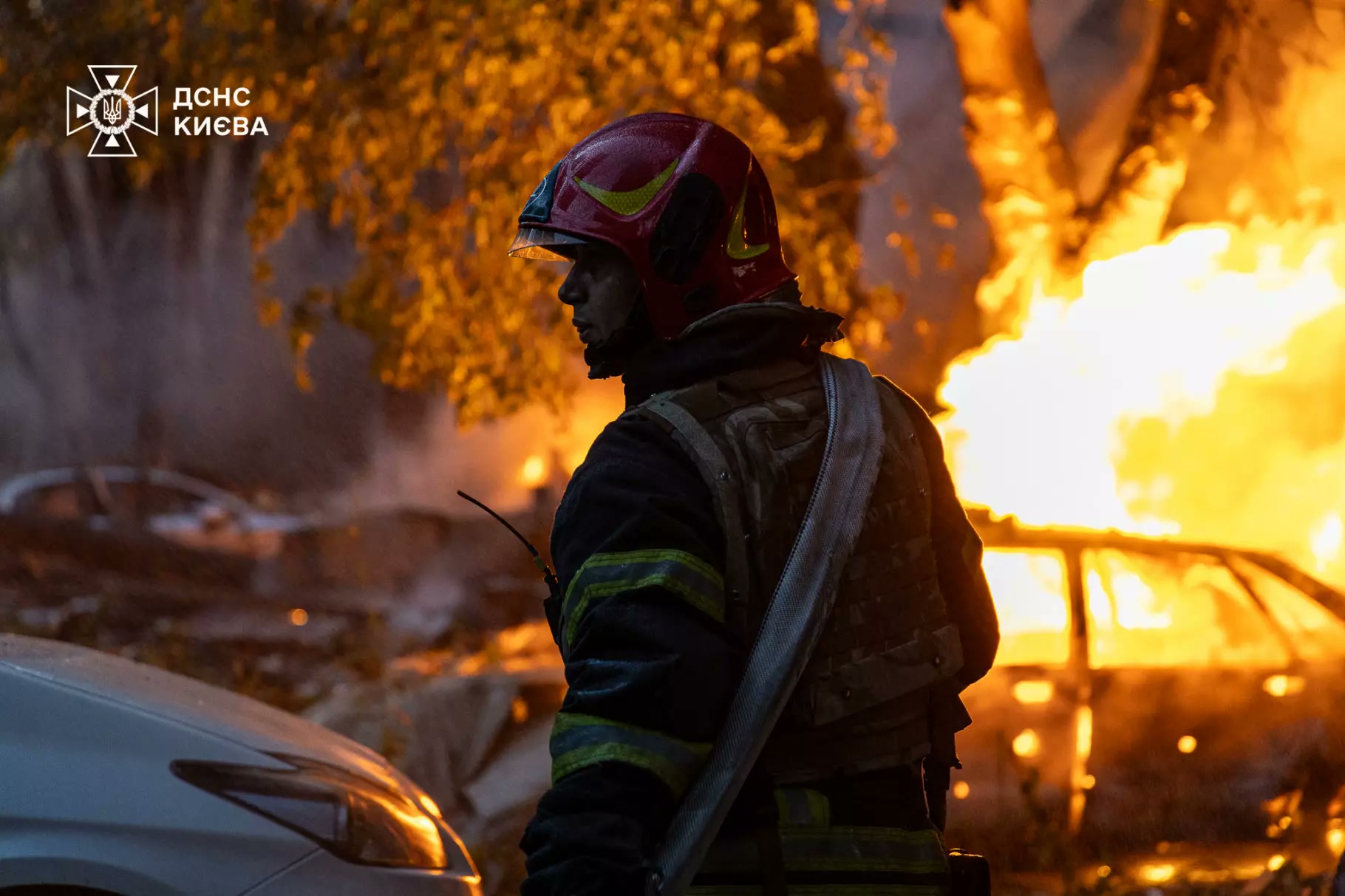
In the Soviet military school, massing fire was not seen as a sign of primitiveness, but as a way to create temporary superiority at a decisive point. The difference is that the Soviet General Staff thought in terms of artillery densities and air sorties, while the current Russian staff translates the same instinct into drone and missile form. One Shahed by itself is not a strategic weapon. Five hundred drones and missiles in one night operation become a tool of coercion because they force the enemy to distribute radars, Patriot batteries, NASAMS, IRIS-T, mobile fire groups, and electronic warfare means across dozens of directions.
Here, unpleasant arithmetic comes into play. A cheap kamikaze drone costs an order of magnitude less than a Western medium or long-range surface-to-air missile. But when Russia adds ballistic missiles to the same package, the cost of the attack sharply increases even for Moscow itself. Ballistics are needed not because they are economical, but because they reduce reaction time and force Ukraine to use its most scarce interceptors. If Reuters' report of 74 missiles and 496 drones is correct, then the Kremlin consciously spent an expensive component to pressure Ukrainian air defense, not just for the physical destruction of a few targets.
Why the ballistic share is more important than the total number
Ukrainian representative Yuriy Ignat noted, according to Reuters, the unusually high number of ballistic missiles. This is a key detail. A cruise missile flies longer, its route can be more complex to program, but it gives the defense more time. A ballistic missile, including the Iskander-M or North Korean analogs of the KN-23 family, creates a different type of threat: a short detection window, high speed in the terminal phase, and a limited set of systems capable of intercepting the target. Therefore, the question is not how many missiles were shot down, but which batteries and which munitions Ukraine was forced to engage.
In Russian logic, this resembles artillery suppression before an infantry attack, only the object of suppression is not a trench, but the national air defense system. Moscow does not have to destroy all complexes. It is enough to force Kyiv to expend interceptors faster than allies can supply them. Zelensky's statement that part of the promised air defense missiles were never delivered is important in this context not as a diplomatic complaint, but as an operational indicator. The Russian staff carefully counts Western delays. There is no genius in this, only bureaucratic consistency.
The main goal of such an attack is not always on the ground. Sometimes it is in the opponent's inventory, where dozens of scarce interceptors disappear after a night.
Ukrainian counter-campaign and Russian fuel vulnerability
However, there is a second half to the picture. ISW noted on July 3 that the Russian government continues to seek ways to increase domestic fuel supplies amid a growing gasoline shortage. According to Reuters, Russia is even preparing to import a batch of aviation fuel through intermediaries from Japan and South Korea, and Mikhail Mishustin's government has temporarily relaxed requirements for gasoline sales on the exchange and allowed the release of Euro-3 standard fuel. This does not look like the behavior of a country fully controlling its energy depth.
The Ukrainian campaign of long-range strikes on oil refining capacities since March 2026 has created a problem for Russia similar to the one Russia is trying to create for Ukraine in the air defense sphere: not an instantaneous collapse, but a constant drain of resilience. The Guardian also linked the July escalation around Kyiv to Ukrainian strikes on Russian oil refineries and energy facilities, including reports of fuel shortages and emergency measures in occupied Crimea. Here, a strategic asymmetry emerges. Russia produces more missiles and drones than Ukraine, but its oil refining has fixed bottlenecks that cannot be quickly replaced by patriotic rhetoric.
Therefore, the night strike on Kyiv was not only an act of punishment. It was an attempt to regain the psychological initiative after Ukrainian strikes deep into Russia. The Putin system poorly tolerates a situation where the war returns to the Russian economic fabric: queues at gas stations in Transbaikalia or Krasnodar Krai are politically more dangerous than abstract reports of advances of 300 meters near Konstantinovka. The Soviet tradition called this the resilience of the rear. Today's Russia prefers the word stability, but the meaning is the same.
Limitations of the Russian model
The Russian approach has a strong side: it is scalable. The production of Shahed-like drones in Russian-Iranian industrial cooperation, the release of Iskanders, the use of old stocks of cruise missiles, and likely North Korean munitions allow for the regular assembly of large strike packages. But this model also has a weakness: it requires constant political justification for the high cost. If every major strike does not yield operational results on the front, it turns into an expensive means of information pressure.
ISW noted on July 4 that the Russian leadership continues to exaggerate successes near Konstantinovka, despite the limited actual advances. This is an important context. The Kremlin simultaneously shows two pictures: a powerful strike on the capital of Ukraine and allegedly rapid success on the ground. In reality, there is no automatic connection between them. A mass attack can kill people, damage homes, temporarily disrupt energy supplies, but it does not solve the task of breaking through Ukrainian defenses in Donbas. For that, trained infantry, functioning armored vehicles, communication, logistics, and commanders capable of exploiting windows of opportunity are needed. It is here that the Russian army has demonstrated a chronic quality deficit since 2022.
- The operational effect of the attack depends on the share of ballistic missiles, not just the total number of drones.
- The economic effect is measured by the expenditure of Ukrainian interceptors and Russia's ability to replenish expensive missiles.
- The political effect in Moscow is related to the attempt to compensate for the impression of Ukrainian strikes on Russian energy.
Forecast
In the coming weeks, Russia is likely to continue alternating large combined salvos with smaller night attacks. The goal will remain the same: to force Ukraine to keep costly air defense systems around Kyiv and other major cities, complicate the protection of energy supplies, and show Western capitals that delays in supplies have a cost. But this strategy is not free. The more Moscow uses ballistic missiles for political pressure, the less flexibility it has for truly military objectives.
My conclusion is cold and therefore unpleasant. The Russian long-range campaign is not exhausted; on the contrary, it is becoming more systematic. But its success will be determined not by the amount of fire in one night, but by the comparison of two production chains: the Russian chain of missiles, drones, and fuel against the Western-Ukrainian chain of interceptors, radars, and energy repairs. If Ukraine's allies continue to supply air defense with delays, Moscow will buy time with the blood of Kyiv's residents. If supplies accelerate, mass strikes will remain terrifying but will gradually become what late Soviet demonstrations of power often became: a loud substitute for the missing operational result.
On July 2, 2023, Russian Armed Forces conducted a massive aerial attack on Kyiv, deploying 496 drones and 74 missiles, including a significant number of ballistic missiles. The assault lasted several hours, forcing over 50,000 residents to seek shelter in the metro. This operation reflects a strategic shift towards overwhelming Ukraine's air defense capabilities, as Russia aims to pressure Ukraine's military resources and response times.
- Russia launched 496 drones and 74 missiles in an attack on Kyiv on July 2, 2023.
- The attack included a high proportion of ballistic missiles, indicating a shift in tactics.
- Over 50,000 people sought shelter in the metro during the attack.
- The Russian Ministry of Defense claimed the attack targeted military and energy infrastructure.
- Ukraine's air defense was pressured to respond to multiple threats simultaneously.