
496 Drones and 74 Missiles Over Kyiv Show the Limits of Russia's Retaliation Strategy
 Dmitri Volkov
496 drones and 74 missiles on Kyiv show the limits of the Russian strategy of retribution
The most important figure of the night on July 2 is not 496 drones and not even 74 missiles. More important is another fact: according to the Ukrainian Air Force, 25 ballistic missiles and 12 drones did reach 33 targets, and Air Force representative Yuriy Ihnat called 28 ballistic missiles aimed at Kyiv a record number for a single attack on the capital. This means that Russia is once again trying to solve an operational-political task not through precision, but through saturation. The old Soviet formula of massive fire impact has received a new guise with "Geran" drones, cruise and ballistic missiles, but the logic remains the same: overload the air defense system, force the opponent to expend expensive interceptors, and simultaneously show its own population that an attack on Russian territory does not go unanswered.
Record density of the strike
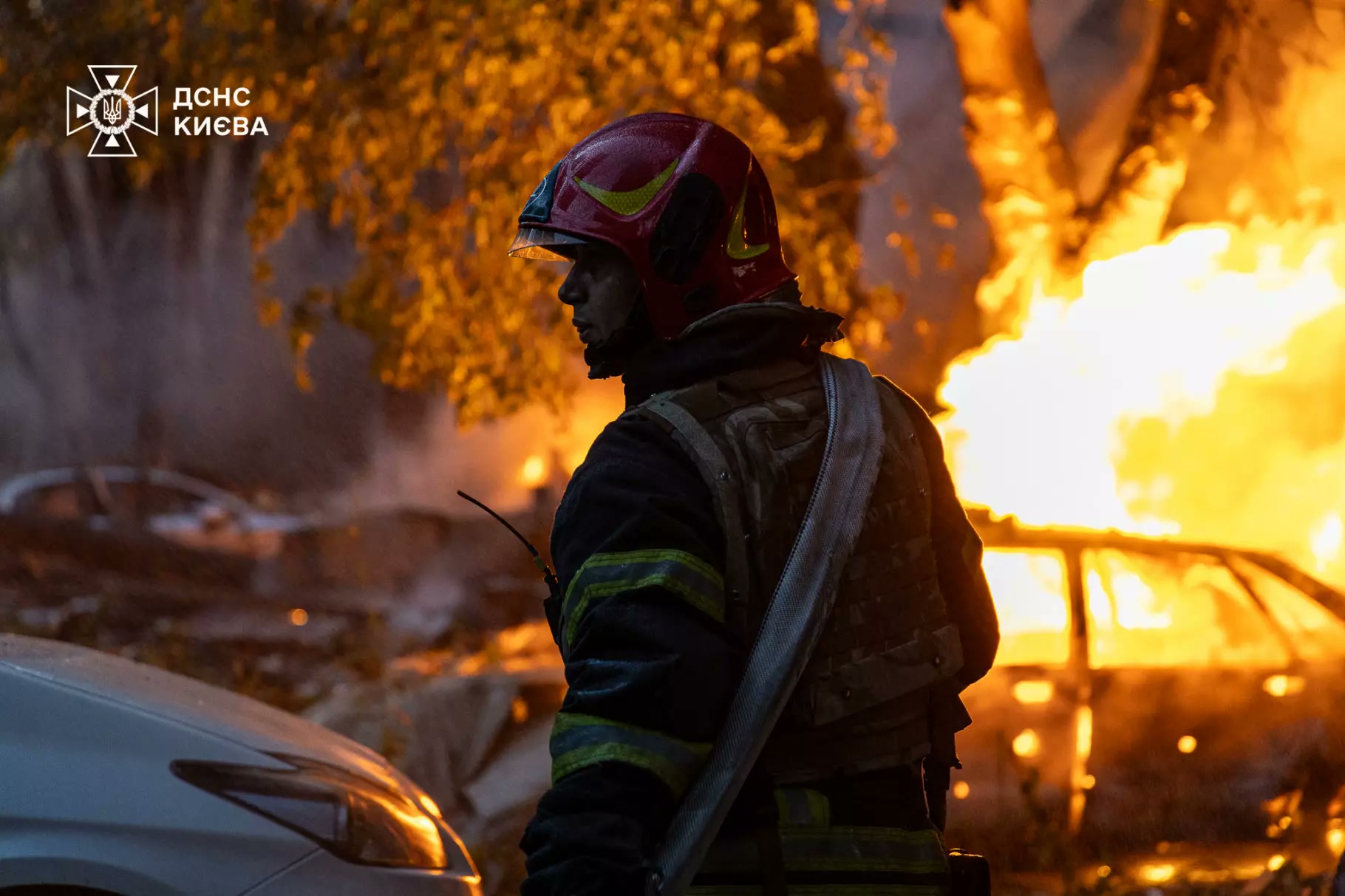
According to Kyiv Independent, citing Ukrainian authorities, the nighttime attack included 496 long-range drones and 74 missiles, most of which were directed at Kyiv. The Ukrainian side reported intercepting or suppressing 476 drones and 48 missiles, but the consequences were still severe: at least 20 dead, 86 injured, destruction in all areas of the city, damage to energy infrastructure, hotels, a research institute, an ambulance station, and residential buildings. The Kyiv metro reported a record 52,500 people taking shelter in underground stations, including nearly 4,500 children. This is no longer just military statistics, but an indicator of how the urban rear is becoming a regular target of strategic pressure.
From a military point of view, such a strike is interesting not for the number of drones per se. Mass launches of Shahed/"Geran" have long become the norm of the Russian campaign. What is new is the combination of a huge swarm with a high proportion of ballistic means, against which the reaction window is measured in minutes, and sometimes seconds. If a cruise missile gives air defense time for routing and tracking, then a ballistic trajectory presses on the most expensive and scarce layer of defense: Patriot, SAMP/T, and associated interceptor missiles. That is why 28 ballistic missiles aimed at one capital are more important than the propaganda figure of 496 drones. This is not a demonstration of technological elegance. This is the accounting of exhaustion.
Why Moscow chose this form of response
The context makes the strike less mysterious. In recent weeks, Ukraine has systematically struck at Russian oil refining and logistics. On July 2, the General Staff of Ukraine reported a strike on LUKOIL-Nizhny Novgorodnefteorgsintez in Kstovo, the fourth largest refinery in Russia with an annual processing capacity of about 17 million tons of oil; according to the Ukrainian version, the primary processing unit AVT-6 was damaged. This package also included strikes on a railway bridge over the Siverskyi Donets near the occupied Stanytsia Luhanska, a command-observation point in the Kharkiv region, and a drone storage facility in the Zaporizhzhia region. These are no longer symbolic raids, but a methodical attempt to cut fuel, transport, and management.
Al Jazeera on July 2 described the Russian fuel shortage as serious and already noticeable to the population: queues at gas stations, limits of 20-30 liters per vehicle, bans on filling canisters, export restrictions on gasoline and aviation fuel, and discussions of diesel restrictions. Expert Stanislav Mitrakhovich assessed indirect signs that Ukrainian strikes could incapacitate about a quarter of Russia's oil refining capacity. Reuters, cited by Al Jazeera, reported on purchases of 60-80 thousand tons of gasoline from India and plans to import up to 400 thousand tons per month from various countries. For a country that has been accustomed to considering itself an energy superpower, importing gasoline sounds almost indecent. But war does not generally align well with decency.
Therefore, the strike on Kyiv should be viewed not only as terror against the civilian population, although that is how it appears at the level of immediate consequences. It is also a political response to the vulnerability of the Russian depth. Moscow cannot quickly shield all refineries and oil depots from Ukrainian long-range drones because the country's area, the density of objects, and the shortage of modern air defense systems make such a task nearly unsolvable. However, it can attempt to raise the cost of the Ukrainian campaign by forcing Kyiv to expend interceptors, repair energy infrastructure, and keep millions of people in shelters. In Soviet military theory, this would be called the struggle for the sustainability of the rear. In current Russian practice, it looks like a nighttime attack on high-rise buildings.
The limits of the Russian saturation model
The Russian strategy has a strong side. It relies on industrial serial production: cheap strike drones, restored missile stocks, Iranian technological base, North Korean components in certain missile programs, and the ability to turn even outdated products into a means of psychological pressure. The system does not require perfect quality for each munition; it requires a sufficient quantity for some to pass through the air defense filter. In this sense, the nighttime attack was rational. If out of 570 means of destruction, dozens reach their targets and paralyze the capital for several hours, the General Staff in Moscow can record the result as a success, even if half of the reporting rhetoric is the usual exaggeration.
But the weakness of the same model is just as evident. A mass strike does not cancel the Ukrainian campaign against Russian energy. While Kyiv was extinguishing fires, Kstovo was also burning, and Moscow was discussing fuel imports and accelerating refinery repairs. If Russia responds to strikes on oil refining with record salvos on the capital, it effectively acknowledges that the Ukrainian long-range strategy is causing it pain. In 2022, the Kremlin wanted to show that the war would remain somewhere "there," beyond the bounds of normal Russian life. In 2026, normal Russian life is measured by the queue at the gas station, while Ukrainian life is measured by the number of children in the metro during an air raid.
There is also a purely military question of cost. One Shahed/"Geran" remains cheap relative to Western interceptors, but ballistic and cruise missiles do not become cheap, especially with sanctioned access to electronics and machine tools. Russia can produce and restore a significant number of missiles, but each record salvo means a choice: strike Kyiv today or conserve munitions for operations against energy facilities, airfields, and depots tomorrow. In the military, as in the economy, there are no free victories; there are only costs that are temporarily hidden in another column.
What this changes for the war in the summer of 2026
The summer phase of the war is increasingly taking the form of mutual pressure on depth. Russia is pressing on the cities and energy of Ukraine, while Ukraine is pressing on Russian oil refining, bridges, depots, and command points. The difference is that Russian strikes on Kyiv have a strong political-psychological effect but do not solve the problem of Russian refineries; Ukrainian strikes on refineries do not immediately stop Russian attacks but worsen logistics, prices, public trust, and fuel availability for the army. This is not a symmetry of good and evil, but an asymmetry of goals.
The main conclusion is cold: the more successful Ukraine is in striking at the Russian military economy, the more Moscow will transfer the war into Ukrainian cities, because it has fewer and fewer quick levers left.
In the coming weeks, we should expect not a decrease, but an alternation of two campaigns: Russian massive combined strikes and Ukrainian attacks on fuel infrastructure. If the West accelerates the supply of interceptors and air defense systems, the Russian saturation strategy will become more expensive and less effective. If supplies are delayed, Moscow will continue to rely on the arithmetic of swarms and ballistic pressure. The Russian military machine can survive this exchange, but at the cost of an increasingly obvious transformation of the war from a "special operation" into a competition of industrial nerves. And nerves, unlike missiles, cannot be produced in a factory in three shifts.
On July 2, 2023, Russian Armed Forces launched a massive attack on Kyiv, deploying 496 drones and 74 missiles, with 28 ballistic missiles hitting the city. The Ukrainian Air Force reported intercepting 476 drones and 48 missiles, but the assault resulted in at least 20 fatalities and significant damage to infrastructure. This operation reflects Russia's strategy of saturation to deplete Ukrainian air defenses and exert psychological pressure.
- 496 drones and 74 missiles were launched at Kyiv.
- 28 ballistic missiles hit the city, marking a record for a single attack.
- 20 people were killed and 86 injured due to the strikes.
- 476 drones and 48 missiles were intercepted or suppressed by Ukrainian forces.
- The attack aimed to overwhelm Ukraine's air defense systems.